Overview
Electrocardiogram
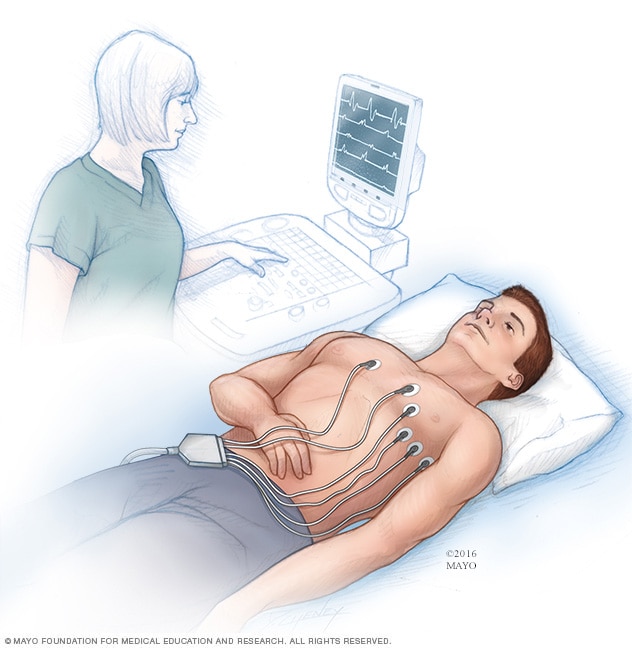
Electrocardiogram
An electrocardiogram (ECG or EKG) is a test to record the electrical signals in the heart. It shows how the heart is beating. Sticky patches called electrodes are placed on the chest and sometimes on the arms or legs. Wires connect the patches to a computer, which prints or displays results.
An electrocardiogram (ECG or EKG) is a quick test to see how the heart is beating. It checks the electrical signals in the heart. Test results can help find heart attacks and irregular heartbeats, called arrhythmias.
ECG machines can be found in medical offices, hospitals, operating rooms and ambulances. Some personal devices, such as smartwatches, can do simple ECGs. Ask your healthcare team if this is an option for you.
Products & Services
Types
Why it's done
An electrocardiogram (ECG or EKG) is done to check the heartbeat. It shows how fast or how slow the heart is beating. ECG test results can help your care team find:
- Irregular heartbeats, called arrhythmias.
- A previous heart attack.
- The cause of chest pain. For example, it may show signs of a blocked or narrowed heart artery.
An ECG also may be done to learn how well a pacemaker and other heart disease treatments are working.
You may need an ECG if you have:
- Chest pain.
- Dizziness, lightheadedness or confusion.
- Pounding, skipping or fluttering heartbeat.
- Fast pulse.
- Shortness of breath.
- Weakness or fatigue.
- Trouble exercising like you used to be able to do.
If you have a family history of heart disease, you may need an electrocardiogram to check for heart disease, even if you don't have symptoms. This is called screening. The American Heart Association says ECG screening may be considered for those at low risk of heart disease in general, even if there are no symptoms. Most heart doctors consider an ECG as a basic tool to look for heart disease. But its use needs to be based on each person's needs.
If your symptoms come and go, a regular ECG may not find a change in your heartbeat. Your healthcare team may ask you to wear a device that checks your heartbeat at home. This is called a portable ECG monitor. There are several types.
- Holter monitor. This small ECG device records your heartbeat for about 1 to 2 days. You wear it at home and during daily activities.
- Event monitor. This device is like a Holter monitor. But it records only at certain times for a few minutes at a time. You typically wear it for about 30 days. You usually push a button so the device records when you feel symptoms. Some devices automatically record when a change in the heartbeat happens.
Some personal devices, such as smartwatches, can take a simple electrocardiogram. Ask your care team if this is an option for you.
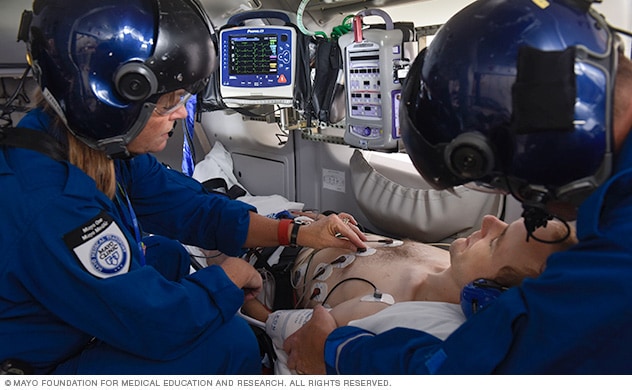 ECG on medical helicopter
A person receives an ECG while on a helicopter for medical transport.
More Information
Risks
The sensors used for an electrocardiogram measure the heart's electrical activity. They do not make electricity. There is no risk of electric shock during the test.
Some people may get a slight rash where the patches were placed. Taking the patches off is similar to removing a bandage. It may be uncomfortable for some people.
How you prepare
You don't need to do anything to prepare for an electrocardiogram (ECG or EKG). But always tell your healthcare team about all the medicines you take. Include those bought without a prescription. Some medicines and supplements may affect the test results.
What you can expect
You might have an electrocardiogram (ECG or EKG) in a medical office or hospital. The test also may be done in an ambulance or other emergency vehicle.
Before
Before you get an electrocardiogram, a healthcare professional may ask you to change into a hospital gown. A member of your healthcare team may shave any hair on the area where the patches will go. This helps the patches stick to your skin better.
Once you're ready, you usually lie down on an exam table or bed.
During
An electrocardiogram (ECG or EKG) uses up to 12 sticky patches with sensors on them, called electrodes. A healthcare professional puts the patches on your chest and sometimes your arms or legs. Wires connect the patches to a computer. The computer prints or shows the results.
You can breathe during the test. But stay still and do not talk. Moving around may affect the test results.
After
Unless you're having heart trouble that needs treatment right away, you can usually go back to your daily activities after having an electrocardiogram.
Results
Your healthcare professional talks to you about your electrocardiogram (ECG or EKG) results.
ECG results are shown in lines called waves. The waves are the signals that travel through your heart with each heartbeat. A healthcare professional looks for patterns in the signals that can be due to heart changes. An ECG gives information about the heart's health, such as:
- Heart rate. The heart rate is the number of times the heart beats a minute. You can measure your heart rate by checking your pulse. If your pulse is hard to feel or count accurately, an ECG may be done. ECG results can help find an unusually fast heart rate, called tachycardia, or an unusually slow heart rate, called bradycardia.
- Heart rhythm. The heart's rhythm is the time between each heartbeat. An ECG can show heart rhythm changes due to conditions such as atrial fibrillation (AFib) and atrial flutter.
- Heart attack. An ECG can tell if you are having a heart attack or if you had one in the past. Your doctor can look at the patterns in the ECG results to help learn which part of the heart is damaged.
- How much blood and oxygen gets to the heart. If you get an ECG while you're having chest pain, the test can show if your heart isn't getting enough blood.
- Changes in the size and shape of the heart. ECG results can give clues that help diagnose an enlarged heart, congenital heart disease and other heart conditions.
If an ECG shows a change in your heartbeat, you may need more tests. For example, you might have an ultrasound of the heart, called an echocardiogram.
Clinical trials
Explore Mayo Clinic studies of tests and procedures to help prevent, detect, treat or manage conditions.
Sept. 11, 2026