概述
Li-Fraumeni (LEE-frau-MEE-nee) syndrome is a rare inherited condition that increases the risk of many types of cancer. These cancers often happen at younger ages than usual. The syndrome also can lead to more than one cancer throughout life.
In the past, Li-Fraumeni syndrome has been called sarcoma, breast, leukemia and adrenal gland (SBLA) cancer syndrome. You also may see the condition spelled Li Fraumeni, without the hyphen.
Li-Fraumeni syndrome is linked to an inherited harmful change, also called a mutation, in the TP53 gene. The TP53 gene usually helps keep cells with damaged DNA from growing into cancer.
Li-Fraumeni syndrome is different from other inherited cancer syndromes because it involves a different gene. It also may be linked with different cancers. For example, Lynch syndrome is caused by changes in other genes that also play a role in managing DNA damage. Though Lynch syndrome also is linked to many cancers, it's especially linked to colon and endometrial cancers.
A diagnosis of Li-Fraumeni syndrome can feel overwhelming. But knowing about Li-Fraumeni syndrome can help you and your healthcare team take steps to screen for cancer early, when treatment may be more successful.
症状
Li-Fraumeni syndrome doesn't cause symptoms itself. But it increases the risk of different types of cancer, which can cause different symptoms.
Some cancers commonly linked to Li-Fraumeni syndrome are:
- Adrenal cancer, a cancer that starts in the outer layer of an adrenal gland. The adrenal glands are located on top of the kidneys. Some symptoms may include back or belly pain and feeling less hungry.
- Brain tumors, such as gliomas, choroid plexus carcinoma, medulloblastoma and astrocytoma. There are many possible symptoms. But some include headaches, nausea or vomiting, changes in vision or hearing, trouble with balance or movement, changes in behavior or personality, and changes in the ability to think.
- Breast cancer of any kind, but it may be more likely to be HER2-positive breast cancer. Symptoms may include a breast lump or changes in the nipple or breast skin. They also may include changes in the size, shape or appearance of the breast.
- Osteosarcoma, a type of bone cancer. Symptoms may include bone or joint pain and swelling near a bone.
- Soft tissue sarcoma, a type of cancer that starts in soft tissues, such as muscle, fat, blood vessels and nerves. Symptoms may include a new lump or pain.
Tell your healthcare team if you have any new or unexplained symptoms. This includes symptoms such as pain that lasts or gets worse.
病因
Li-Fraumeni syndrome is caused by a harmful change in the TP53 gene, which is located on chromosome 17. The TP53 gene gives the body instructions to make a protein called p53. This protein helps stop cells with damaged DNA from growing and dividing. When TP53 doesn't work well, damaged cells may survive and grow. Over time, they may become cancer.
Li-Fraumeni syndrome often is inherited. When it's inherited, a person needs to inherit only one changed copy of the TP53 gene from a parent to have the syndrome. This is called an autosomal dominant pattern. If a parent has the harmful gene change, each child has a 50% chance of inheriting it.
In Li-Fraumeni syndrome, the TP53 gene change usually is a germline gene change. This means the change was present in the egg or sperm cell that formed a person, so it's found in almost every cell in the body. This is why the TP53 change can increase the risk of many different types of cancer.
Not everyone with Li-Fraumeni syndrome inherits the TP53 change from a parent. In some people, the gene change happens by chance. This is called a de novo variant.
常染色体显性遗传模式
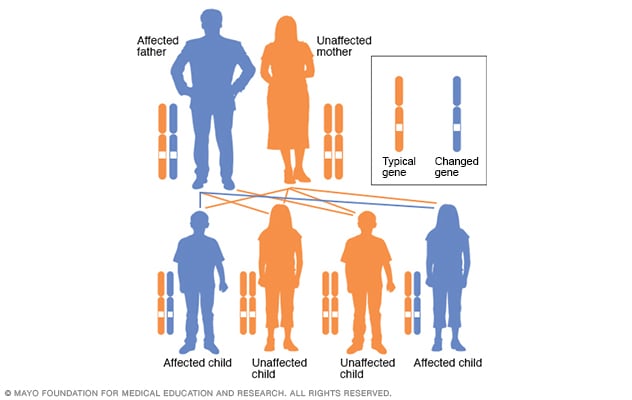
常染色体显性遗传模式
在常染色体显性遗传病中,突变基因是显性基因。该基因位于非性染色体(即常染色体)上。只需一个突变基因即可受累于该状况。常染色体显性遗传状况患者(本案例中为父亲)的子女,有 50% 的概率是携带一个突变基因的受累者。患者子女有 50% 的概率是未受累者。
风险因素
Having a parent with the changed TP53 gene that causes Li-Fraumeni syndrome is the main risk factor for Li-Fraumeni syndrome. If either parent has the changed TP53 gene, the child has a 50% chance of inheriting it. This is called an autosomal dominant inheritance pattern.
In some people, the gene change is new. This means it wasn't inherited from either parent and happened by chance.
Risk of cancer
Li-Fraumeni syndrome greatly increases the risk of getting cancer. One study estimates that:
- More than 90% of women with Li-Fraumeni syndrome will develop cancer by age 50.
- More than 90% of men with Li-Fraumeni syndrome will develop cancer by age 70.
This is why regular cancer screening and medical exams throughout life are important — to find and treat cancer early.
并发症
The main complication of Li-Fraumeni syndrome is cancer. Research has estimated that the lifetime risk of cancer for someone with Li-Fraumeni syndrome is 90%, possibly more.
When it comes to cancer linked to Li-Fraumeni syndrome:
- Cancer can happen at a younger age. Cancer often happens at a younger age than usual for someone without Li-Fraumeni syndrome. In one study of people with Li-Fraumeni syndrome, half of women had cancer by about age 34, and half of men had cancer by age 45.
- Cancer risk is much higher. Cancer also is much more common in those with Li-Fraumeni syndrome. For example, in women with Li-Fraumeni syndrome, the lifetime risk of breast cancer is more than 60%. In the general population, the lifetime risk is 12% to 13%. One study found that, overall, people with Li-Fraumeni syndrome had nearly 24 times the rate of cancer compared with the general population.
- More than one cancer is possible. People with Li-Fraumeni syndrome who get cancer also have a high risk of getting another unrelated cancer later. In one study, the chance of a second cancer was close to 60% within 30 years of the first cancer. Some people later had cancer a third or fourth time.
Cancer risk estimates for Li-Fraumeni syndrome, especially for specific types of cancer, can change depending on the study. Because Li-Fraumeni syndrome is rare, risk estimates may change as more people are studied. Cancer risk also depends on your age and sex and which TP53 change you have.
In general, cancers most strongly linked to Li-Fraumeni syndrome include:
Some TP53 gene changes, also called gene mutations, also increase the risk of certain cancers beyond those traditionally linked with Li-Fraumeni syndrome. They include:
预防
There is no known way to prevent the gene change linked to Li-Fraumeni syndrome. However, early testing and regular screening and follow-up care, along with some other steps, may help manage the increased cancer risk that comes with Li-Fraumeni syndrome.
Your healthcare team may recommend some of the following steps.
- Get regular cancer screening. Cancer screening usually starts at a younger age than is typical for most people. It also is done more often and checks for more types of cancer. This can help find cancer early, when it may be easier to treat successfully.
- Limit radiation exposure when possible. People with Li-Fraumeni syndrome may have a higher cancer risk after radiation exposure. Because of this, healthcare teams try to limit imaging tests and treatments that use radiation when the benefits do not outweigh the risks.
- Consider surgery to lower breast cancer risk. For women with Li-Fraumeni syndrome, surgery to remove both breasts before breast cancer develops may lower the risk of breast cancer. You might hear this called a risk-reducing mastectomy or a prophylactic mastectomy.
Aug. 28, 2026