Mayo Clinic's approach
At Mayo Clinic, heart doctors with special training in heart rhythm conditions, called electrophysiologists, work in the Electrophysiology Laboratory.
 Collaborating to provide the best care
At Mayo Clinic, healthcare professionals work together to understand your condition and provide personalized treatment options.
- Collaborative approach. Electrophysiologists work closely with other doctors, including cardiologists and cardiovascular surgeons, in the Heart Rhythm Clinic. This team approach helps them understand your heart condition and recommend the best treatment options for you. It also helps ensure that you receive personalized, quality care.
- Expertise in all arrhythmias, including rare and complex types. Mayo Clinic doctors use EP studies to diagnose and treat a variety of irregular heartbeats, including those that are very rare and hard to treat.
-
Advanced technology. Mayo Clinic doctors who do EP studies use the most advanced technology to understand your condition and guide treatment decisions.
Advanced mapping systems, including multielectrode mapping and 3D heart mapping, are used during cardiac ablation treatments. These innovative techniques help your care team accurately determine where to apply radiofrequency energy or cryoablation to correct irregular heartbeats.
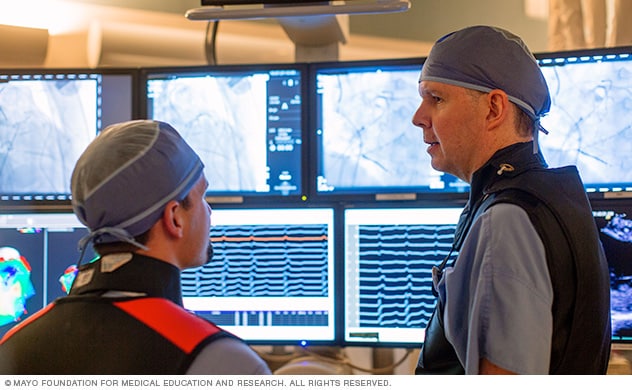 Using the latest technology to make an accurate diagnosis
Mayo Clinic experts have access to state-of-the-art systems for diagnosing and treating irregular heart rhythms.
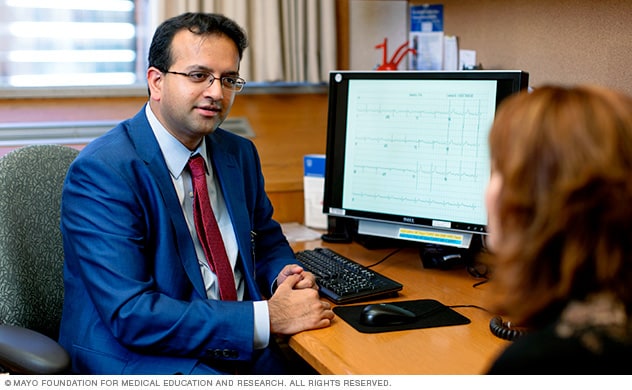 Compassionate and personalized care from experts
Your Mayo Clinic care team has extensive experience diagnosing and treating all types of arrhythmias.
Expertise and rankings
Mayo Clinic offers one of the largest groups of electrophysiologists trained in performing EP studies and related treatments, such as cardiac ablation.
The Electrophysiology Laboratory at Mayo Clinic's campuses in Arizona and Florida treats adults with arrhythmias. Doctors trained in treating adults with heart conditions, called cardiologists, and doctors trained in treating children with heart conditions, called pediatric cardiologists, provide care for people with arrhythmias at Mayo Clinic's campus in Rochester, Minnesota.
Nationally recognized expertise
Mayo Clinic campuses are nationally recognized for expertise in cardiology and cardiovascular surgery:
- Mayo Clinic in Rochester, Minnesota, Mayo Clinic in Phoenix/Scottsdale, Arizona, and Mayo Clinic in Jacksonville, Florida, are ranked among the Best Hospitals for heart and heart surgery by U.S. News & World Report.
- Mayo Clinic Children's in Rochester is ranked the No. 1 hospital in Minnesota and the five-state region of Iowa, Minnesota, North Dakota, South Dakota and Wisconsin, according to U.S. News & World Report's 2025–2026 "Best Children's Hospitals" rankings.
With Mayo Clinic's emphasis on collaborative care, specialists at each of the campuses — Minnesota, Arizona and Florida — work closely with colleagues at the other campuses and the Mayo Clinic Health System.
Learn more about Mayo Clinic's expertise and rankings in cardiovascular medicine.
Locations, travel and lodging
Mayo Clinic has major campuses in Phoenix and Scottsdale, Arizona; Jacksonville, Florida; and Rochester, Minnesota. The Mayo Clinic Health System has dozens of locations in several states.
For more information on visiting Mayo Clinic, choose your location below:
Costs and insurance
Mayo Clinic works with hundreds of insurance companies and is an in-network provider for millions of people.
In most cases, Mayo Clinic doesn't require a physician referral. Some insurers require referrals or may have additional requirements for certain medical care. All appointments are prioritized on the basis of medical need.
Learn more about appointments at Mayo Clinic.
Please contact your insurance company to verify medical coverage and to obtain any needed authorization prior to your visit. Often, your insurer's customer service number is printed on the back of your insurance card.
Clinical trials
Explore Mayo Clinic studies of tests and procedures to help prevent, detect, treat or manage conditions.