Mayo Clinic's approach
Mayo Clinic cardiovascular surgeons work with cardiologists and other healthcare professionals to provide coordinated, comprehensive care for people with all types of heart valve disease.
Your healthcare team talks with you to decide if heart valve surgery or another treatment is right for you.
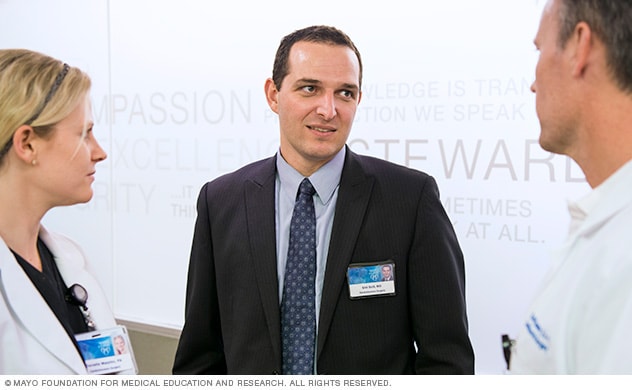 Mayo Clinic care team
A team of healthcare professionals talks about care for people who have heart valve surgery.
Advanced technology and treatment
Mayo Clinic cardiovascular surgeons perform many types of heart valve surgery, including:
Mayo Clinic offers advanced treatment options, including minimally invasive heart surgery, for some people. Minimally invasive heart surgery involves smaller incisions than does open-heart surgery. So you might have less pain and a quicker recovery.
Transcatheter aortic valve replacement, also called TAVR, is a minimally invasive way to replace a narrowed aortic valve. In TAVR, a surgeon places a flexible, hollow tube called a catheter into a blood vessel in the leg or chest. The surgeon guides the tube to the heart. A replacement valve passes through the catheter and is moved to the proper area in the heart. A balloon might be used to expand the heart valve. Some replacement heart valves can self-expand.
Another type of advanced treatment is robot-assisted heart valve surgery. A Mayo Clinic surgeon sits at a special computer called a remote console. The surgeon looks at a close-up 3D video of the heart and uses robot arms to do the surgery. Another surgeon and the surgical team help at the operating table.
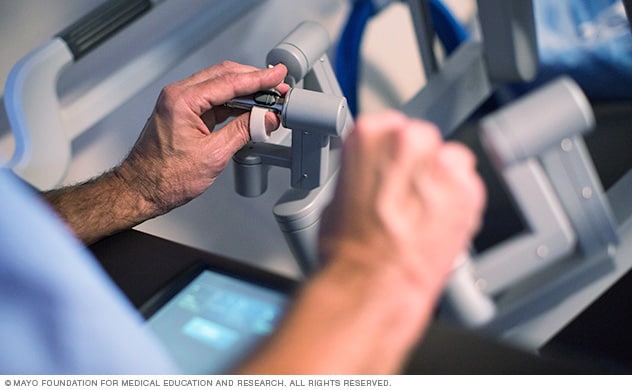 Robot-assisted heart surgery at Mayo Clinic
A Mayo Clinic surgeon sits at a remote console. The surgeon uses robotic arms to do robot-assisted heart surgery. A surgical team helps at the operating table.
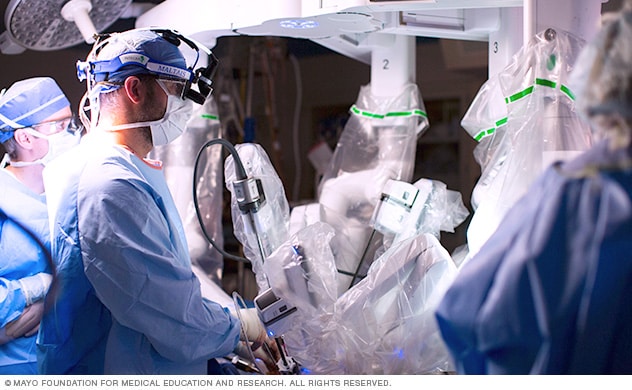 Robot-assisted heart surgery team at Mayo Clinic
A Mayo Clinic surgeon and surgical team help with robot-assisted heart surgery. Another surgeon sits at a remote console controlling the robotic arms.
Mayo doctors also can fix or replace some heart valves with long, thin tubes called catheters and clips, plugs or other devices.
Expertise and rankings
Mayo Clinic cardiovascular surgeons have extensive experience and ability in performing heart valve surgery. Mayo surgeons do more than 2,300 heart valve surgeries each year.
 Collaboration
A Mayo Clinic cardiologist and cardiac surgeon work together and talk about heart valve surgery.
Pediatric cardiologists and pediatric cardiac surgeons at Mayo Clinic's campus in Minnesota have experience treating children with heart valve disease and other heart conditions.
Valvular heart disease expertise
Mayo doctors in the Valvular Heart Disease Clinic have extensive experience and ability evaluating and treating people with heart valve disease. Cardiologists work with cardiovascular surgeons and other healthcare professionals to decide whether heart valve repair, heart valve replacement or another treatment is most appropriate.
Nationally recognized expertise
Mayo Clinic in Rochester, Minnesota, Mayo Clinic in Phoenix/Scottsdale, Arizona, and Mayo Clinic in Jacksonville, Florida, are ranked among the Best Hospitals for heart and heart surgery by U.S. News & World Report. Mayo Clinic Children's in Rochester is ranked the No. 1 hospital in Minnesota and the five-state region of Iowa, Minnesota, North Dakota, South Dakota and Wisconsin, according to U.S. News & World Report's 2025-2026 "Best Children's Hospitals" rankings.
With Mayo Clinic's emphasis on collaborative care, specialists at each of the campuses — Arizona, Minnesota and Florida — interact with colleagues at the other campuses and the Mayo Clinic Health System.
Learn more about Mayo Clinic's cardiovascular surgery and cardiovascular medicine departments' expertise and rankings.
Locations, travel and lodging
Mayo Clinic has major campuses in Phoenix and Scottsdale, Arizona; Jacksonville, Florida; and Rochester, Minnesota. The Mayo Clinic Health System has dozens of locations in several states.
For more information on visiting Mayo Clinic, choose your location below:
Costs and insurance
Mayo Clinic works with hundreds of insurance companies and is an in-network provider for millions of people.
In most cases, Mayo Clinic doesn't require a physician referral. Some insurers require referrals or may have additional requirements for certain medical care. All appointments are prioritized on the basis of medical need.
Learn more about appointments at Mayo Clinic.
Please contact your insurance company to verify medical coverage and to obtain any needed authorization prior to your visit. Often, your insurer's customer service number is printed on the back of your insurance card.
Clinical trials
Explore Mayo Clinic studies of tests and procedures to help prevent, detect, treat or manage conditions.