AV node ablation
AV node ablation is a treatment for an irregular and often very fast heartbeat called atrial fibrillation (AFib). The treatment uses heat energy to destroy a small amount of tissue between the upper and lower heart chambers. This area is called the atrioventricular node, also known as the AV node.
AV node ablation can be done only if you have a device called a pacemaker or a device called an implantable cardioverter-defibrillator (ICD) placed before getting ablation. A pacemaker is placed under the skin by the collarbone. It keeps the heart from beating too slowly. An ICD is placed in the chest. It detects and stops irregular heartbeats.
Risks
The risk of complications is low with AV node ablation. But some possible risks are:
- Bleeding from the surgical cut.
- Infection.
- More or new irregular heartbeats.
- Blood clots.
- Heart or blood vessel damage.
- Problems with the pacemaker.
- Rarely, death.
Ask your healthcare team about all of the possible risks.
Why it's done
AV node ablation may be done if you have atrial fibrillation (AFib) that doesn't get better with medicine or other treatments, especially if medicines can't control your heart rate. AV node ablation is often considered the last treatment option for AFib. That's because it needs the use of a pacemaker.
How you prepare
Your healthcare team tells you how to prepare for AV node ablation. You may have some tests to check your heart health.
Anyone who has AV node ablation needs a pacemaker for life. The device helps the heart beat correctly. It's placed under the skin by the collarbone. You might have this device placed weeks before AV node ablation to make sure the device works well. But some people get the pacemaker on the day of the ablation.
What you can expect
During
AV node ablation
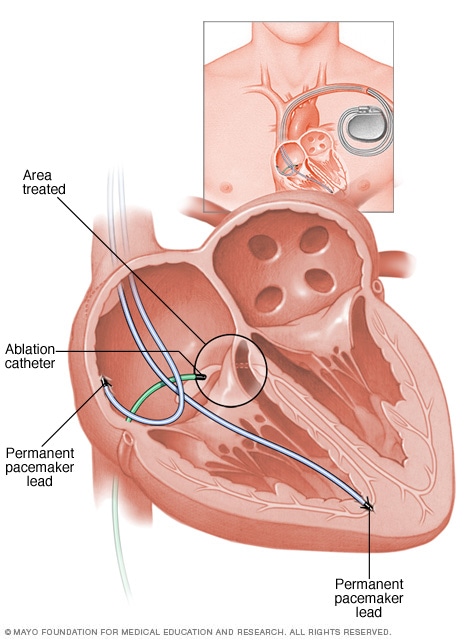
AV node ablation
Atrioventricular (AV) node ablation uses heat energy, called radiofrequency energy, to destroy the area between the upper and lower heart chambers. This area is called the AV node. The heart's electrical signals can't pass through the damaged area. A pacemaker or an implantable cardioverter-defibrillator (ICD) is needed to control the heartbeat before you get this treatment.
AV node ablation is done in the hospital. A member of your care team places an IV into a vein in your forearm or hand. You get medicine to help you relax.
During the treatment, you may be awake or lightly sedated. Some people get a combination of medicines to put them in a sleeplike state. This is called general anesthesia. The type of sedation you get depends on your type of irregular heartbeat and overall health.
The doctor places a pacemaker under the skin near the collarbone, unless you already have one. The device helps the heart beat properly.
Then, the doctor places a thin, soft tube called a catheter through a blood vessel, usually in your groin. The doctor guides the tube to the area of the heart being treated.
Sensors on the tip of the catheter apply heat to the heart tissue at the AV node. The heat energy is called radiofrequency energy. It damages the tissue. This destroys the heart's signaling connection that causes irregular heartbeats.
After
After AV node ablation, your healthcare team usually takes you to a recovery room. The team closely checks on you. Depending on your condition, you may go home the same day. Or you may spend at least a night in the hospital.
Once you get home, follow your healthcare team's instructions. For instance, you are usually told not to do heavy physical activity or lifting for a while.
Call your healthcare professional if:
- You have numbness or tingling in the area where the catheter was placed.
- The skin around the area looks more bruised.
- The area swells, or fluids leak from it.
- You feel sick to your stomach or sweat a lot.
Call 911 or your local emergency number if:
- You have a fast or irregular heartbeat.
- You feel short of breath.
- You feel dizzy or lightheaded enough to have to lie down.
- A lump forms by the catheter site.
- Bleeding from the catheter site or incision doesn't slow down when you press on the area.
- You feel pain or discomfort in your chest that spreads into your neck, jaw or arm.
- Your face droops, your arm becomes weak, or you have trouble speaking.
Results
After AV node ablation, atrial fibrillation (AFib) symptoms and quality of life often get better. You may need to take blood-thinning medicines to lower your risk of a stroke.
Sept. 17, 2026