Overview
The liver
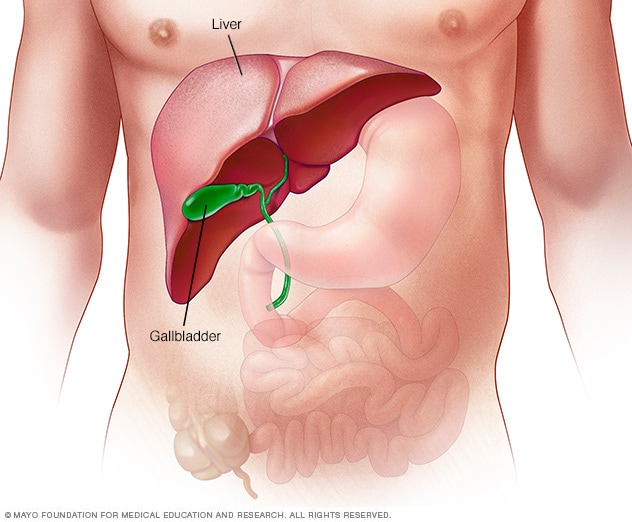
The liver
The largest organ inside the body, the liver is located mainly in the upper right portion of the abdomen, beneath the diaphragm and above the stomach.
Wilson's disease, also called hepatolenticular degeneration, is a rare inherited condition that causes copper to build up in the body, especially in the liver, brain and eyes. Symptoms most often appear between ages 3 and 40. But they can appear at any time.
Copper is important for healthy nerves, bones, collagen and the skin pigment melanin. You usually take in copper from the food you eat. Your liver creates a substance called bile that removes any extra copper.
In people with Wilson's disease, copper isn't removed properly and instead builds up. If not treated, this can sometimes become life-threatening. When diagnosed early, Wilson's disease is treatable. Many people with the condition live full lives.
Wilson's disease affects about 1 in 30,000 people worldwide. There are other conditions that affect how the body processes copper. But Wilson's disease is caused by changes, also called mutations, in a specific gene — ATP7B.
Products & Services
Symptoms
Wilson's disease is an inherited condition that's present at birth. But Wilson's disease signs and symptoms appear later, after copper levels build up in the brain, liver, eyes or another organ.
The early symptoms of Wilson's disease can be subtle and vary depending on which parts of the body the disease affects. Early symptoms may include tiredness, loss of appetite, mood or personality changes, tremors, or trouble with coordination.
Eye symptoms
These signs and symptoms can include:
- Kayser-Fleischer rings are golden-brown or copper-colored rings that appear around the outside edge of the colored part of the eye, called the iris. The Kayser-Fleischer eye rings in Wison's disease are caused by copper buildup in a part of the cornea called the Descemet membrane. The cornea is the clear, dome-shaped layer that covers your pupil and iris. Kayser-Fleischer rings usually appear first at the top and bottom of the iris and may eventually form a full circle. The ring is usually only visible with the use of a special light called a slit-lamp at an eye exam.
- Sunflower cataracts refer to patterns of radiating lines on the lenses of the eyes that can form as a result of copper buildup. They're also visible with a slit lamp at an eye exam.
- Yellowing of the eyes, also called jaundice, can happen in advanced Wilson's disease if the liver is damaged.
Neurological symptoms
Wilson's disease can cause copper buildup in areas of the brain that control movement and mood. This damage can lead to certain signs and symptoms.
- Tremor. Wilson's disease can cause different types of tremor, which is a shaking you can't control. Wilson's tremor is a classic sign that looks like a slow wing-beating motion when the arms are stretched out to the sides.
- Other muscle and movement changes. These can include trouble with speech, swallowing or physical coordination as well as uncontrolled movements and stiff muscles.
- Psychiatric and mood or personality changes. These can include depression, irritability, and trouble falling or staying asleep. Wilson's disease also can cause a loss of touch with reality, called psychosis. Wilson's disease does not cause psychopathy, but it can cause serious behavior changes, including symptoms similar to those in schizophrenia.
- Face of the giant panda sign. This refers to a pattern that appears on a brain MRI in about 10% to 15% of people with Wilson's disease. It shows up mainly in those with neurological symptoms when Wilson's disease has damaged the middle part of the brain called the midbrain. The name of the sign reflects a pattern of lighter and darker colors that look similar to a panda's face in the MRI image.
Liver symptoms
If Wilson's disease has caused copper to build up in the liver, it sometimes causes symptoms, such as:
- Yellowing of the skin and eyes, known as jaundice.
- Swelling or fluid buildup in the legs or stomach area.
These symptoms of liver damage may not appear right away. In some cases, the liver damage is found not because of symptoms but because of blood tests. Those blood tests show the liver is not working properly, also called abnormal liver function.
But sometimes Wilson's disease can cause liver damage with normal liver function and typical test results. This is called compensated liver disease. When the liver damage isn't obvious on tests and isn't causing liver symptoms, neurological symptoms can sometimes lead to a diagnosis.
Skin and nail symptoms
Copper buildup in other areas of the body may cause:
- Blue fingernails or toenails. Depending on the skin color, this may be harder or easier to see. Sometimes this is called "Wilson's disease nails."
- Darkened skin on the front of the lower legs.
Other symptoms
Other possible signs and symptoms include:
When to see a doctor
If you notice symptoms that concern you, make an appointment with a healthcare professional. This is especially important if Wilson's disease runs in your family.
Causes
Autosomal recessive inheritance pattern
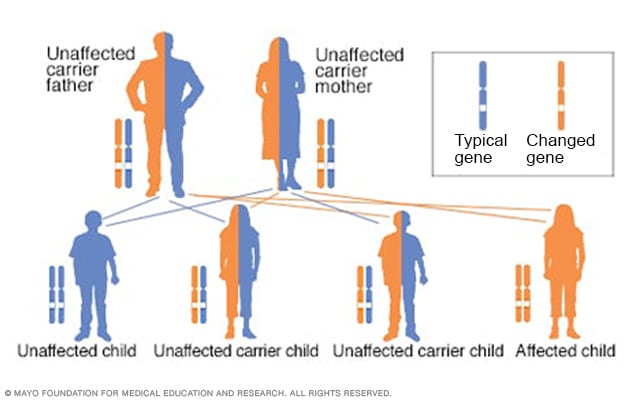
Autosomal recessive inheritance pattern
Wilson's disease is caused by a changed gene inherited from each parent. This is called autosomal recessive inheritance. Inheriting a changed gene from just one parent rarely affects a person's health. That person has one changed gene and one typical gene. When two carriers of the same changed gene have a child, there is a 25% chance the child will inherit two typical genes, a 50% chance the child will be a carrier but not be affected, and a 25% chance the child will have Wilson's disease.
Wilson's disease is a genetic condition caused by a change, also called a mutation, in a specific gene — ATP7B — passed down from each parent. A child can inherit Wilson's disease if each parent passes along the same disease-causing mutation in the ATP7B gene or if each parent passes on a different mutation in the ATP7B gene.
The ATP7B gene provides instructions for making a protein that helps to transport copper out of the liver into bile to be removed from the body. When mutations occur in the ATP7B gene, this copper transport process is disrupted. This disruption leads to a buildup of excess copper in the liver and eventually in other organs such as the brain, kidneys and eyes.
The buildup of copper is what causes symptoms of Wilson's disease. This includes Kayser-Fleischer rings. These golden-brown or copper-colored rings around the outside edge of the colored part of the eye are caused by extra copper in a part of the cornea called the Descemet membrane. The rings can be seen with a special lamp during an eye exam.
While there are many possible mutations in the ATP7B gene, one of the most common is known as a p.H1069Q mutation. Wilson's disease is not related to mutations in the PTP1B gene. PTP1B may play a role in type 2 diabetes and some blood cancers.
A blood test can look for the genetic changes that cause Wilson's disease. If you're found to have the genetic mutation, close family members — including children and siblings — should be screened too. If the condition is found early, treatment can begin before symptoms start.
Risk factors
Your risk of Wilson's disease is higher if you have parents or siblings who have the condition. If you know that Wilson's disease runs in your family, ask a healthcare professional if you need genetic testing to find out if you're at risk of the condition. Diagnosing Wilson's disease early increases the chances of successful treatment.
Complications
Healthy liver vs. liver cirrhosis
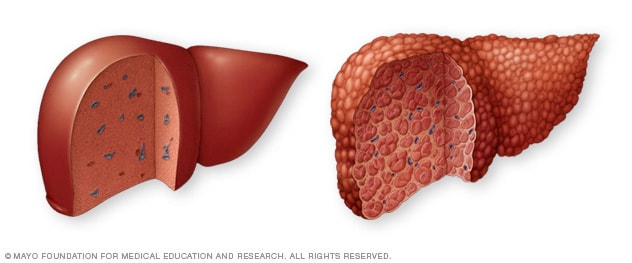
Healthy liver vs. liver cirrhosis
A healthy liver, at left, shows no signs of scarring. In cirrhosis, at right, scar tissue replaces healthy liver tissue.
Without treatment, Wilson's disease causes copper to build up over time in the liver, brain and other organs. This can cause damage that can't be reversed. If not treated, Wilson's disease can cause permanent liver damage, liver failure, lasting neurological problems and sometimes death. But treatment can help ease Wilson's disease symptoms and prevent more damage.
Serious complications include:
- Scarring of the liver, also called cirrhosis. As liver cells try to repair damage due to high copper levels, scar tissue forms in the liver. This scarring makes it harder for the liver to work as it should. Even with treatment, the scarring may not be completely reversible.
- Liver failure. This can happen suddenly in what's known as acute liver failure. It also can come about slowly over years. Liver failure can be life-threatening. A liver transplant might be a treatment option.
- Nervous system issues. Symptoms such as tremors, involuntary muscle movements, unsteady walking and trouble speaking usually improve with treatment. Even with treatment, some people with Wilson's disease may have lasting neurological symptoms. Wilson's disease can damage different parts of the brain. If the middle brain is damaged, it may appear on an MRI in a pattern that looks like a panda's face. This is called the face of the giant panda sign. If the part of the brain just below the midbrain, called the pons, has damage, it may look like a small panda's face on the MRI. This is called the face of miniature panda sign. It also could look like a trident, which is called the trident sign.
- Kidney problems. Wilson's disease can damage the kidneys. This can cause issues such kidney stones or changes in how the kidneys filter waste, leading to extra amino acids in the urine.
- Mental health conditions. These might include personality changes, depression, irritability, bipolar disorder or psychosis.
- Blood concerns. Wilson's disease can sometimes damage red blood cells, a process called hemolysis. This leads to anemia and jaundice.
- Heart conditions. Wilson's disease may cause heart conditions such as weakness of the heart muscle, called cardiomyopathy, and irregular heartbeats called arrhythmias, including atrial fibrillation. There's no direct relationship between Wilson's disease and systolic murmur.
Dec. 27, 2025