Rotator cuff injury Diagnosis and treatment
Diagnosis
A physical exam is the first step to diagnosing rotator cuff injuries. During the exam, a healthcare professional will press on different parts of the affected shoulder and move the arm into different positions. They'll also test the strength of the muscles around the shoulder and in the arms.
Imaging tests also may help diagnose rotator cuff injuries. Imaging tests may include:
- X-rays. Although a rotator cuff tear won't show up on an X-ray, this test can visualize bone spurs or other potential causes for your pain, such as arthritis.
- Ultrasound. This type of test uses sound waves to produce images of structures within your body, particularly soft tissues such as muscles and tendons. It allows a provider to assess the structures of your shoulder during movement. It also allows a quick comparison between the affected shoulder and the healthy shoulder.
- Magnetic resonance imaging (MRI). This technology uses radio waves and a strong magnet. The images obtained display all structures of the shoulder in great detail.
Treatment
Conservative treatments — such as rest, ice and physical therapy — sometimes are all that's needed to recover from a rotator cuff injury. If your injury is severe, you might need surgery.
Therapy
Physical therapy is usually one of the first treatments suggested. Exercises tailored to the specific location of your rotator cuff injury can help restore flexibility and strength to your shoulder. Physical therapy also is an important part of the recovery process after rotator cuff surgery.
Injections
An injection into the shoulder joint might be helpful. Injections are especially helpful if the pain is interfering with sleep, daily activities or physical therapy. While such shots often provide temporarily relief, they also can weaken the tendon and reduce the success of future shoulder surgery.
Surgery
Many different types of surgeries are available for rotator cuff injuries, including:
- Arthroscopic tendon repair. In this procedure, surgeons insert a tiny camera, called an arthroscope, and tools through small incisions. These tools are used to reattach the torn tendon to the bone.
- Open tendon repair. In some situations, an open tendon repair may be a better option. In these types of surgeries, your surgeon works through a larger incision to reattach the damaged tendon to the bone.
- Tendon transfer. If the torn tendon is too damaged to be reattached to the arm bone, surgeons may decide to use a nearby tendon as a replacement.
- Shoulder replacement. Massive rotator cuff injuries may require shoulder replacement surgery. An innovative procedure, called a reverse shoulder arthroplasty, can improve the artificial joint's stability. Reverse shoulder arthroplasty installs the ball part of the artificial joint onto the shoulder blade and the socket part onto the arm bone.
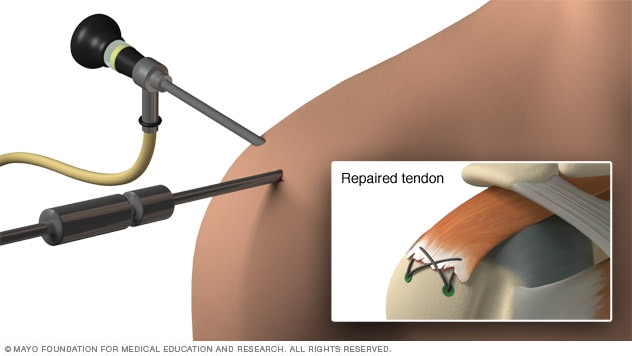
Arthroscopic rotator cuff repair
During an arthroscopic repair of a rotator cuff tendon, the surgeon inserts a tiny camera and tools through small incisions in the shoulder.
Clinical trials
Explore Mayo Clinic studies testing new treatments, interventions and tests as a means to prevent, detect, treat or manage this condition.
Self-care
The pain from a minor rotator cuff injury often diminishes on its own, with proper care. Stop doing what caused the pain and try to avoid painful movements. Limit heavy lifting or overhead activity until the shoulder pain subsides. Icing the shoulder may help it feel better. Over-the-counter pain relievers such as ibuprofen (Advil, Motrin IB, others) or acetaminophen (Tylenol, others) also may be helpful.
From Mayo Clinic to your inbox
Sign up for free and stay up to date on research advancements, health tips, current health topics, and expertise on managing health. Click here for an email preview.
Preparing for your appointment
You'll probably start by seeing your family healthcare professional or sports medicine physician. If your injury is severe, you might be referred to an orthopedic surgeon. If you've been treated for a similar problem in the past, you may need to bring past records and imaging studies with you to your appointment.
What you can do
Before the appointment, you might want to write a list that answers the following questions:
- When did you first begin experiencing shoulder pain?
- What movements and activities worsen your shoulder pain?
- Have you ever injured your shoulder?
- Have you experienced any symptoms in addition to shoulder pain?
- Does the pain travel down your arm below your elbow?
- Is the shoulder pain associated with any neck pain?
- Does your job or hobby aggravate your shoulder pain?
What to expect from your doctor
Your healthcare professional is likely to ask you a number of questions. Being ready to answer them may reserve time to go over any points you want to spend more time on. Your doctor may ask:
- Where exactly is the pain located?
- How severe is your pain?
- What movements and activities aggravate or relieve your shoulder pain?
- Do you have any weakness or numbness in your arm?


Top ranked in the U.S.
Mayo Clinic in Rochester, Minnesota, Mayo Clinic in Phoenix/Scottsdale, Arizona, and Mayo Clinic in Jacksonville, Florida, are ranked among the Best Hospitals for orthopedics by U.S. News & World Report.
CON-20126916
Mayo Clinic does not endorse companies or products. Advertising revenue supports our not-for-profit mission.
Advertising & Sponsorship
Mayo Clinic Press
Check out these best-sellers and special offers on books and newsletters from Mayo Clinic Press.
