Overview
Atrial fibrillation ablation is a treatment for an irregular and often very fast heartbeat called atrial fibrillation (AFib). The treatment uses heat energy, cold energy or high-energy electric pulses to create tiny scars in an area of the heart. The signals that tell the heart to beat can't pass through scar tissue. So the treatment helps block faulty signals that cause AFib.
Atrial fibrillation ablation may be done if medicines or other treatments for AFib don't work. But sometimes it's the first treatment for some people with AFib.
A doctor most often uses thin, flexible tubes called catheters to do atrial fibrillation ablation. The tubes are placed into blood vessels and guided to the heart. Less often, ablation is done during heart surgery.
Types
Why it's done
Atrial fibrillation
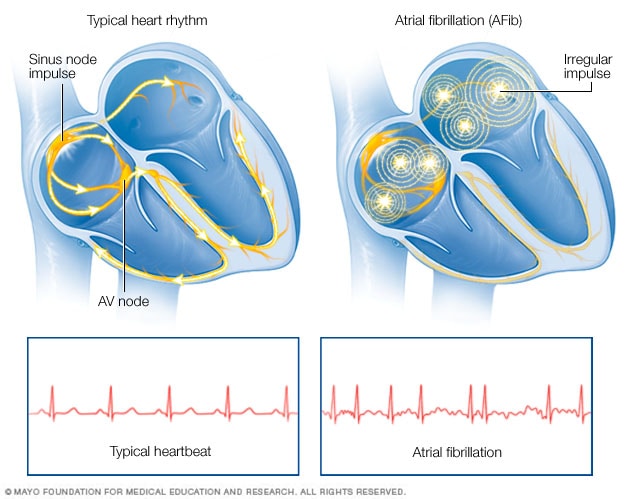
Atrial fibrillation
Atrial fibrillation (AFib) is a heart rhythm condition. In a typical heart, a group of cells called the sinus node sends electrical signals that start each heartbeat. The signals go across the upper heart chambers to the AV node, where they usually slow down. Then the signals go to the lower heart chambers, causing them to squeeze and pump out blood. But in AFib, the signals in the upper chambers are chaotic. The AV node can't stop all of the chaotic signals from entering the lower chambers. This causes a fast and irregular heartbeat.
Atrial fibrillation ablation is done to treat and prevent an irregular and often very fast type of heartbeat called AFib. You may need this treatment if you have a fast, fluttering heartbeat that doesn't get better with medicine or other treatments.
Risks
Possible atrial fibrillation ablation risks include:
- Bleeding or infection at the site where the catheters were placed.
- Blood vessel damage.
- Heart valve damage.
- Irregular heartbeats that are new or become worse.
- Slow heart rate that may need to be treated with a device called a pacemaker.
- Blood clots in the legs or lungs.
- Stroke or heart attack.
- Narrowing of the veins that carry blood between the lungs and heart, called pulmonary vein stenosis.
- Damage to the kidneys from dye, called contrast, used to see the arteries during the treatment.
Talk with your healthcare professional about the risks and benefits of atrial fibrillation ablation. Together you can decide whether the treatment can help with your AFib.
How you prepare
You may have some tests to check your heart health.
Your healthcare team tells you how to prepare for atrial fibrillation ablation.
- You usually need to stop eating and drinking the night before the treatment.
- Tell your care team about all the medicines you take. The team tells you how or if you should take them before the treatment.
What you can expect
Before
Atrial fibrillation ablation is done in a hospital. A member of your care team places an IV into your forearm or hand. You usually get medicines to help you relax. This is called sedation.
The amount of sedation needed for the treatment depends on the type of irregular heartbeat you have and your overall health. You may be fully awake or lightly sedated. Some people get a combination of medicines to put them in a sleep-like state. This is called general anesthesia.
During
Catheter insertion points for cardiac ablation
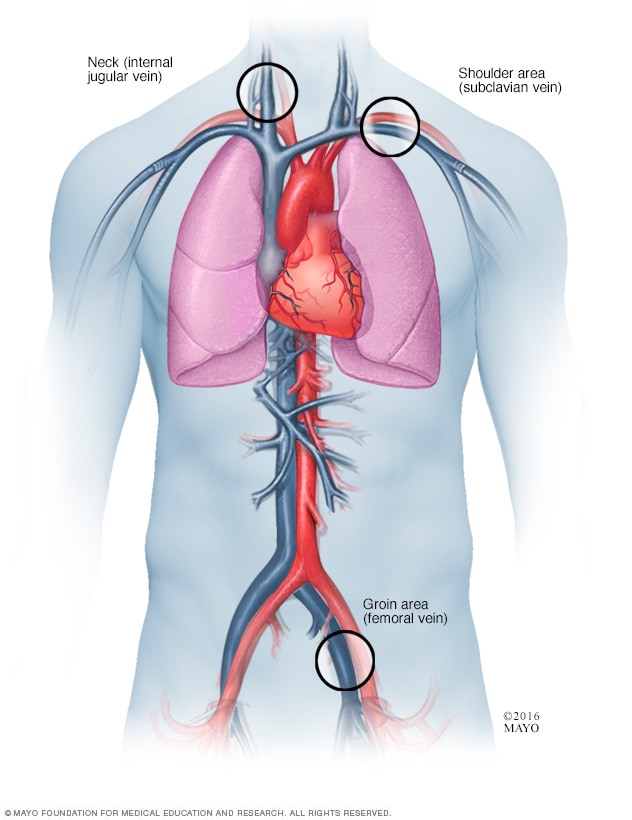
Catheter insertion points for cardiac ablation
During cardiac ablation, a thin, flexible tube called a catheter is passed through a blood vessel to reach the heart. More than one catheter is often used. The catheter may be inserted in the groin, the shoulder or the neck.
What happens during atrial fibrillation ablation depends on the specific treatment being done.
Most often, a doctor inserts one or more thin, flexible tubes called catheters into a blood vessel and guides them to the heart. These tubes are usually placed in a blood vessel in the groin, shoulder or neck.
The doctor uses one of the following ablation methods to create small scars in the heart. The scars block the irregular heartbeats:
- Heat energy, called radiofrequency energy.
- Extreme cold, called cryoablation.
- High-energy electric pulses, called pulsed field ablation.
You shouldn't feel any discomfort during the treatment. If you have bad pain or shortness of breath, tell your care team.
Atrial fibrillation ablation usually takes 3 to 6 hours. If the treatment is more complex than usual, it may take longer. For example, if you have a type of atrial fibrillation ablation called AV node ablation, you need a permanent pacemaker to control your heart rate. The pacemaker may be placed before or during the ablation.
Another type of ablation to treat AFib is called the maze procedure. Most often, it's done during open-heart surgery. The surgeon creates a pattern of scar tissue in the heart using a scalpel, heat energy or cold energy. The scars block irregular heart signals that cause atrial fibrillation.
During cardiac ablation, a thin, flexible tube called a catheter is passed through a blood vessel to reach the heart. More than one catheter is often used. The catheter may be inserted in the groin, the shoulder or the neck.
After
After atrial fibrillation ablation, you rest in a recovery area for a few hours. Your healthcare team closely checks on you. Depending on your condition, you may go home the same day or spend the night in the hospital. Plan to have someone drive you home.
Some people feel sore after atrial fibrillation ablation. The soreness shouldn't last more than a week. Most people can return to their daily routines within a few days. But ask your healthcare team what activities are safe for you. In general, don't lift anything that weighs more than 10 pounds for about a week.
Call your healthcare professional if:
- The site where a catheter was placed loses feeling or tingles.
- The skin around the site looks more bruised.
- The site swells, or fluids drain from it.
- You feel sick to your stomach or sweat a lot.
Call 911 or your local emergency number if:
- You have a fast or irregular heartbeat.
- You feel short of breath.
- You feel dizzy or lightheaded enough to have to lie down.
- A lump forms by the catheter site.
- Bleeding from the catheter site or incision doesn't slow down when you put pressure on the area.
- You feel pain or discomfort in your chest that spreads into your neck, jaw or arm.
- Your face droops, your arm becomes weak or you have trouble speaking.
Results
Most people see their quality of life get better after atrial fibrillation ablation. But there's a chance that AFib may come back. If this happens, another ablation may be done. Or your healthcare professional might suggest other treatments.
AFib is linked to stroke. Atrial fibrillation ablation hasn't been shown to lower this risk. After ablation, you may need to take blood thinners to lower your stroke risk.
Sept. 17, 2026