Descripción general
Astrocitoma
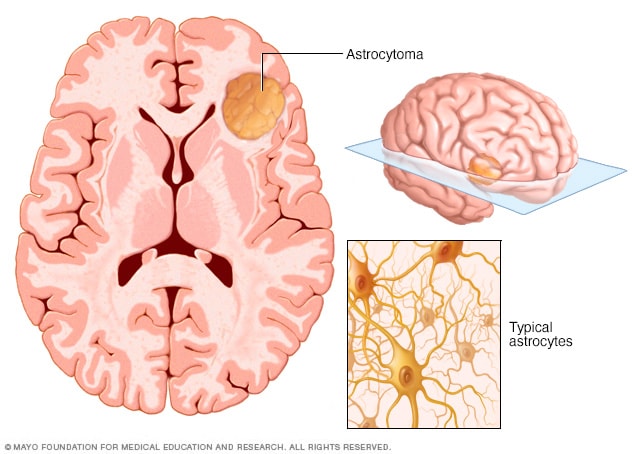
Astrocitoma
El astrocitoma es un tipo de cáncer que puede ocurrir en el cerebro o en la médula espinal. Comienza en las células llamadas astrocitos que brindan sostén a las células nerviosas. Algunos astrocitomas crecen muy lentamente y otros pueden ser cánceres agresivos que crecen rápidamente.
El astrocitoma es un tipo de tumor cerebral o tumor de la médula espinal. Se origina en unas células llamadas astrocitos. Estas células con forma de estrella ayudan a que las células nerviosas se mantengan sanas y funcionen correctamente.
Los síntomas del astrocitoma dependen de la ubicación del tumor. Un astrocitoma cerebral puede causar dolores de cabeza, convulsiones, náuseas o cambios en el estado de ánimo o el comportamiento. Un astrocitoma de la médula espinal puede causar debilidad o dificultad para mover los brazos o las piernas.
Los astrocitomas pueden comportarse de diferentes maneras. Algunos crecen más lentamente y se consideran menos agresivos, mientras que otros crecen y se diseminan más rápidamente. Los médicos suelen analizar los genes o las características moleculares del tumor para ayudar a elegir el mejor tratamiento.
El astrocitoma forma parte de un grupo más amplio de tumores cerebrales denominados gliomas. Estos tumores se originan en células que dan apoyo a las células nerviosas. Los astrocitomas se clasifican en grados del 1 al 4 según su velocidad de crecimiento. El astrocitoma de grado 4, también denominado glioblastoma, es el que crece más rápido y el más agresivo. Los astrocitomas de grado inferior, del 1 al 3, suelen crecer más lentamente. A menudo tienen un mejor pronóstico que el glioblastoma. El tratamiento y el pronóstico dependen del grado, el tamaño, la ubicación y las características moleculares del tumor.
Productos y servicios
Síntomas
Los síntomas del astrocitoma suelen ser leves al principio. Los síntomas dependen de si el tumor se encuentra en el cerebro o en la médula espinal. Estos síntomas del tumor cerebral pueden cambiar a medida que el tumor crece. Los primeros síntomas se deben a la irritación local del tejido cerebral cercano. Los síntomas posteriores se producen a medida que el tumor cerebral crece y aumenta la presión en el cerebro o el canal espinal.
Los astrocitomas de grado bajo pueden crecer antes de causar síntomas, mientras que los tumores cerebrales de grado alto tienden a causar síntomas antes.
Síntomas tempranos del astrocitoma
- Nuevos episodios de convulsiones, que suelen ser el primer signo de tumores de crecimiento lento.
- Cambios sutiles en el pensamiento, el estado de ánimo o la memoria.
- Dolores de cabeza leves.
- Dificultad para encontrar las palabras adecuadas.
- Cambios en la vista.
- Torpeza en los movimientos que se da en un lado del cuerpo.
- Dolor en el cuello o la espalda que comienza lentamente.
- Hormigueo o entumecimiento que se extiende a un brazo o una pierna.
Síntomas tardíos del astrocitoma a medida que el tumor crece
- Dolores de cabeza que empeoran, especialmente por la mañana o al toser o hacer mucho esfuerzo.
- Náuseas y vómitos, que pueden producirse como resultado del aumento de la presión.
- Aumento de la debilidad.
- Problemas del habla o de la visión.
- Deterioro cognitivo, que implica cambios en la memoria, el pensamiento o la concentración.
- Pérdida de equilibrio.
- Cambios en el funcionamiento del intestino o la vejiga.
Síntomas del astrocitoma según la ubicación del tumor
Un astrocitoma puede aparecer en el cerebro o en la médula espinal. Los signos y síntomas suelen variar en función de la ubicación del tumor.
Parte posterior e inferior del cerebro
- Problemas de equilibrio y coordinación, como tropiezos o movimientos temblorosos.
- Dolor de cabeza, náuseas y vómitos por la presión en el cerebro.
Tronco cerebral
- Visión doble u otros problemas de movimiento ocular.
- Debilidad facial o falta de sensibilidad en la cara.
- Dificultad para hablar o tragar.
- Dificultad para caminar y mantener el equilibrio.
- Debilidad.
Médula espinal
- Dolor de espalda o cuello que empeora lentamente.
- Dolor que se extiende a un brazo o una pierna.
- Entumecimiento y hormigueo.
- Debilidad.
- Falta de equilibrio, caídas e inestabilidad al caminar.
- Cambios en el funcionamiento del intestino o la vejiga que pueden aparecer más adelante.
Estos síntomas no son necesariamente específicos del astrocitoma, sino que pueden presentarse con muchos tipos de tumores cerebrales. Es importante que un profesional de atención médica revise cualquier síntoma nuevo o que empeore. Estos síntomas incluyen un primer episodio de convulsiones, cambios en la visión, problemas del habla, debilidad en un lado del cuerpo o dolores de cabeza que empeoran por la mañana.
¿Puede el edema, es decir, la hinchazón alrededor del tumor, empeorar los síntomas?
Sí. El edema peritumoral es la hinchazón del tejido cerebral alrededor del tumor. Puede empeorar los síntomas o causar la aparición de nuevos síntomas. Estos síntomas pueden incluir dolores de cabeza, debilidad, problemas del habla o cambios en la visión. La hinchazón aumenta la presión dentro del cráneo y puede estirar o irritar las vías cerebrales cercanas. Esto puede empeorar los síntomas comunes. Se pueden utilizar tratamientos cortos con medicamentos esteroides para reducir la hinchazón y aliviar los síntomas.
El edema es más común en los astrocitomas de grado alto y contribuye a los síntomas incluso cuando el tumor en sí no es muy grande.
¿En qué se diferencian los síntomas del astrocitoma pilocítico en los niños de los síntomas en los adultos?
Los astrocitomas pilocíticos son un tipo de astrocitoma más común en niños y adolescentes. Los adultos también pueden padecer estos tumores, pero es poco frecuente. Debido a que los astrocitomas pilocíticos crecen de forma lenta, los síntomas suelen aparecer progresivamente a lo largo de semanas o meses.
Los niños pueden presentar lo siguiente:
- Dolores de cabeza, especialmente por la mañana.
- Problemas de equilibrio o torpeza si el tumor se encuentra en el cerebelo.
- Náuseas, vómitos o irritabilidad debido a la presión en el cerebro.
- Problemas de visión si el tumor afecta la vía óptica.
En niños muy pequeños, el padre o la madre pueden notar cambios en la coordinación, el rendimiento en los estudios o el comportamiento.
En los adultos, los astrocitomas son más propensos a presentarse en una parte diferente del cerebro. Pueden causar nuevos episodios de convulsiones, problemas del habla o cambios en el pensamiento o la personalidad como síntomas tempranos.
Sistema de clasificación de los astrocitomas
Los astrocitomas se clasifican en grados según el aspecto y el comportamiento de las células que se observan con un microscopio. La Organización Mundial de la Salud (OMS) creó este sistema de clasificación para ayudar a predecir la rapidez con la que el tumor podría crecer o diseminarse, y para orientar las decisiones de tratamiento.
| Grado |
Nombre |
Cómo se comporta |
Notas |
| 1 |
Astrocitoma pilocítico |
Es el menos agresivo. Tiene un crecimiento lento y, por lo general, bordes bien definidos. |
A menudo, la cirugía es suficiente para tratarlo con éxito. Se considera no maligno, o sea, benigno. La mayoría de las personas se curan con cirugía y tienen una expectativa de vida normal. |
| 2 |
Astrocitoma difuso |
De crecimiento lento, pero a menudo se extiende al tejido cerebral cercano, lo que puede dificultar su extirpación completa. |
Las células solo se diferencian ligeramente de las típicas cuando se observan bajo un microscopio. El tratamiento suele consistir en una cirugía para extirpar la mayor parte posible del tumor de forma segura, seguida de radioterapia o quimioterapia, o ambas. En promedio, la supervivencia es de entre 7 y 8 años. |
| 3 |
Astrocitoma anaplásico |
De grado alto. Crece más rápido que el de grado 2 y es más grave. |
Requiere un tratamiento más agresivo. El tratamiento suele consistir en una cirugía para extirpar la mayor parte posible del tumor de forma segura, seguida de radioterapia y quimioterapia. En promedio, la supervivencia global es de unos 5 años o más, según el tipo de tumor. |
| 4 |
Glioblastoma |
El más agresivo. Puede originarse a partir de un tumor de grado inferior o aparecer repentinamente como una enfermedad de grado alto. |
Es más común en adultos. El tratamiento suele consistir en cirugía seguida de radioterapia y quimioterapia. En promedio, la supervivencia es de unos 15 meses. |
Tumores circunscritos frente a tumores difusos
Algunos astrocitomas se denominan circunscritos y otros se conocen como difusos. Circunscrito significa que el tumor está bien definido y localizado. Los astrocitomas difusos se diseminan al tejido cerebral cercano. "Circunscrito" define el patrón de crecimiento y la categoría del tumor, pero no el grado. El xantoastrocitoma pleomórfico y el pilocítico son tumores circunscritos. Estos se agrupan por separado de los astrocitomas difusos.
Tumores e IDH
El IDH es un gen que se encuentra en las células. Existen dos: IDH1 e IDH2. Cuando un tumor presenta un IDH natural, significa que el gen IDH parece sano y que no hay alteraciones en el gen IDH de las células tumorales. El glioblastoma es un tumor con IDH natural.
Cuando un tumor tiene un IDH mutante, hay una alteración en el gen IDH1 o IDH2. En el sistema actual de la Organización Mundial de la Salud, si las pruebas de laboratorio muestran un cambio en el gen IDH, el tumor se denomina astrocitoma con mutación del IDH. Después de determinar el tipo, se le asigna un grado, ya sea 2, 3 o 4, en función de la rapidez con la que es probable que crezca. Las pruebas del gen IDH ayudan al equipo de atención médica a clasificar el tumor y predecir su comportamiento.
Cuándo debes consultar a un médico
Si tienes síntomas continuos que te preocupan, haz una cita con un profesional de atención médica.
Causas
A menudo se desconoce la causa exacta del astrocitoma, que es un tipo de tumor cerebral o de la médula espinal. Se origina cuando los astrocitos, que son células del cerebro y de la médula espinal, comienzan a proliferar y dividirse de manera inusual e incontrolada. Los astrocitos suelen sostener y proteger las células del cerebro y la médula espinal.
Un astrocitoma ocurre cuando los astrocitos presentan cambios en el ADN. El ADN de una célula contiene las instrucciones que le indican lo que debe hacer. En las células sanas, el ADN da las instrucciones para que crezcan y proliferen a un determinado ritmo. Las instrucciones les indican a las células que deben morir en un momento determinado.
En las células tumorales, los cambios en el ADN dan instrucciones diferentes. Estos cambios genéticos se denominan mutaciones. Probablemente, causan el astrocitoma al afectar la forma en la que las células controlan su proliferación y reparan el daño. Los genes mutados hacen que las células se dividan cuando no deberían y vivan más tiempo del que deberían. Esto hace que se agrupen demasiadas células y formen un tumor.
A medida que el tumor crece, puede presionar las áreas cercanas del cerebro o la médula espinal. A veces, los cambios en el ADN ocasionan que las células tumorales se conviertan en células cancerosas. Las células cancerosas pueden invadir y destruir los tejidos sanos del cuerpo.
Los científicos han descubierto que ciertos cambios genéticos dentro del tumor causan esta proliferación anómala de las células del astrocitoma:
- Los cambios en los genes IDH1 e IDH2 afectan la forma en que las células tumorales producen y utilizan la energía. Son comunes en muchos astrocitomas de grado bajo.
- Los cambios en los genes TP53 y ATRX afectan la forma en que las células reparan el ADN y controlan la proliferación celular.
- El silenciamiento del gen MGMT afecta la forma en que las células tumorales reparan el daño en el ADN y puede influir en la eficacia del tratamiento.
- En los niños, a menudo se observan cambios en el gen BRAF en astrocitomas pilocíticos, que son tumores cerebrales de crecimiento lento. Estos cambios genéticos se presentan dentro del tumor y no suelen ser hereditarios.
Los tumores astrocitomas pilocíticos se producen cuando una señal de proliferación en la célula queda "activada" de forma permanente. Esto causa que las células proliferen lentamente en un solo lugar. Los astrocitomas de grado alto se presentan cuando se acumulan muchos cambios perjudiciales en el ADN. Esto hace que las células proliferen rápidamente y se diseminen al tejido cerebral cercano.
Factores de riesgo
Entre los factores de riesgo para astrocitoma se incluyen los siguientes:
- Antecedentes de radioterapia con dosis altas de radiación ionizante en la cabeza o el cuello. Si te sometiste a radiación con dosis altas para tratar otro tipo de cáncer, tu riesgo puede ser mayor. Esto aplica especialmente si la radiación se administró cerca de la cabeza o el cuello, sobre todo, durante la infancia.
- Edad. Los astrocitomas pueden aparecer tanto en niños como en adultos. Los niños suelen presentar tumores de grado bajo, que tienden a crecer lentamente. Los adultos suelen presentar tumores de grado alto, que crecen más rápidamente y son más agresivos. La mayoría de los astrocitomas de grado alto se diagnostican después de los 40 años.
- Afecciones hereditarias. Ciertas afecciones poco frecuentes de carácter hereditario, como la neurofibromatosis tipo 1, el síndrome de Lynch, el síndrome de Turcot y la esclerosis tuberosa, pueden aumentar el riesgo.
¿El estilo de vida o el entorno pueden causar astrocitomas?
No existe una relación probada entre factores relacionados con el estilo de vida, como la dieta, el ejercicio o el hábito de fumar, y el astrocitoma. No se ha demostrado que otros posibles riesgos ambientales, como la exposición a sustancias químicas o el uso de teléfonos celulares, causen astrocitomas. La mayoría de los casos aparecen por azar, sin un desencadenante externo claro.
No se conoce ninguna forma de prevenir el astrocitoma.
Complicaciones
Los astrocitomas pueden causar complicaciones a medida que el tumor crece o como resultado del tratamiento. Entre las posibles complicaciones del astrocitoma se incluyen las siguientes:
- Problemas neurológicos. El tumor puede presionar partes del cerebro o la médula espinal. Esto puede derivar en dolores de cabeza, convulsiones, problemas para hablar, debilidad o dificultad para caminar.
- Recurrencia del tumor. Incluso después del tratamiento, los astrocitomas pueden reaparecer, especialmente si son de grado alto o si no se pudieron extirpar por completo.
- Riesgos y efectos secundarios del tratamiento. La cirugía, la radiación y la quimioterapia, a veces, pueden causar efectos secundarios como problemas de memoria o para pensar, convulsiones, dolores de cabeza, náuseas o fatiga. En algunos casos, el tratamiento puede dañar el tejido cerebral sano.
El equipo de atención médica trabajará contigo para ayudarte a manejar estos problemas y mejorar tu calidad de vida.