Diagnosis
To diagnose aortic valve disease, a healthcare professional examines you and asks questions about your symptoms and medical history.
A whooshing sound, called a heart murmur, may be heard when listening to the heart with a stethoscope. If so, you may need to see a doctor trained in heart diseases, called a cardiologist.
Tests
Tests to diagnose aortic valve disease include:
-
Echocardiogram. An echocardiogram uses sound waves to create pictures of the beating heart. It shows how blood flows through the heart and heart valves. It can help determine how severe aortic valve disease is.
There are different types of echocardiograms. The type you have depends on the information your healthcare team needs. A standard echocardiogram is done from outside the body. The ultrasound device is gently pressed against the skin of the chest above the heart. If more details are needed about the heart, a transesophageal echocardiogram may be done. This type creates pictures of the heart from inside the body. The ultrasound device is attached to a tube that goes down your throat and into the esophagus.
- Electrocardiogram. Also called an ECG or EKG, this quick test records the electrical activity of the heart. It shows how the heart beats. Sticky patches with sensors on them go on the chest and sometimes the legs. Wires connect the sensors to a computer, which displays or prints results.
- Chest X-ray. A chest X-ray shows the condition of the heart and lungs. It can show if the heart is larger than usual, which can be a sign of certain types of aortic valve disease or heart failure.
- Cardiac MRI. A cardiac MRI uses magnetic fields and radio waves to create detailed pictures of the heart. This test may be used to learn how severe aortic valve disease is. It also helps measure the size of the aorta.
- Cardiac computerized tomography (CT) scan. A cardiac CT scan uses a series of X-rays to create detailed images of the heart and heart valves. The test may be done to measure the size of the aorta and look at the aortic valve more closely. A CT scan also may be used to see how much calcium is in the aortic valve or determine how severe aortic stenosis is.
- Exercise tests or stress tests. These tests often involve walking on a treadmill or riding a stationary bike while an ECG or echocardiogram is done. Exercise tests show how the heart reacts to physical activity and whether valve disease symptoms occur during exercise. If you can't exercise, you may get medicine that affects the heart like exercise does.
- Cardiac catheterization. This test isn't often used to diagnose aortic valve disease. But it may be done to see how severe aortic valve disease is or to diagnose the condition if other tests can't. In this test, a doctor places a thin, flexible tube into a blood vessel, usually in the groin area or arm, and guided to the heart. Cardiac catheterization can give more details about blood flow and how well the heart is working. Certain heart treatments can be done during cardiac catheterization.
Staging
After testing confirms a diagnosis of aortic or other heart valve disease, your healthcare team may tell you the stage of disease. Staging helps determine the most appropriate treatment.
The stage of heart valve disease depends on many things, including symptoms, disease severity, the structure of the valve or valves, and blood flow through the heart and lungs.
Heart valve disease is staged into four basic groups:
- Stage A: At risk. Risk factors for heart valve disease are present.
- Stage B: Progressive. Valve disease is mild or moderate. There are no heart valve symptoms.
- Stage C: Asymptomatic severe. There are no heart valve symptoms but the valve disease is severe.
- Stage D: Symptomatic severe. Heart valve disease is severe and is causing symptoms.
Treatment
Treatment for aortic valve disease depends on:
- The stage of aortic valve disease.
- Whether the disease is causing symptoms.
- Whether the condition is getting worse.
Treatment may include:
- Regular health checkups.
- Lifestyle changes.
- Medicines.
- Surgery or other procedure.
If aortic valve disease is mild or moderate or if you aren't having symptoms, you may only need regular medical checkups and healthy lifestyle changes.
If you have aortic valve disease, consider being evaluated and treated at a medical center with a multidisciplinary team of heart doctors called cardiologists and other care professionals trained and experienced in evaluating and treating heart valve disease.
Medications
Medicines may be needed to treat symptoms of aortic valve disease or reduce the risk of complications. For example, medicines may be used to:
- Lower blood pressure.
- Prevent irregular heartbeats.
- Remove extra fluid from the body to reduce the strain on the heart.
Surgery or other procedures
Eventually, surgery or a catheter procedure may be needed to fix or replace the diseased aortic valve. Some people with aortic valve disease need surgery even if it's not severe or when it's not causing symptoms.
Aortic valve repair
During aortic valve repair, the surgeon may do one or all of the following:
- Separate valve flaps that have fused.
- Add support to the base of the valve.
- Reshape or remove extra valve tissue so that the flaps can close tightly.
- Patch holes or tears in a valve.
Aortic valve repair often requires open-heart surgery. However, less-invasive options may be available. For example, a catheter procedure may be used to insert a plug or device to repair a leaking replacement aortic valve.
In infants and children with aortic valve stenosis, a less invasive procedure called balloon valvuloplasty may be done to temporarily open a narrowed valve. During this treatment, the doctor inserts a thin, flexible tube into a blood vessel, usually in the groin, and threads it to the heart. A balloon on the tip inflates to make the valve opening wider. Then the balloon is deflated and removed. This valve repair procedure also may be done in adults who are too sick for surgery or who are waiting for a valve replacement.
Aortic valve replacement
Mechanical valve replacement
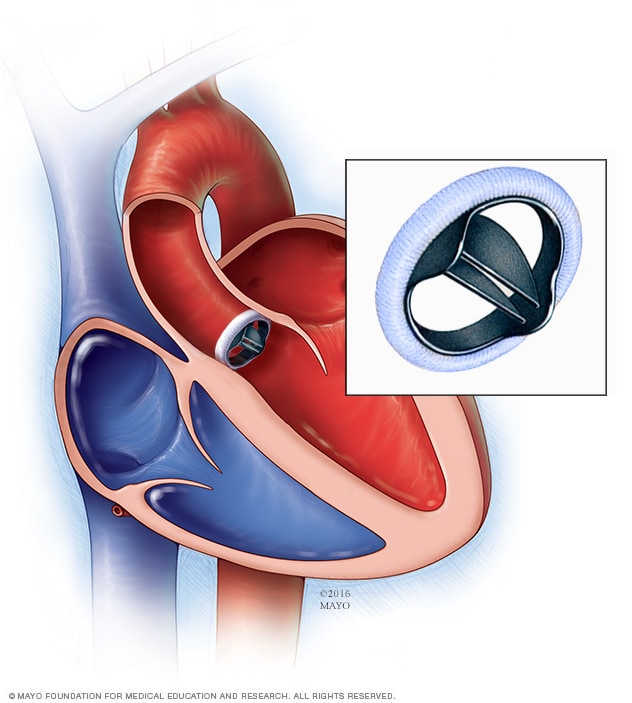
Mechanical valve replacement
In mechanical valve replacement, a mechanical valve replaces the damaged valve.
Biological valve replacement
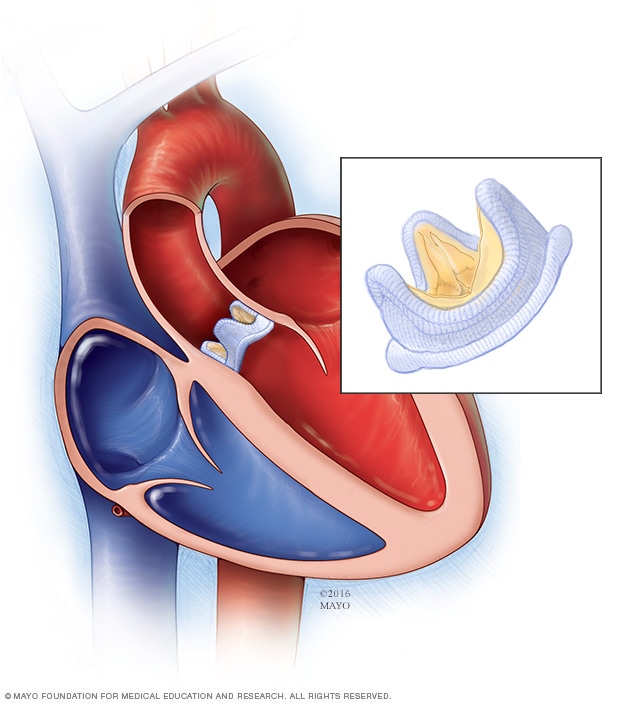
Biological valve replacement
In a biological valve replacement, a valve made from cow, pig or human heart tissue replaces the damaged heart valve.
Transcatheter aortic valve replacement (TAVR)
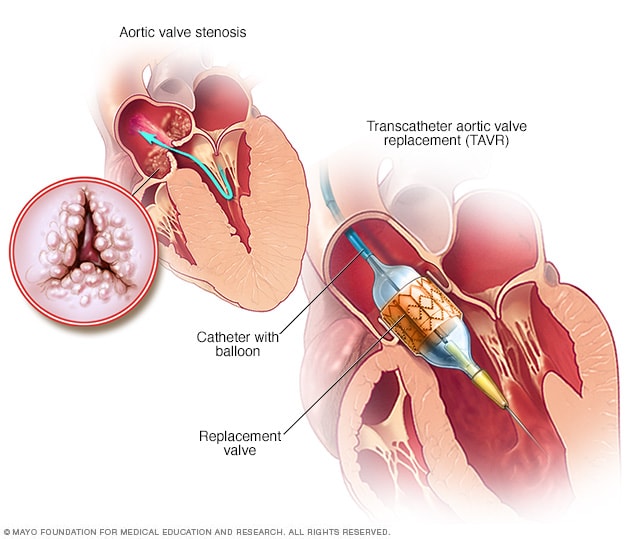
Transcatheter aortic valve replacement (TAVR)
Transcatheter aortic valve replacement, also called TAVR, is a minimally invasive procedure. It is done to replace a narrowed aortic valve that fails to open properly, a condition called aortic valve stenosis. During TAVR, a doctor places a thin, flexible tube into the leg or chest and guides it to the heart. A replacement valve goes through the tube to the correct position in the heart. A balloon on the catheter expands to press the valve into place. Some TAVR valves expand on their own.
In aortic valve replacement, a surgeon removes the damaged valve and replaces it with a mechanical valve or a valve made from cow, pig or human heart tissue. A tissue valve is called a biological tissue valve.
Sometimes, the aortic valve is replaced with your own lung valve, called a pulmonary valve. Then your pulmonary valve is replaced with a biological lung tissue valve. This more complicated surgery is called the Ross procedure.
Talk with your healthcare team about the benefits and risks of each type of valve to choose the best option for you.
Aortic valve replacement typically requires open-heart surgery. Sometimes, surgeons can use a minimally invasive procedure called transcatheter aortic valve replacement to replace a narrowed aortic valve with a biological tissue valve. Transcatheter aortic valve replacement also is commonly called TAVR. TAVR uses smaller surgical cuts than those used in open-heart surgery. TAVR may be an option for people at increased risk of heart valve surgery complications.
Aortic valve disease and pregnancy
If you have aortic valve disease, it's important to talk with a healthcare professional before becoming pregnant. Careful and regular checkups are needed if you have aortic valve disease during pregnancy. Talk with your healthcare team about which medicines are safe to use during pregnancy. Your healthcare team also can determine whether valve disease treatment is needed before getting pregnant.
Healthcare professionals may recommend that people with severe heart valve disease do not get pregnant to avoid the risk of complications.
More Information
Clinical trials
Explore Mayo Clinic studies testing new treatments, interventions and tests as a means to prevent, detect, treat or manage this condition.
Lifestyle and home remedies
After diagnosis or treatment of aortic valve disease, you need regular health checkups. Your healthcare team may tell you to make heart-healthy lifestyle changes. Try these steps:
- Do not smoke or use tobacco. If you smoke or chew tobacco, quit. Smoking is a major risk factor for heart disease. Quitting is the best way to reduce the risk. If you need help quitting, talk to a healthcare professional.
- Eat healthy foods. Choose a variety of fruits and vegetables, low-fat or fat-free dairy products, poultry, fish, and whole grains. Avoid saturated and trans fats and excess salt and sugar.
- Keep a healthy weight. Being overweight raises the risk of heart disease and other health conditions. Ask your healthcare team what a healthy weight is for you.
- Get regular exercise. Staying active keeps the heart healthy. Exercise at least 30 minutes a day on most days of the week. Talk with your healthcare team about the amount and type of exercise that's best for you.
- Manage stress. Find ways to help reduce emotional stress. Some ideas are to get more exercise, practice mindfulness and connect with others in support groups.
- Practice good sleep habits. Poor sleep may increase the risk of heart disease and other health conditions. Adults should try to get 7 to 9 hours of sleep daily.
- Manage blood pressure, cholesterol and blood sugar. Ask your healthcare professional how often you need to have your blood pressure, blood sugar and cholesterol levels checked.
Coping and support
If you have aortic valve disease, here are some steps that may help you manage the condition:
- Take medicines as told. Take your medicines as directed by your healthcare team.
- Get support. Connecting with others who have the same or a similar condition may be helpful. Ask your healthcare team about support groups in your area.
- Stay active. Regular exercise is one of the best ways to improve heart health. Ask a healthcare professional about how much and what types of physical activity are safe for you.
Preparing for your appointment
If you think you have aortic valve disease, make an appointment for a health checkup. Here's some information to help you prepare for your appointment.
- Ask if there is anything you need to do before the appointment. For example, you may be told not to eat or drink for a short period before some blood and imaging tests.
- Write down your symptoms. Include any that seem unrelated to aortic valve disease.
- Write down important personal information. Note if you have a family history of heart disease. Include any major stresses or recent life changes.
- Make a list of all medicines, vitamins and supplements you take. Include the dosages.
- Take someone with you, if possible. Someone who goes with you can help you remember the information you're given.
- Write down questions to ask your healthcare team.
For aortic valve disease, some basic questions to ask your healthcare team are:
- What is the likely cause of my symptoms or condition?
- What are other possible causes for my symptoms or condition?
- What tests do I need?
- What's the best treatment?
- What are the options to the main treatment you're suggesting?
- I have other health conditions. How can I best manage them together?
- How do I need to change my diet or activity level?
- Should I see a specialist?
- If I need surgery, which surgeon do you recommend for aortic valve surgery?
- Is there any information that I can take with me? What websites do you recommend?
Don't hesitate to ask other questions.
What to expect from your doctor
Your healthcare team is likely to ask you many questions, including:
- When did your symptoms start?
- Do you always have symptoms, or do they come and go?
- On a scale of 1 to 10, with 10 being the worst, how bad are your symptoms?
- What, if anything, makes your symptoms better?
- What, if anything, makes your symptoms worse?