Valvuloplasty
A valvuloplasty is a treatment to repair a heart valve that has a narrowed opening. Narrowing of a heart valve is called valve stenosis.
Four heart valves open and close to let blood flow through the heart. They're called the aortic, mitral, tricuspid and pulmonary valves. Each valve has flaps, called leaflets. The flaps open and close once during each heartbeat. In a narrowed heart valve, the valve flaps may become thick or stiff and fuse together. Valve stenosis reduces blood flow through the valve.
A valvuloplasty may help blood flow through the heart valve. It also may make symptoms of heart valve disease better, such as shortness of breath or chest pain.
Valvuloplasty also may be called:
- Balloon valvuloplasty.
- Balloon valvotomy.
- Percutaneous balloon valvuloplasty.
Why it's done
A doctor may do a valvuloplasty to repair a narrowed heart valve, also called valve stenosis. It may be done to treat:
- Aortic valve stenosis.
- Mitral valve stenosis.
- Pulmonary valve stenosis, also called pulmonic stenosis.
- Tricuspid valve stenosis.
Without treatment, some types of heart valve stenosis can lead to complications. These include irregular heartbeats and heart failure.
Talk with a healthcare professional to decide whether valvuloplasty or another treatment would help you. Your healthcare professional may suggest a valvuloplasty if you have severe valve narrowing that's causing symptoms. But some people with heart valve disease need valvuloplasty even if the condition isn't severe or when it's not causing symptoms.
The choice of whether to have a valvuloplasty also may depend on the valve affected. For example, the aortic valve tends to narrow again in adults who've had a valvuloplasty. So a doctor usually does the treatment if you're too sick for surgery or are waiting for a valve replacement.
Risks
Some risks of valvuloplasty are:
- Bruising or bleeding of the body part where a thin tube called a catheter is placed.
- Infection.
- Heart attack or stroke.
- Blood clots.
- A buildup of extra fluid in the sac around the heart, which puts pressure on the heart.
- Blood that leaks backward across the narrowed valve.
Ask your healthcare professional about all the possible risks.
What you can expect
During
Balloon valvuloplasty
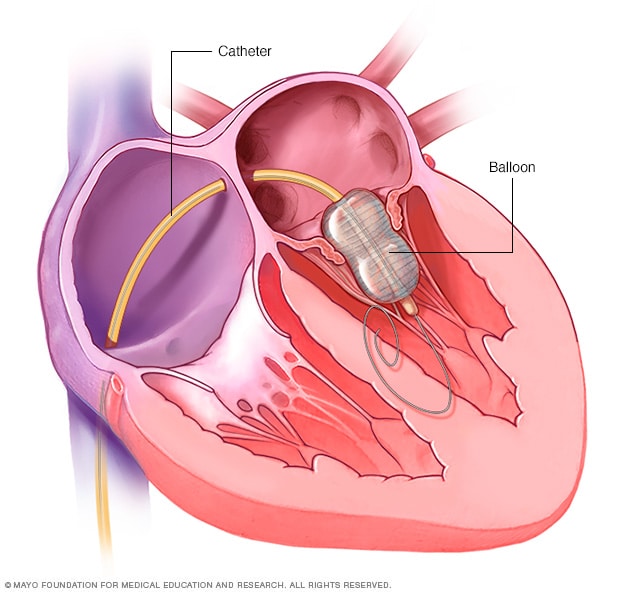
Balloon valvuloplasty
In balloon valvuloplasty, a catheter is inserted in the heart and guided to the narrowed valve. The balloon is then inflated, which expands the opening of the valve.
A doctor does valvuloplasty in the hospital, usually while you're awake. A healthcare professional may give you a medicine called a sedative to help you relax. Another medicine called a local anesthetic prevents pain where the doctor inserts a thin, flexible tube called a catheter into the body.
Valvuloplasty is done during a treatment called cardiac catheterization. A doctor inserts the catheter into a blood vessel, usually in the groin. Then the doctor carefully guides it to the narrowed valve in the heart. Once the catheter is in position, the doctor inflates a balloon on the tip of the catheter to widen the valve opening. This improves blood flow. Then the balloon is deflated and the catheter is removed.
After
Afterward, you usually stay in the hospital overnight. Once you go home, call a member of your healthcare team if you start to get irregular heartbeats. Also call if the area where the catheter was inserted:
- Loses feeling or tingle
- Becomes more bruised.
- Looks swollen or leaks fluid.
Call 911 or your local emergency number if you have:
- Chest pain or shortness of breath.
- Bleeding from the catheter site that won't stop when you put firm pressure on it.
- Very fast swelling at the puncture site.
- Fever or dizziness.
After a valvuloplasty, you get regular health checkups and imaging tests of your heart. These help make sure that your heart valve is working properly.
Valvuloplasty may improve blood flow through the heart and reduce symptoms. But the valve may narrow again. You may need another valvuloplasty or heart valve treatment in the future.
Aug. 15, 2026