Overview
Cataract surgery is a procedure to remove the lens of an eye and replace it with an artificial lens. The natural lens typically is clear, but a cataract causes the lens to become cloudy. Cataracts eventually can affect vision.
Cataract surgery is performed by an eye doctor, also called an ophthalmologist. The procedure is performed on an outpatient basis. This means you don't have to stay in the hospital after the surgery. Cataract surgery is very common and generally is a safe procedure.
Products & Services
Why it's done
How a cataract affects your vision

How a cataract affects your vision
Clear vision, like on the left, becomes blurred as a cataract forms, like on the right.
Cataract surgery is done to treat cataracts. Cataracts are irregularities in a lens that can cause blurry vision. They also may cause poor vision in bright lights or at night. If a cataract makes it hard for you to carry out your usual activities, your healthcare team may suggest cataract surgery.
Cataract surgery also may be recommended if a cataract makes it hard to diagnose, monitor or treat other conditions of the inner eye. These conditions may include age-related macular degeneration or diabetic retinopathy.
In most cases, waiting to have cataract surgery won't harm your eye. That means you have time to consider your options. If your vision is still quite good, you may not need cataract surgery for many years.
When considering cataract surgery, keep these questions in mind:
- Can you see well enough to do your job and drive safely?
- Do you have difficulty reading or watching television?
- Is it difficult to cook, shop, do yard work, climb stairs or take medicine?
- Does your vision affect your level of independence?
- Do bright lights make it more difficult to see?
Risks
Complications are not common after cataract surgery. Most complications can be treated successfully.
Cataract surgery risks include:
- Swelling.
- Infection.
- Bleeding.
- Drooping eyelid.
- Artificial lens moving out of place.
- Retina moving out of place. This is called retinal detachment.
- Glaucoma.
- Secondary cataract.
- Loss of vision.
Your risk of complications is higher if you have another eye disease or a serious medical condition. Sometimes, cataract surgery doesn't improve vision because of underlying eye damage from other conditions. These may include glaucoma or macular degeneration. If possible, it is good to evaluate and treat other eye conditions before deciding to have cataract surgery.
How you prepare
Food and medicines
You may be told not to eat or drink anything for 12 hours before cataract surgery. Your eye doctor may tell you to stop taking any medicine that could increase your risk of bleeding during the procedure for a short time. Tell your eye doctor if you take medicine for a prostate condition. Some of these medicines can interfere with cataract surgery.
Medicated eye drops may be prescribed for use one or two days before the surgery to lower the risk of infection.
Other precautions
You typically can go home the same day as your surgery. You won't be able to drive, so arrange for a ride home. Also, arrange for help around your home, if necessary. Your eye doctor may limit activities such as bending and lifting for about a week after your surgery.
What you can expect
Before the procedure
Before cataract surgery, your eye doctor performs a painless ultrasound test to measure the size and shape of your eye. This helps determine the right type of artificial lens, called an intraocular lens.
You won't be able to see or feel the artificial lens. It requires no care and becomes a permanent part of your eye.
The artificial lens does some of the work of eyeglasses or contact lenses. Some of the types of artificial lenses available include:
- Fixed-focus monofocal. This type of lens focuses light to see clearly at one distance. Distance vision is usually the preferred correction, but near or reading vision can be chosen, depending on your preferences. If distance vision is corrected, you'll need reading glasses for near vision or reading.
- Multifocal or extended depth of focus. These types of lenses have different areas that can help to see various combinations of near, medium and distance. These lenses are like glasses with bifocal or progressive lenses.
- Astigmatism correction, also called toric. If you have significant astigmatism, a toric lens can help correct your vision.
Artificial lenses are made of plastic, acrylic or silicone. Some block ultraviolet light.
Some artificial lenses are rigid plastic and implanted through an incision that requires several stitches to close.
Many artificial lenses are flexible. This allows a smaller incision that requires few or no stitches. The doctor folds this type of lens and inserts it into the empty housing of the natural lens, called the lens capsule. Once inside the eye, the folded artificial lens unfolds, filling the empty capsule.
Before surgery, you and your eye doctor discuss the benefits and risks of the different types of artificial lenses to determine what's best for you. Cost also may be a factor because insurance companies may not pay for all types of lenses.
Rarely, artificial lenses can't be used. In these situations, the original lens is removed and is not replaced. Eyeglasses or contact lenses are needed to correct vision after surgery.
During the procedure
Cataract surgery
Cataract surgery
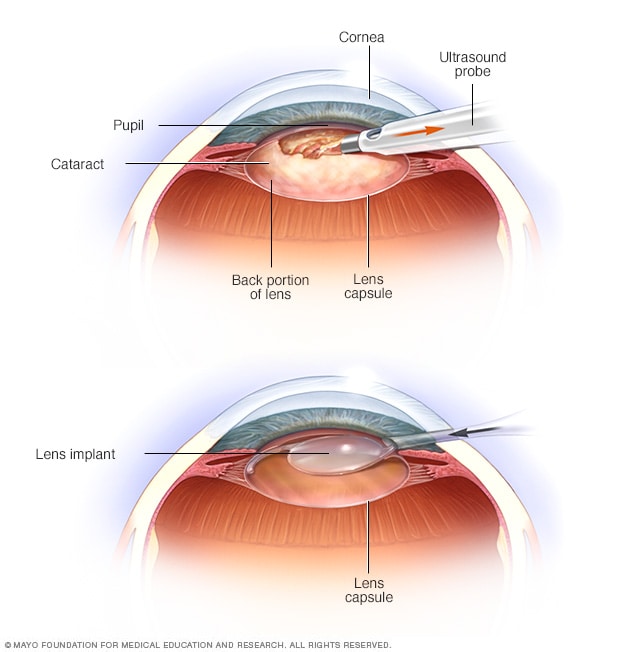
The most common type of cataract surgery is called phacoemulsification (fak-o-e-mul-sih-fih-KAY-shun). During this process, a probe is inserted into the eye and uses ultrasound energy to rapidly move the tip of the probe back and forth to break up the cataract. The doctor then suctions out the lens, as seen in the top image. The outer housing of the lens, called the lens capsule, is left in place. After removing the lens, the doctor places the artificial lens into the capsule where the natural lens used to be, as seen in the bottom image.
Cataract surgery, usually an outpatient procedure, takes an hour or less to perform.
First, eye drops are placed in your eye to make the pupil larger. You'll receive medicines to numb the area. You also may be given a medicine called a sedative to help you relax. If you're given a sedative, you may feel groggy.
During cataract surgery, the clouded lens is removed, and a clear artificial lens is implanted. If the surgeon determines before or during the procedure that an artificial lens cannot be placed, the lens capsule is left empty. Vision then is corrected with prescription glasses or contact lenses.
Surgical methods
Procedures to remove cataracts include:
-
Breaking up the lens before removal. The most common cataract surgery procedure is called phacoemulsification (fak-o-e-mul-sih-fih-KAY-shun). Your surgeon makes a tiny incision in the eye and inserts a needle-thin probe into the lens. The probe uses ultrasound energy to rapidly move back and forth, breaking up the cataract. The surgeon then uses the probe to suction out the fragments.
The surgeon places the artificial lens into the capsule that held the natural lens. Stitches may be used to close the tiny incision in your cornea once the procedure is done. Most often the cornea incision closes without any stitches.
-
Removing the lens in one piece. A procedure called extracapsular cataract extraction is used much less often. The doctor makes a relatively large incision to remove the entire lens in one piece. The lens capsule is left in place to hold the artificial lens.
This procedure may be performed if you have certain eye complications. With the larger incision, stitches are required.
After the procedure
After cataract surgery, expect your vision to start getting better within a few days. Your vision may be blurry at first as your eye heals and adjusts.
A cataract usually is tinted yellow or brown before surgery. This causes colors to look dull. After your surgery, colors may seem brighter because you are looking through a new, clear lens.
You'll usually see your eye doctor one day after your surgery and then again a month later to monitor healing. A visit one week after surgery may be scheduled depending on your doctor's preference.
Most people feel itching and mild discomfort for a couple of days after surgery. Avoid rubbing or pushing on your eye.
Your eye doctor may ask you to wear an eye patch or protective shield the day of surgery and for a few days after. Your doctor also may recommend wearing the protective shield when you sleep during the recovery period.
You may be prescribed eye drops or other medicines to prevent infection, reduce swelling and manage eye pressure.
After a couple of days, most of the discomfort likely will disappear. Often, complete healing happens within eight weeks.
Contact your doctor right away if you experience any of the following after cataract surgery:
- Vision loss.
- Pain that doesn't go away with pain medicines.
- Increased eye redness.
- Eyelid swelling.
- Light flashes or multiple new spots, called floaters, in front of your eye.
After cataract surgery, most people need glasses at least some of the time. Your doctor will let you know when your eyes have healed enough for you to get a final prescription for eyeglasses. This usually is between one and three months after surgery.
If you have cataracts in both eyes, your doctor usually schedules the second surgery after the first eye has healed.
Results
Cataract surgery restores vision in most people who have the procedure.
People who've had cataract surgery may develop a secondary cataract. The medical term for this common issue is posterior capsule opacification (PCO). This happens when the back of the lens capsule becomes cloudy and affects your vision.
PCO is treated with a painless outpatient procedure. This procedure is called yttrium-aluminum-garnet (YAG) laser capsulotomy. In YAG laser capsulotomy, a laser beam is used to make a small opening in the clouded capsule. This opening gives light a clear path to pass through.
After the procedure, eye pressure is checked to make sure your eye pressure doesn't rise. Other issues are rare but can include retinal detachment, where the retina moves out of place.
Clinical trials
Explore Mayo Clinic studies of tests and procedures to help prevent, detect, treat or manage conditions.