Nerve sheath tumors Symptoms and causes
Overview
Nerve sheath tumors are the most common type of peripheral nerve tumor. Peripheral nerve tumors are growths that develop in or around nerves that connect the brain and spinal cord to the rest of the body. Depending on the nerve involved, these tumors can affect movement, sensation or both.
Nerve sheath tumors form in the protective covering around nerves and can develop along any peripheral nerve in the body. They may occur in the arms or legs, along spinal nerve roots, or on the cranial nerves that control hearing, balance and facial movement.
Most nerve sheath tumors are benign and tend to grow slowly. But they can press on nearby nerves or tissues and lead to pain, numbness, tingling or loss of function. A small number of these tumors are malignant and can grow quickly or spread to other parts of the body.
Nerve sheath tumors may be found during imaging for another reason or after symptoms begin. Many can be monitored with imaging or removed with surgery. When surgery risks harming nearby nerves, you may have other treatments.
Because most nerve sheath tumors are benign, staging is not needed. Malignant tumors can grow faster, invade nearby tissues, or spread. These tumors may require staging and a broader treatment approach. Prognosis depends on the type of tumor, how fast it grows, and whether it can be removed safely.
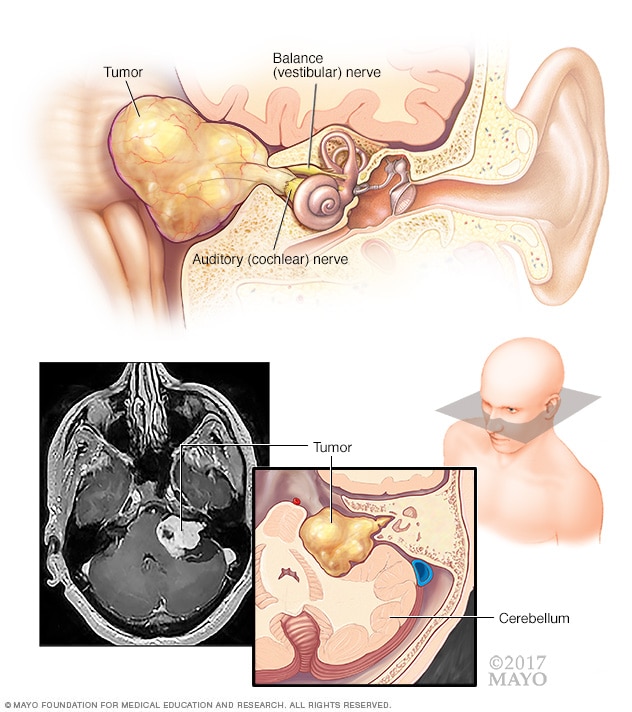
Vestibular schwannoma (acoustic neuroma)
Vestibular schwannoma, formerly called acoustic neuroma, is a benign tumor. It usually starts on the balance nerve, called the vestibular nerve. This nerve runs next to the hearing nerve, called the cochlear nerve. These nerves lead from the inner ear to the brain, as shown in the top image. Pressure from the tumor can cause hearing loss, ringing in the ear and balance problems. In some cases, the tumor may grow and affect the cerebellum or other nearby brain tissue, as shown in the MRI scan and illustrations above.
Types
Nerve sheath tumors are a type of peripheral nerve tumor. They include several benign tumor types and a smaller number of malignant tumor types.
- Schwannomas (benign)
-
Schwannomas are the most common nerve sheath tumors. They usually grow slowly and form a clear border that pushes nerve fibers aside rather than growing through them. Schwannomas can occur along spinal nerve roots or cranial nerves involved in hearing and balance.
- Vestibular schwannomas (benign)
-
A vestibular schwannoma, previously called an acoustic neuroma, is a schwannoma that forms on the vestibulocochlear nerve. This nerve controls hearing and balance. These tumors grow along the internal auditory canal at the skull base. They are therefore classified as a type of skull base tumor. As a vestibular schwannoma grows, it may affect hearing, balance or nearby cranial nerves. It is a type of nerve sheath tumor.
- Neurofibromas (benign)
-
Neurofibromas grow within the nerve and mingle with the nerve fibers.
- Plexiform neurofibromas (usually benign)
-
Plexiform neurofibromas involve multiple branches of a nerve. They can extend through nearby soft tissues. Depending on their size and location, they may change how the affected body part moves or feels. These tumors occur most often in people with neurofibromatosis type 1. Most plexiform neurofibromas are benign, but certain types can get larger over time and have a risk of becoming malignant.
- Hybrid nerve sheath tumors (usually benign)
- Hybrid tumors have features of more than one benign tumor type, most often schwannoma and neurofibroma. They tend to behave like benign tumors but can appear in people with genetic syndromes that cause multiple nerve tumors.
- Spinal nerve root tumors (benign)
- Spinal nerve root tumors are nerve sheath tumors that begin on or near the nerves exiting the spinal cord. Schwannomas and neurofibromas commonly arise from spinal nerve roots and may grow inside or outside the covering around the spinal cord. These tumors can cause back pain, limb symptoms or signs of pressure on the spinal cord. Nerve root involvement means the tumor is growing on or pressing against a spinal nerve root. This can affect movement or sensation in the areas served by that nerve.
- Cranial nerve tumors (benign)
- Cranial nerves can develop nerve sheath tumors, most often schwannomas. These tumors can form along several cranial nerves. These include the nerve for facial sensation, also called the trigeminal nerve, the nerve that controls swallowing and voice, also called the vagus nerve, and nerves for hearing and balance. Tumors in these locations may affect hearing, facial movement, swallowing or speech depending on their size and where they grow.
- Malignant peripheral nerve sheath tumors
-
Malignant peripheral nerve sheath tumors (MPNSTs) are rare cancerous tumors that can grow quickly or spread. They may arise on their own or develop from a plexiform neurofibroma. MPNSTs occur most often in people with neurofibromatosis type 1. They also tend to grow in areas previously treated with radiation. A nerve tumor is considered a sarcoma when it becomes malignant and grows into nearby tissue or spreads to other areas of the body.
Which nerves can develop sheath tumors?
Any peripheral nerve can develop a sheath tumor. These tumors may appear along:
- Major nerves in the chest or arms, including the brachial plexus.
- Major nerves in the legs, including the sciatic nerve.
- Spinal nerve roots.
- Cranial nerves such as the vestibulocochlear, trigeminal and vagus nerves.
Are brain tumors the same as nerve sheath tumors?
Brain tumors and nerve sheath tumors are not the same. Brain tumors form from cells within the brain. Nerve sheath tumors start on peripheral nerves or cranial nerves but not in brain tissue.
Symptoms
The symptoms of a nerve sheath tumor develop from direct effects on the main nerve or from the tumor pressing on nearby nerves, blood vessels or tissues. As the tumor grows, it may be more likely to cause symptoms, although tumor size doesn't always determine effects.
Because nerve sheath tumors can form anywhere along the nerves, symptoms vary by location and the structures involved. Some tumors cause no symptoms at all. A larger tumor may be more likely to cause symptoms, although size alone does not predict how someone will feel.
Skin or surface changes
You may notice skin or surface changes on or near the tumor site. These changes can reflect a slow-growing lump along a peripheral or spinal nerve. They may be sensitive when touched. You may have:
- A lump or swelling under the skin.
- A tender area that is sore when pressed.
- A feeling of fullness or pressure in the area.
Sensory changes
These symptoms affect how an area feels. They may occur when a tumor irritates or compresses sensory fibers, a sensory nerve or a nerve root. This leads to changed or increased sensation. Symptoms include:
- Tingling or numbness.
- Burning or shocklike sensations.
- Heightened sensitivity to touch.
Changes in strength or movement
These symptoms relate to how muscles work. They may appear when a nerve sheath tumor affects a motor branch or compresses the spinal cord or nerve root. This can limit signals that support movement. You may feel:
- Weakness in the affected area.
- Reduced ability to move the area.
- Muscle cramping or shrinking over time.
Symptoms linked to specific nerve locations
Some symptoms appear when tumors affect cranial or spinal nerves. These symptoms may reflect pressure on hearing or balance pathways, facial nerve involvement, or irritation of spinal roots that send signals into the arms or legs. You may feel:
- Dizziness or changes in balance.
- Hearing changes, such as ringing or reduced hearing.
- Changes in facial movement.
- Back or neck discomfort or pain that travels into an arm or a leg.
When to see a doctor
See your healthcare professional if you have any of the symptoms listed, especially if you have a lump that grows quickly.
Causes
It's not clear why most nerve sheath tumors develop. These tumors develop from the cells that surround and support peripheral nerves, spinal nerve roots or cranial nerves.
Inherited conditions
Some nerve sheath tumors are linked to inherited conditions that affect how nerve cells grow. Inherited means a gene change is present at birth and can be passed down in families. Neurofibromatosis type 1 (NF1) increases the risk of having neurofibromas, plexiform neurofibromas and malignant peripheral nerve sheath tumors.
Neurofibromatosis type 2 and schwannomatosis are linked to having multiple schwannomas along spinal nerve roots or cranial nerves. These conditions are caused by changes in genes such as NF1, NF2, SMARCB1 and LZTR1. These genes help guide cell growth.
Genetic changes that are not inherited
For many people, the cause of a nerve sheath tumor is not known. Most tumors appear after genetic changes develop within the cells of the nerve sheath. These changes can affect how the cells control their growth. These changes often happen randomly and are not inherited.
How nerve sheath tumors begin
Nerve sheath tumors form when Schwann cells or other cells around the nerve grow in a way that is not controlled. These cells usually help protect and insulate nerves, but genetic changes can cause them to form a lump of extra cells that grow in one area rather than spreading throughout the nerve.
How some tumors can turn into cancer
Malignant peripheral nerve sheath tumors often develop from long-standing plexiform neurofibromas, especially in people with neurofibromatosis type 1. These malignant tumors are linked to other genetic changes that allow cells to grow quickly or invade nearby tissues. Only a small number of benign nerve sheath tumors become cancerous.
Less common causes
Prior radiation exposure is a less common cause. Radiation therapy can lead to genetic changes in nerve sheath cells years after treatment. It also may increase the risk of developing a benign nerve sheath tumor or malignant peripheral nerve sheath tumor.
What does not cause nerve sheath tumors
Most nerve sheath tumors are not caused by injury. An injury may draw attention to a tumor that is already present, but injuries do not cause tumors to form.
Risk factors
Nerve sheath tumors most often develop from the cells that support and surround nerves. Factors that affect how these cells grow, repair damage or form supportive tissue can increase the chance of developing a tumor.
Some people develop nerve sheath tumors with no known risk factors. These tumors can develop in anyone, but certain conditions or exposures can make them more likely. These factors influence how nerve cells grow, repair damage or form supportive tissue around nerves.
Having a risk factor does not predict how many tumors will form or how they will behave. The lack of risk factors does not eliminate the possibility of having a tumor.
Genetic conditions
Some conditions change how nerve cells develop and significantly increase the chance of having one or more nerve sheath tumors. These include:
- Neurofibromatosis type 1 (NF1).
- NF2-related schwannomatosis.
- Other forms of schwannomatosis.
These conditions are inherited, meaning that they can run in families. As a result, tumors can form along nerves throughout the body, and some people have many tumors over time. Most of these tumors are benign, but their number and location can influence symptoms.
History of radiation exposure
Exposure to radiation, especially earlier in life, can increase the chance of having a nerve sheath tumor years later. This is most often linked to previous radiation used to treat another condition. Even so, radiation-related nerve sheath tumors are uncommon.
Complications
Some complications of nerve sheath tumors may be lasting if a nerve is compressed or affected for a long time.
Nerve sheath tumors can interfere with how nerves work by putting pressure on the nerves from which they grow, on nearby nerves or on the spinal cord. If this pressure continues, some changes may not fully improve even after treatment. The type of complication depends on where the tumor forms and how long the nerve has been affected.
Long-term weakness or loss of movement
Persistent pressure on a nerve can limit its ability to send signals to the muscles it serves. Over time this may lead to lasting weakness or reduced function of the affected area.
Lasting changes in feeling
If a nerve has been pressed on for a long time, feeling in that area or function of the nerve may not completely return.
Changes in how the area works
Depending on the nerve involved, a tumor can make it hard to do tasks such as grasping objects, lifting the foot while walking or coordinating hand movements. Some of these changes can continue even after the tumor is taken out.
Chronic pain
Long-term pain can occur if the nerve has been squeezed, stretched or injured, either from the tumor itself or from treatment.
Changes in balance or coordination
Tumors involving spinal nerve roots or cranial nerves may disrupt pathways that support balance or coordination. Sometimes these changes can become long lasting.
Changes in hearing or facial movement
Tumors on cranial nerves, such as vestibular schwannomas, can lead to lasting hearing loss or weakness of facial muscles if the nerve has been affected for a long time.
Pressure on the spinal cord
Larger tumors in the spine can narrow the space around the spinal cord. If severe, this narrowing can lead to long-term weakness, changes in walking, or loss of bladder or bowel function.
Complications related to malignant tumors
Malignant peripheral nerve sheath tumors are more likely to invade nearby tissues or spread. They can be harder to remove completely and may cause lasting changes in how the affected area moves or feels.
Complications from treatment
Even with careful planning, surgery or radiation may affect how well the nerve works afterward. Some people may have lasting weakness, less sensation or changes in how the nerve works after treatment.
Prevention
There is no known way to prevent most nerve sheath tumors. Many develop without a clear cause. You can't avoid or change the factors that increase risk — such as inherited conditions or prior radiation exposure.
What cannot be prevented
Most nerve sheath tumors occur randomly and are not linked to anything you do or do not do. Conditions such as NF1, NF2-related schwannomatosis and other forms of schwannomatosis are present from birth and cannot be prevented.
What may reduce preventable risk
Although prevention is limited, a few steps can help lower avoidable exposures or support earlier recognition of concerning changes.
- Avoid unnecessary exposure to radiation when alternative options are available.
- Use protective measures during medically necessary radiation, especially in childhood.
- Share any personal or family history of NF1, NF2, or schwannomatosis with members of your care team so they are aware of your risk.
- Have regular care if you have a genetic condition linked to tumor development so your care team can find new growths early.
Understanding limits of prevention
Prevention focuses mainly on reducing avoidable exposures and recognizing tumors early so they can be managed before causing significant symptoms.
CON-20592860
Mayo Clinic does not endorse companies or products. Advertising revenue supports our not-for-profit mission.
Advertising & Sponsorship
Mayo Clinic Press
Check out these best-sellers and special offers on books and newsletters from Mayo Clinic Press.
