Overview
Golfer's elbow, also known as medial epicondylitis, is a condition that causes pain on the inner elbow. It causes pain where the tendons from the forearm muscles attach to the bone. The pain also may spread down the forearm and into the wrist. Golfer's elbow is similar to tennis elbow, which affects the outside of the elbow. But golfer's elbow happens on the inside of the elbow, closer to the body.
Despite the name, golfer's elbow doesn’t happen only to golfers. Anyone who uses their wrists or grips things over and over can develop it. This includes tennis players, pickleball players and people whose jobs require certain repetitive movements.
The good news is that golfer's elbow typically gets better with rest, simple treatments and changes to how you use your wrist and arm. Most people return to their usual activities with the right care.
Mayo Clinic Health Letter & Books
Join thousands of readers who trust Mayo Clinic Health Letter for reliable health tips and insights. Start your journey to better health today.
Products & Services
Symptoms
Golfer's elbow
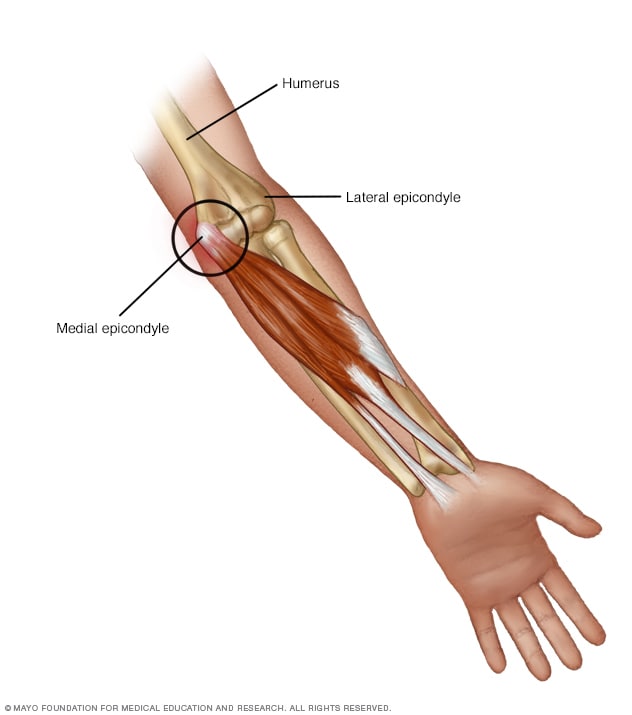
Golfer's elbow
The pain of golfer's elbow occurs primarily where the tendons of the forearm muscles attach to the bony bump on the inside of the elbow (medial epicondyle). By contrast, the pain of tennis elbow usually occurs at the bony bump on the outside of the elbow (lateral epicondyle).
Golfer's elbow typically causes:
- Pain and tenderness on the inside of the elbow. The pain can spread down the forearm. It often gets worse with certain movements, such as gripping or lifting, especially when you use your wrist.
- Stiffness in the elbow. It may hurt to make a fist.
- Weakness in the hands or wrists.
- Numbness or tingling, which may travel into the fingers. This is more common in the ring and little fingers.
The pain can start suddenly or build up over time. It may feel worse when doing activities such as swinging a golf club, pitching a ball or playing a racquet sport. Shaking someone's hand, turning a doorknob, picking up something with your palm down, and flexing your wrist also may hurt.
When to see a doctor
See your healthcare professional if your pain doesn't improve with rest, ice and pain medicines you can buy without a prescription.
Get medical help right away if:
- Your elbow is swollen and warm to the touch and you have a fever.
- You can't bend your elbow.
- Your elbow looks odd or out of place.
- You think you may have broken a bone.
Causes
Golfer's elbow happens when the muscles and tendons that control the wrist and fingers get overused or injured. This typically comes from repeating the same motion too often, especially forceful wrist bending and finger bending movements.
Golfer's elbow can be caused by:
- Lifting, throwing or hitting the wrong way.
- Not warming up properly before activity.
- Having weak or poorly conditioned muscles.
You don't have to play golf to get golfer's elbow. Many sports and jobs can lead to this condition, including:
- Racket sports such as tennis and pickleball. Using poor technique, too much topspin, or a racket that's too small or heavy can strain your tendons.
- Throwing sports such as baseball, softball, football, archery or javelin. Improper pitching technique in baseball or softball is a common cause.
- Weight training. Lifting weights using improper technique, such as curling the wrists during the completion of a biceps curl, can overload the elbow muscles and tendons.
- Jobs with repeated arm movements. These include jobs in fields such as construction, plumbing and carpentry.
To cause golfer's elbow, the provoking activity generally needs to be done for a long period on many days.
Risk factors
You're more likely to get golfer's elbow if you:
- Are 40 or older.
- Do repetitive movements for two or more hours a day.
- Are overweight.
- Have diabetes.
- Smoke cigarettes, which may affect tendon health and healing.
Prevention
You can help prevent golfer's elbow by taking these steps:
- Strengthen your forearm muscles, especially those that flex the wrist. Use light weights or squeeze a tennis ball regularly to build strength and protect your tendons from sudden strain.
- Warm up and stretch. Walk or jog for a few minutes, then gently stretch your wrists before playing sports or working.
- Use good technique. Ask a coach or trainer to check your form during sports or workouts to avoid putting too much stress on your elbow. Try to keep your wrist stiff and rigid throughout your sports movement.
- Use the right equipment. If your golf clubs are old and heavy, try switching to lighter ones. If you play tennis or pickleball, make sure your racket grip fits your hand and isn't too heavy.
- Lift safely. Keep your wrist straight and firm when lifting anything — especially weights — to avoid straining the tendons attached to your elbow.
- Rest when needed. If your elbow starts to hurt, stop what you are doing and give it time to heal. Pushing through pain can make golfer's elbow worse.