التشخيص
To diagnose bundle branch block, a healthcare professional examines you and listens to your heart using a tool called a stethoscope. Your healthcare professional may ask you about your lifestyle habits and personal and family health history.
If your healthcare professional thinks you might have left bundle branch block (LBBB), you have tests to check the heart and heartbeat. Tests also can look for conditions that may cause LBBB.
Electrocardiogram
تخطيط كهربية القلب
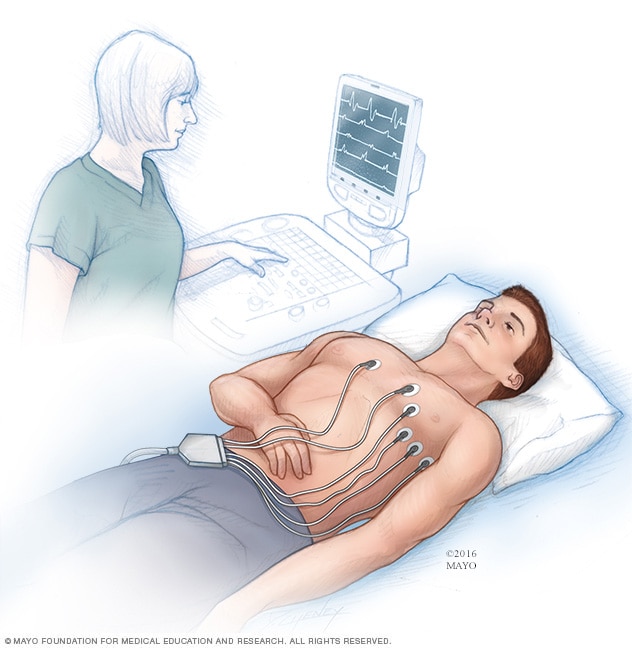
تخطيط كهربية القلب
تخطيط كهربية القلب اختبار يهدف إلى قياس الإشارات الكهربائية في القلب. ويُجرَى هذا الفحص للكشف عن كفاءة نبض القلب. وفيه تُثبَّت لصيقات جلدية (أقطاب كهربائية) على الصدر، وأحيانًا على الذراعين والساقين. وتتصل اللصيقات عبر أسلاك بجهاز كمبيوتر يطبع النتائج أو يعرضها.
An electrocardiogram (ECG or EKG) is the main test used to diagnose left bundle branch block. The test records the heart's electrical activity. It shows how your heart is beating. During an ECG, sticky patches with sensors on them go on the chest and sometimes the arms or legs. Wires connect the sensors to a computer, which prints or shows results. Your healthcare professional looks for patterns in the ECG results related to bundle branch block.
The ECG results show the heartbeat as lines. This is called a tracing. In left bundle branch block, the lines for the heartbeats in the lower chambers look wide. These wide lines are called wide QRS complexes or a widened QRS complex. Also in left bundle branch block, the ECG results have a specific wave pattern that shows that the left lower heart chamber is getting heartbeat signals later than usual.
If your ECG test result says sinus rhythm, it means the heartbeat starts in the usual area. You can have sinus rhythm and left bundle branch block at the same time.
The specific ECG findings used to diagnose LBBB can vary. Some healthcare professionals use strict rules to look for a pattern due to a true complete block in the left bundle branch. These strict rules are called the Strauss criteria. Your healthcare professional can look at the patterns in your ECG results to learn the type of left bundle branch block.
- Complete block. The ECG shows all the signs of complete LBBB. These signs include changes in the QRS complex.
- Incomplete block. The test shows signs of left bundle branch block but doesn't meet all the criteria for a complete block.
- Intermittent or episodic block. The pattern related to left bundle branch block can be seen only sometimes.
- Rate-dependent block. The LBBB pattern happens only at certain heart rates. It may not be seen when the heart rate changes.
If your healthcare professional says you have new-onset LBBB, it means the heart block was not seen on an earlier ECG.
Sometimes, symptoms may suggest a sudden drop in blood flow to the heart, called acute coronary syndrome (ACS). ACS can include a heart attack. If you have left bundle branch block, the changes it causes on the ECG can make some signs of a heart attack harder to spot. But LBBB itself does not mean that a heart attack is happening.
If left bundle branch block makes a heart attack harder to see on an ECG, healthcare professionals may look for special ECG patterns called the Sgarbossa criteria. These patterns can help show whether a heart attack is happening.
Your healthcare team considers all your symptoms along with ECG and blood test results to make a diagnosis. The diagnosis doesn't rely only on whether the left bundle branch block is new or has been there for a while.
Tests to look for causes
If an ECG shows you have left bundle branch block (LBBB), your healthcare professional usually does other tests to see how your heart is working. Tests also can help show changes to the structure of the heart.
An echocardiogram shows how blood moves through the heart and its valves. It also shows the shape and structure of the heart. The test can help find causes of left bundle branch block, including cardiomyopathy or heart valve disease.
Other tests depend on your symptoms and medical history. These may include imaging tests that look at blood flow or the arteries that supply blood to the heart. Some people may need a procedure called cardiac catheterization.
العلاج
Treatment for left bundle branch block (LBBB) depends on:
- Your symptoms.
- The cause of LBBB.
- How well your heart pumps.
- Whether you have another heart condition.
If another heart condition leads to LBBB, your healthcare professional usually monitors or treats that condition.
Heart procedures and devices
Some people with left bundle branch block need a procedure or device to help the heart pump better or beat as it should.
- Pacemaker. If you have left bundle branch block with another condition that causes a slow heartbeat called bradycardia, your healthcare professional might suggest a pacemaker. A healthcare professional places the device under the skin of the upper chest during a minor surgery. A pacemaker works only when needed. When the heart beats too slowly, the pacemaker sends electrical signals to the heart to speed up the beat. Not everyone with left bundle branch block needs a pacemaker.
- Cardiac resynchronization therapy (CRT). If you have left bundle branch block and your heart doesn't pump well, you may need this treatment. CRT uses a device called a biventricular pacemaker. It helps the heart chambers squeeze in a better and more organized way. This helps the heart pump blood better. Not everyone with LBBB needs CRT. Talk with your healthcare professional about whether it is right for you. Your healthcare professional considers your symptoms and results from an electrocardiogram and other tests when deciding whether you need CRT.
- Conduction system pacing. This treatment may be recommended for some people with LBBB and heart failure if CRT isn't an option or doesn't work well enough. A pacemaker is needed for this treatment. A healthcare professional places a pacemaker wire near an area of the heart where electrical signals travel. The device then sends small electrical signals through the wire to help the heart use its own heartbeat signal pathways. Two types of this treatment are His bundle pacing and left bundle branch area pacing. Pacing can help the lower heart chambers beat together better.
Prognosis
Prognosis means what may happen over time. It also may be called your outlook. Left bundle branch block (LBBB) can happen for many different reasons. Because of this, there is no single health outlook or life expectancy that applies to everyone with LBBB.
Your long-term outlook depends on factors such as:
- Whether structural heart disease is present.
- How well the lower left heart chamber pumps.
- Whether you have heart failure.
- Whether you have other heart conditions.
Studies show that people who have LBBB along with heart disease may have a higher risk of serious illness or death. But LBBB by itself doesn't tell exactly how long a person will live.
LBBB does not always go away. In some people, it may be long lasting, also called persistent LBBB. Intermittent or rate-dependent LBBB may come and go. If LBBB leads to cardiomyopathy, treatments such as cardiac resynchronization or pacing may help the heart work better. Treatment also may reverse some of the changes in the lower left heart chamber.
Self-care
You can take an active part in your care. Follow the left bundle branch block treatment plan from your care team. Also try these steps:
- Ask about medicines. Some medicines can affect the heart's electrical signals and have been linked to left bundle branch block. Talk with your healthcare professional before starting or changing any medicines. These include medicines you buy without a prescription.
- Ask about alcohol and caffeine. These substances may cause changes in the heartbeat. Ask your healthcare team how much alcohol or caffeine, if any, is safe for you.
- Keep your follow-up visits. Your healthcare professional may do tests to check how well your heart is pumping or how any heart devices are working.
الاستعداد لموعدك
If you have symptoms of left bundle branch block (LBBB) or are worried about your risk of the condition, make an appointment with your healthcare professional. If you have LBBB, you may be sent to a doctor trained in heart disease, called a cardiologist. Some people also may see a heart rhythm specialist, called an electrophysiologist.
Appointments can be brief. Because there's often a lot to talk about, it's a good idea to be prepared for your appointment. Here's some information to help you get ready.
What you can do
When you make your appointment, ask if you need to do anything in advance. For example, you may be told not to eat or drink for a while before some tests.
Make a list of:
- Your symptoms. Include any that do not seem related to the heart or bundle branch block. Note when the symptoms started and how often they happen.
- Important personal information, including major stresses or recent life changes. Note any family history of heart disease.
- All medicines, vitamins and supplements you take. Include those you buy without a prescription. Also include the doses.
- Results from any heart tests you've had if your care team does not already have them. Make sure you include electrocardiogram (ECG or EKG) results.
- Questions you want to ask your healthcare professional.
Take someone with you to the appointment, if possible. Someone who goes with you can help you remember the information that you get.
If you recently learned that you have left bundle branch block (LBBB), preparing a few questions can help you understand what the diagnosis means for you. Questions you may want to ask include:
- What type of LBBB do I have?
- How serious is my condition?
- What is the most likely cause?
- Do I have another heart condition?
- How well is my lower left heart chamber pumping blood?
- What tests do I need?
- What treatments are available, and which do you recommend?
- What are the side effects of treatment?
- How often do I need health checkups or tests?
- Will bundle branch block happen again after treatment?
- Could I ever need a heart device such as a pacemaker?
- Do I need to make any changes to my activities, diet or medicines?
- I have other health conditions. How can I best manage them together?
- Do you have any printed information that I can take home with me? What websites do you recommend?
What to expect from your doctor
Your healthcare team is likely to ask you many questions, including:
- Do you have chest pain, shortness of breath, fainting or trouble exercising?
- Does anything make your symptoms better?
- What, if anything, makes your symptoms worse?
- Has a healthcare professional ever told you that you have bundle branch block or any type of heart disease?
- Have you been diagnosed with high blood pressure, coronary artery disease, cardiomyopathy, heart failure or heart valve disease?
- Have you had heart surgery, heart valve repair or heart valve replacement?