Overview
Chambers and valves of the heart
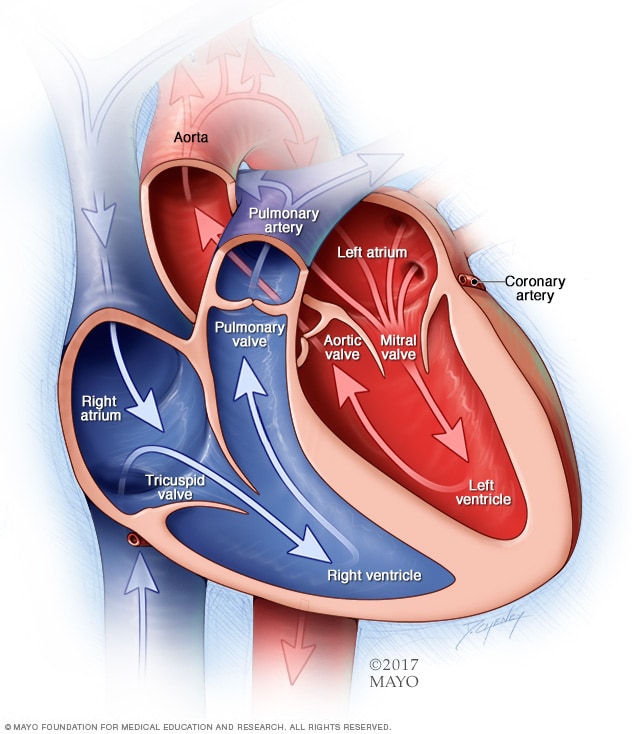
Chambers and valves of the heart
A typical heart has two upper and two lower chambers. The upper chambers, the right and left atria, receive incoming blood. The lower chambers, the more muscular right and left ventricles, pump blood out of the heart. The heart valves, which keep blood flowing in the right direction, are gates at the chamber openings.
Tricuspid valve repair and tricuspid valve replacement are surgeries to treat a damaged or diseased tricuspid valve. The tricuspid valve is one of four valves that control blood flow through the heart. It separates the upper and lower right chambers of the heart.
A damaged or diseased tricuspid valve can change the way blood flows through the heart. The heart must work harder to send blood to the lungs and the rest of the body.
Tricuspid valve repair and tricuspid valve replacement can help improve blood flow and ease symptoms of heart valve disease. Tricuspid valve repair or replacement may be done as open-heart surgery or as minimally invasive heart surgery. Sometimes, a surgeon may use flexible tubes called catheters and a balloon or clip to fix a leaky tricuspid valve.
Products & Services
Types
Why it's done
Tricuspid valve repair and tricuspid valve replacement are done to fix a damaged or diseased tricuspid valve.
Some people with tricuspid valve disease need more than medicine. They may need surgery to ease their symptoms and lower the risk of complications, such as heart failure.
Some reasons why a surgeon might suggest tricuspid valve repair or tricuspid valve replacement are:
- Tricuspid valve regurgitation. The valve doesn't close all the way. Blood leaks backward into the upper right chamber of the heart. Many health conditions can cause tricuspid valve regurgitation. One example is a heart condition present at birth called Ebstein anomaly.
- Tricuspid valve stenosis. The tricuspid valve is narrowed or blocked. It's harder for blood to move from the upper right heart chamber to the lower right heart chamber. Tricuspid valve stenosis may happen with tricuspid regurgitation.
- Tricuspid atresia. This is a heart condition present at birth, also called a congenital heart defect. The tricuspid valve isn't formed. Instead, there's solid tissue between the heart chambers, which limits blood flow. So, the lower right heart chamber isn't fully developed.
If tricuspid valve disease isn't causing symptoms, surgery may not be needed.
If it's needed, the type of tricuspid valve surgery that's done depends on:
- How severe the tricuspid valve disease is, also called the stage.
- The symptoms.
- Age and overall health.
- Whether the condition is getting worse.
- Whether surgery is needed to fix another valve or heart condition.
Surgeons recommend tricuspid valve repair when possible. It saves the heart valve and helps save heart function. Having the valve fixed instead of replaced may lessen the need for long-term blood thinners.
Tricuspid valve surgery may be done at the same time as other heart valve surgeries.
Leaky tricuspid valve animation
In tricuspid valve regurgitation, a leaky valve can lead to poor heart function.
The tricuspid valves job is to allow blood flowing into the heart from the body to flow to the right ventricle where it's pumped to the lungs for oxygen. If the tricuspid valve is leaky, blood can flow backwards, causing the heart to pump harder. Over time, the heart becomes enlarged and functions poorly.
Risks
All surgery involves some risk. Risks of tricuspid valve repair and tricuspid valve replacement depend on:
- The type of valve surgery.
- Your overall health.
- The expertise of the surgeons.
If you need tricuspid valve repair or replacement, think about getting care at a medical center with a team of heart surgeons and other healthcare professionals. The team should be trained and experienced in heart valve surgery.
Possible risks of tricuspid valve repair and tricuspid valve replacement surgery may include:
- Bleeding.
- Blood clots.
- Failure of an earlier repair.
- Failure of a replacement valve.
- Irregular heartbeats, called arrhythmias.
- Infection.
- Stroke.
- Death.
How you prepare
Before tricuspid valve repair or replacement, you usually have tests to learn more about your heart and heart valves. For example, you may have an echocardiogram. It can show blood flow through the heart and heart valves.
Ask your healthcare professional any questions you may have about tricuspid heart valve surgery. Your care team tells you what to expect during and after surgery and talks about any possible risks.
Before the day of tricuspid valve surgery, talk with your loved ones or any caregivers about your upcoming hospital stay. Ask for any help you may need when you return home.
Food and medications
Talk to your healthcare team about:
- When or if you can take your regular medicines before surgery.
- When or if you should stop eating or drinking the night before surgery.
Bring a list of your medicines with you to the hospital or surgery center.
Clothing and personal items
Your healthcare team may suggest that you bring some items to the hospital, including:
- A copy of your advance directive. This legal document includes instructions about the kinds of treatments you want or don't want in case you can't tell someone.
- Items that help you relax, such as portable music players or books.
- Eyeglasses, hearing aids or dentures.
- Loose-fitting, comfortable clothing.
- Personal care items such as a brush, comb, shaving equipment and toothbrush.
During surgery, do not wear:
- Contact lenses.
- Dentures.
- Eyeglasses.
- Jewelry.
- Nail polish.
What you can expect
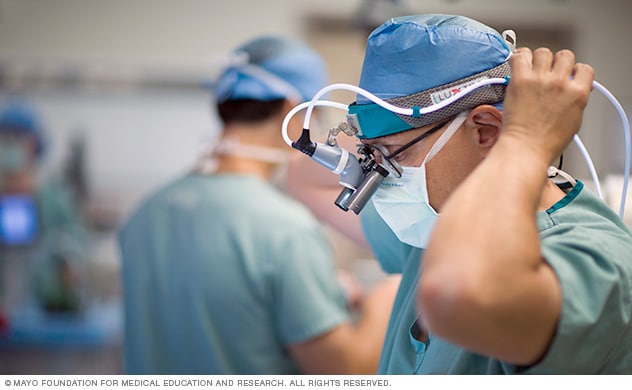 Tricuspid valve repair and replacement surgery at Mayo Clinic
Mayo Clinic surgeons are pioneers in the field of tricuspid valve repair and tricuspid valve replacement surgery.
Before
A member of your healthcare team may shave hair from the body area where the doctor will make surgical cuts. A special soap often is used to wash your skin and kill germs. This helps prevent infection.
During
Tricuspid valve repair or replacement may be done as open-heart surgery or as minimally invasive heart surgery. Open-heart surgery uses a surgical cut, called an incision, through the middle of the chest to reach the heart. Minimally invasive heart surgery uses much smaller incisions than those used in open-heart surgery. Sometimes, tricuspid valve disease may be treated with thin, soft tubes called catheters and a balloon or clip.
For most tricuspid valve repair and tricuspid valve replacement surgeries, you get medicines to put you in a sleeplike state. This is called general anesthesia. You are connected to a heart-lung bypass machine. The machine keeps blood moving through your body during the surgery.
Tricuspid valve repair
Heart doctors recommend heart valve repair when possible. It saves the heart valve and keeps you from needing a replacement heart valve. It also can help save heart function.
Tricuspid valve repair usually is done with open-heart surgery. Sometimes, a tricuspid valve can be repaired with minimally invasive surgery. Minimally invasive tricuspid valve repair typically involves smaller surgical cuts and a shorter hospital stay than open-heart surgery.
During tricuspid valve repair, a surgeon might:
- Patch holes or tears in the valve flaps, called leaflets.
- Reconnect valve flaps.
- Reshape or remove extra valve tissue so that the flaps can close tightly.
- Replace cords that support the valve for better support.
- Separate valve flaps that have joined together.
- Tighten or strengthen the ring around the valve, called the annulus.
If Ebstein anomaly causes tricuspid regurgitation, a heart surgeon may do a type of valve repair called a cone reconstruction. The heart surgeon separates the tricuspid valve flaps from the heart muscle. The surgeon then rotates the valve flaps and attaches them again.
Cone procedure for tricuspid valve repair
In the cone procedure, a surgeon separates the tricuspid valve flaps, called leaflets, and reshapes them so that they work properly.
During the cone procedure, the surgeon isolates the deformed leaflets of the tricuspid valve. The surgeon then reshapes them so they function properly.
Balloon valvuloplasty
Balloon valvuloplasty is a minimally invasive way to treat infants and children with tricuspid valve stenosis. It also is called balloon valvotomy.
During balloon valvuloplasty, a surgeon places a thin, soft tube called a catheter into a blood vessel, usually in the groin. The surgeon guides the catheter to the heart. A balloon on the tip of the catheter fills with air. This makes the narrowed tricuspid valve wider. The surgeon then lets the air out of the balloon and removes it.
Transcatheter tricuspid valve repair (T-TEER) with a clip
If you have severe tricuspid regurgitation and standard surgery isn't an option, your healthcare professional may suggest tricuspid transcatheter edge-to-edge repair (T-TEER). This newer treatment uses tubes called catheters and a clip to fix a leaky tricuspid valve. The clip brings the valve flaps closer together so less blood goes backward. Open-heart surgery is not needed for T-TEER. People with tricuspid regurgitation who have this treatment often have fewer symptoms and a better quality of life.
Talk with your healthcare team about the right treatment for you.
Tricuspid valve replacement
Incisions in minimally invasive heart surgery and open-heart surgery
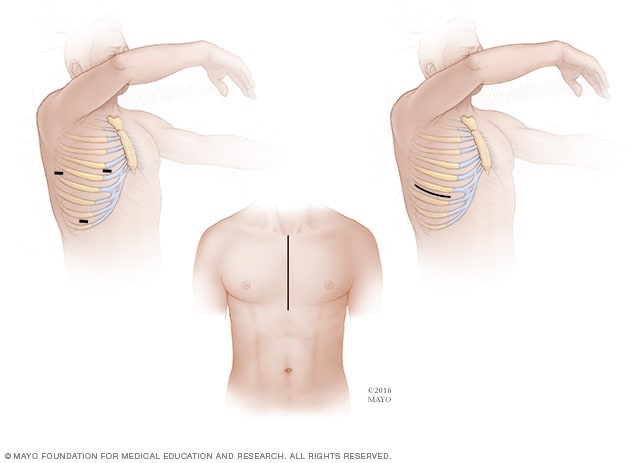
Incisions in minimally invasive heart surgery and open-heart surgery
In minimally invasive heart surgery, surgeons reach the heart through small cuts, called incisions, in the chest, as shown in the top two images. In open-heart surgery, surgeons make a larger incision in the chest, as shown in the bottom image.
Biological tricuspid valve replacement
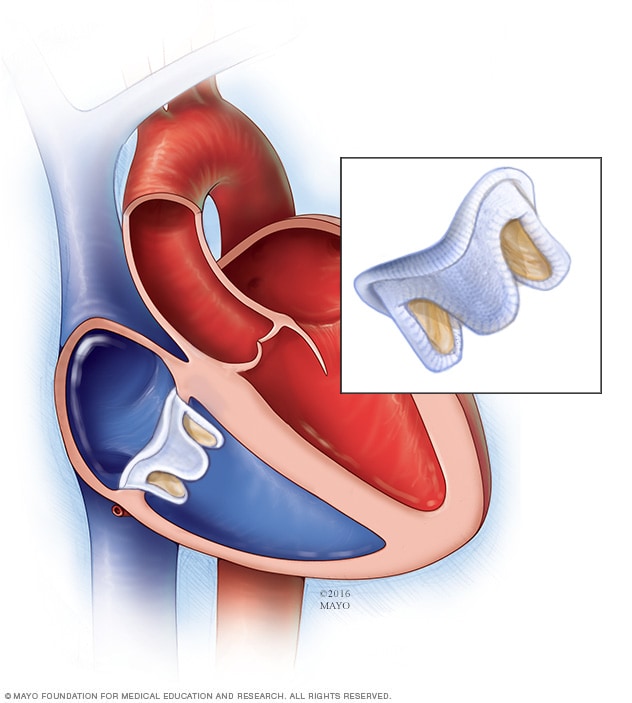
Biological tricuspid valve replacement
In a biological tricuspid valve replacement, a damaged or diseased tricuspid valve is replaced with one made from cow, pig or human heart tissue.
If the tricuspid valve can't be repaired, a surgeon may replace the valve. Tricuspid valve replacement surgery may be done as open-heart surgery or minimally invasive surgery.
During tricuspid valve replacement, a surgeon removes the damaged or diseased valve. The valve is replaced with a mechanical valve or a valve made from cow, pig or human heart tissue. A tissue valve is called a biological valve.
Together, you and your healthcare team talk about the risks and benefits of each type of valve to choose the one that's best for you.
If you have a mechanical valve, you need to take blood thinners for the rest of your life. These medicines prevent blood clots. You don't need to take blood thinners for life if you have a biological tissue valve. But biological valves can wear down over time and may need to be replaced.
Valve-in-valve replacement
If you have a biological tissue tricuspid valve that no longer works, valve replacement may be done using a tube called a catheter instead of open-heart surgery. The doctor places the catheter into a blood vessel and guides it to the tricuspid valve. The replacement valve goes through the catheter and is placed into the existing biological valve.
After
After tricuspid valve repair or replacement surgery, you typically stay in the hospital for a few days. How long you stay depends on your condition and specific type of tricuspid valve surgery.
During the hospital stay, you may have:
- An IV to get fluids and medicines.
- Tubes to drain urine from your bladder.
- Tubes to drain fluid and blood from your heart and chest.
Your healthcare team:
- Checks for infection at your surgical cuts.
- Regularly checks your blood pressure, breathing and heart rate.
- Helps you manage pain after surgery.
- Asks you to take longer and longer walks so you get more activity.
- Shows you how to do breathing exercises as you get better.
Your healthcare team gives you instructions to follow after tricuspid valve repair or replacement surgery. These instructions usually have details about the following:
- The medicines you are taking.
- The symptoms of infection.
- How to care for your surgical cuts.
- How to manage pain.
- The side effects of surgery.
Results
How long it takes to recover from tricuspid valve repair or replacement surgery depends on the specific treatment, any complications and your overall health before the surgery.
Your healthcare professional tells you when you can return to daily activities, such as working, driving and exercise.
After tricuspid valve repair or replacement surgery, you need regular health checkups. You may have tests to check your heart to make sure the tricuspid valve is working properly.
After tricuspid valve surgery, it's important to follow a heart-healthy lifestyle. Try these tips:
- Do not smoke or use tobacco. Talk with your healthcare team if you need help quitting.
- Eat healthy foods.
- Stay active and get regular exercise.
- Keep a healthy weight.
- Learn ways to manage stress.
- Get enough sleep. Adults should try to get 7 to 9 hours a night.
- Manage your blood pressure, blood sugar and cholesterol.
Your care team also may suggest that you take part in cardiac rehabilitation. This is a personalized education and exercise program to help you get better after heart surgery and boost your overall health.