Overview
Barium enema
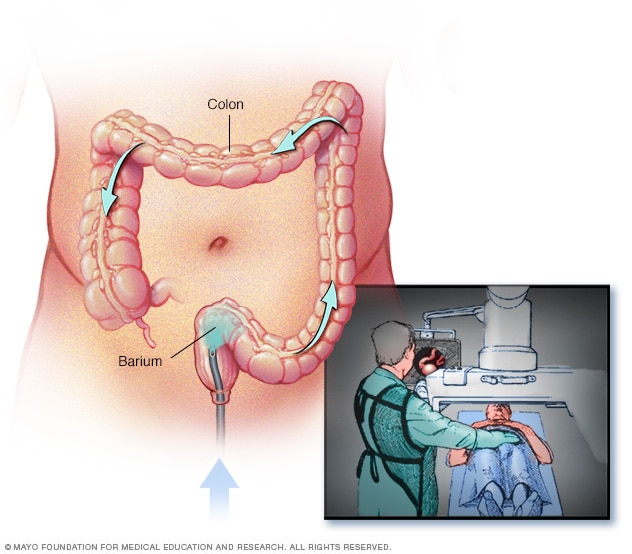
Barium enema
During a barium enema exam, an X-ray machine takes pictures of the colon while an enema tube inserted in the rectum delivers liquid barium.
A barium enema is an X-ray exam that helps detect conditions that affect the large intestine, also called the colon. The procedure also is called a colon X-ray.
An enema is the injection of a liquid into the rectum through a small tube. In this case, the liquid contains a metallic substance called barium that coats the lining of the colon. The barium helps make the X-ray images clearer.
During a barium enema exam, air may be pumped into the colon. The air expands the colon and helps make it easier to see all of the colon. This is called an air-contrast barium enema or double-contrast barium enema.
Before a barium enema, your healthcare professional will tell you to try to completely empty your colon, clearing out all the stool.
Products & Services
Why it's done
Healthcare professionals may recommend a barium enema to find out the cause of:
- Belly pain.
- Blood in the stool.
- Changes in bowel habits.
- Losing weight without trying.
- Chronic diarrhea.
- Chronic constipation.
- Growths, called polyps, in the colon.
- Inflammatory bowel disease.
More Information
Risks
A barium enema exam poses a few risks. Complications of a barium enema are rare but may include:
- Swelling in tissues surrounding the colon.
- Blockages in the gastrointestinal tract.
- Tear in the colon wall.
- Allergic reaction to barium.
Barium enema exams generally aren't done during pregnancy. Tell your healthcare professional if you're pregnant.
How you prepare
Before a barium enema exam, you'll be instructed to empty your colon. Clearing out all the stool makes it easier to see the colon on the X-rays.
To empty your colon, you may be asked to:
- Follow a special diet the day before the exam. You may be asked not to eat and to drink only clear liquids — such as water, tea, broth or coffee without milk or cream — the day before the exam.
- Avoid eating or drinking after midnight. Usually, you'll be asked not to drink or eat anything after midnight before the exam.
- Take a laxative the night before the exam. A laxative, in a pill or liquid form, helps empty your colon.
- Use an enema kit. You may need to use an enema kit that provides a cleansing solution to remove any residue in your colon. You may use this the night before or a few hours before the exam.
- Ask your healthcare professional about your medicines. At least a week before your exam, talk with your healthcare professional about the medicines you take. You may need to stop taking them before the exam.
What you can expect
During the exam
During your barium enema, you'll wear a gown and be asked to remove eyewear, jewelry or removable dental devices. The exam may be performed by a radiology technician and a doctor who specializes in diagnostic imaging called a radiologist.
You'll begin the exam lying on your side on a specially designed table. The healthcare team may take an X-ray to make sure your colon is empty. Then a member of the care team inserts a lubricated enema tube into your rectum. A barium bag is connected to the tube to deliver the barium solution into your colon.
If you're having an air-contrast barium enema, also called a double-contrast barium enema, air flows through the same tube and into your rectum.
The enema tube may have a balloon near its end, which can be inflated if needed to keep the barium or air in the colon. As your colon fills with barium, you may feel the urge to have a bowel movement. You might feel a cramping feeling in your belly.
Do your best to hold the enema tube in place. To relax, take long, deep breaths.
You may be asked to turn and hold various positions on the exam table. This helps ensure that your entire colon is coated with barium. It also allows the healthcare professional to view the colon from different angles. You may be asked to hold your breath at times.
The healthcare professional may press firmly on your belly and pelvis to move your colon for better viewing on a monitor attached to the X-ray machine. The healthcare professional will likely take several X-rays of your colon from different angles.
A barium enema exam typically takes about 30 to 60 minutes.
After the exam
After the exam, most of the barium leaves your colon through the enema tube. When the tube is removed, you'll be able to use the toilet to release additional barium and air. Any belly cramping usually ends quickly. You should be able to return to your usual diet and activities right away.
You may have white stools for a few days as your body naturally removes any remaining barium from your colon. Barium may cause constipation, so you may wish to drink extra fluids in the days following your exam to make stool easier to pass. Your healthcare professional may recommend a laxative if you are having trouble passing stool.
Check with your healthcare professional if you don't have a bowel movement or pass gas more than two days after the exam or if your stool doesn't return to its usual color within a few days.
Results
The radiologist prepares a report based on the results of the barium enema and sends it to your healthcare professional. Your healthcare professional will likely discuss the results with you and any further tests or treatments that may be needed:
- Negative result. A barium enema exam is considered negative if the radiologist does not see anything that is not typical in the colon.
- Positive result. A barium enema exam is considered positive if the radiologist detects something that isn't typical in the colon. Depending on the findings, you may need additional testing. An example of additional testing could be a colonoscopy where a healthcare professional can view the colon and possibly remove or sample tissue for testing.
If the healthcare team is concerned about the quality of your X-ray images, they may recommend a follow-up exam or a different imaging exam if possible.
Oct. 15, 2026