Enfermedad de Wilson Diagnóstico y tratamiento
Diagnóstico
El diagnóstico de la enfermedad de Wilson puede ser difícil, porque sus síntomas se parecen a los de otras enfermedades hepáticas, como la hepatitis. Los síntomas también pueden aparecer lentamente con el tiempo. Los cambios en el comportamiento que aparecen de manera progresiva pueden ser especialmente difíciles de vincular con la enfermedad de Wilson.
Criterios de diagnóstico
Los profesionales de atención médica diagnostican la enfermedad de Wilson sobre la base de una combinación de síntomas, valores de laboratorio y estudios por imágenes o pruebas genéticas. Una herramienta de puntuación estructurada, como los criterios diagnósticos de Leipzig, puede ayudar a los profesionales de atención médica a combinar estos síntomas y los resultados de las pruebas para confirmar o descartar la enfermedad de Wilson. La herramienta asigna puntos en función de los síntomas y los resultados de las pruebas. Una puntuación de Leipzig de 4 o más, por ejemplo, significa que es muy probable que se trate de la enfermedad de Wilson.
Las pruebas y los procedimientos pueden consistir en lo siguiente:
Análisis de sangre y de orina
Los análisis de sangre pueden indicar el funcionamiento del hígado y medir los niveles de ceruloplasmina, una proteína que se une al cobre en la sangre. Los análisis de sangre también pueden comprobar el nivel de cobre en sangre. Es posible que el profesional de atención médica quiera medir la cantidad de cobre eliminado en la orina durante un período de 24 horas.
- Ceruloplasmina. Esta prueba comprueba los niveles de una proteína que se une al cobre en la sangre. En la enfermedad de Wilson, los niveles de ceruloplasmina suelen ser bajos. Lo que se considera un nivel bajo depende del laboratorio concreto, pero a menudo se considera bajo un valor inferior a 20 miligramos por decilitro (mg/dl) o 0,2 gramos por litro (g/l). Los niveles son bajos porque la mutación del gen ATP7B que causa la enfermedad de Wilson impide que el cobre se una correctamente a la proteína ceruloplasmina. Algunas personas con la enfermedad de Wilson no presentan niveles bajos de ceruloplasmina. Y se pueden tener niveles bajos de ceruloplasmina sin padecer la enfermedad de Wilson. Por ejemplo, una enfermedad hepática causada por otro factor puede reducir los niveles de ceruloplasmina.
- Cobre en suero. Esta prueba verifica el nivel de cobre en sangre. Por sí sola, la prueba no se utiliza para diagnosticar la enfermedad de Wilson. En la enfermedad de Wilson, los niveles totales de cobre en suero suelen ser bajos debido a los bajos niveles de ceruloplasmina. Sin embargo, el nivel de cobre libre, es decir, el cobre que no está unido a la ceruloplasmina, suele ser más alto de lo habitual.
- Cobre en orina de 24 horas. Es posible que el profesional de atención médica quiera medir la cantidad de cobre eliminado en la orina durante un período de 24 horas. En la enfermedad de Wilson, este nivel suele ser alto. El valor que se considera alto depende del laboratorio concreto, pero por lo general se considera alto un nivel superior a 40-100 microgramos (mcg) al día.
- Otras pruebas hepáticas. Es posible que se realicen otras pruebas para comprobar el funcionamiento del hígado. Se conocen como liver function tests Sin embargo, la enfermedad de Wilson puede ocasionar daño hepático aunque la función del hígado sea normal y los resultados de las pruebas sean normales. A esto se le conoce como enfermedad hepática compensada.
Examen ocular
Durante un examen ocular, el oftalmólogo puede utilizar una luz especial llamada lámpara de hendidura para verificar los anillos de Kayser-Fleischer y las cataratas en forma de girasol.
Los anillos de Kayser-Fleischer son de color marrón dorado o cobrizo y aparecen alrededor del borde exterior de la parte de color del ojo, llamada iris. Estos anillos se deben a la acumulación de cobre en una parte de la córnea llamada membrana de Descemet. La córnea es la capa con forma de cúpula que recubre la pupila y el iris. Los anillos de Kayser-Fleischer se observan en la mayoría de las personas con síntomas neurológicos y en aproximadamente la mitad de las personas que solo presentan síntomas de enfermedad hepática.
La enfermedad de Wilson también puede ocasionar un tipo especial de catarata, la catarata en forma de girasol. Esta se debe a la acumulación de cobre en el cristalino del ojo.
Biopsia de hígado
En una biopsia de hígado, liver biopsyel profesional de atención médica introduce una aguja delgada a través de la piel y la dirige hacia el hígado para tomar una pequeña muestra de tejido. Luego, en el laboratorio, se analiza el tejido para detectar un exceso de cobre. Un nivel de cobre superior a 250 microgramos por gramo de peso seco de hígado (mcg/g) es un signo de la enfermedad de Wilson.
Pruebas genéticas
Un análisis de sangre permite detectar mutaciones en el gen ATP7B, que es el causante de la enfermedad de Wilson. Se conocen cientos de mutaciones del gen ATP7B. Una de las más comunes es p.H1069Q. Si tiene el gen alterado que causa la enfermedad de Wilson, sus hermanos e hijos también deberían hacerse genetic testing pruebas genéticas. Detectar la enfermedad a tiempo les permitirá comenzar el tratamiento antes de que aparezcan los síntomas.
Resonancia magnética
Magnetic resonance imaging (MRI) Es una técnica de obtención de imágenes médicas que usa un campo magnético y ondas de radio generadas por computadora para crear imágenes detalladas de los órganos y tejidos del cuerpo. En las personas con síntomas neurológicos de la enfermedad de Wilson, una resonancia magnética cerebral puede mostrar alteraciones en las zonas del cerebro afectadas por la acumulación de cobre. El signo de la cara de panda gigante aparece en la resonancia magnética cerebral de entre el 10 % y el 15 % de las personas con enfermedad de Wilson. Este signo se observa cuando la enfermedad de Wilson ha dañado la parte central del cerebro, que se conoce como mesencéfalo. El nombre del signo hace referencia a un patrón de colores más claros y más oscuros que se asemejan a la cara de un panda en la imagen de la resonancia magnética.
Afecciones que pueden presentar síntomas similares
Al diagnosticar la enfermedad de Wilson, los profesionales de atención médica tienen en cuenta otras posibles afecciones que podrían causar síntomas similares. Esto ayuda a garantizar el diagnóstico y el tratamiento correctos.
Todas estas otras afecciones son causadas por diferentes alteraciones genéticas:
- Hemochromatosis. Al igual que la enfermedad de Wilson, la hemocromatosis puede afectar al hígado. Sin embargo, una diferencia entre la enfermedad de Wilson y la hemocromatosis es que la enfermedad de Wilson se caracteriza por una acumulación de cobre. La hemocromatosis, por su parte, se caracteriza por un exceso de hierro.
- Huntington's disease. Tanto la enfermedad de Wilson como la enfermedad de Huntington pueden causar síntomas motores y conductuales similares. Pero la enfermedad de Wilson se diferencia de la enfermedad de Huntington en que afecta tanto al hígado como al cerebro debido a la acumulación de cobre. La enfermedad de Huntington afecta al cerebro causando que las células nerviosas del cerebro se deterioren con el tiempo.
- Aceruloplasminemia. La aceruloplasminemia y la enfermedad de Wilson no están relacionadas, aunque ambas afectan a la proteína ceruloplasmina, que se encarga de fijar el cobre en la sangre. La aceruloplasminemia causa una acumulación de hierro, y no de cobre, en el hígado.
- Enfermedad de Menkes. La enfermedad de Menkes también afecta a la forma en que el organismo utiliza el cobre. Sin embargo, la enfermedad de Wilson no es lo mismo que la enfermedad de Menkes. La enfermedad de Menkes causa un nivel bajo de cobre en el hígado y el cerebro. La enfermedad de Wilson causa un nivel alto de cobre en el hígado y el cerebro.
- Otras afecciones del metabolismo del cobre o del hierro. Existen otras pocas afecciones hereditarias poco frecuentes que pueden afectar al equilibrio del cobre y el hierro. Pero tienen causas genéticas diferentes.
Todas estas afecciones están causadas por alteraciones genéticas distintas de la que ocasiona la enfermedad de Wilson. Además, todas tienen efectos diferentes en el organismo.
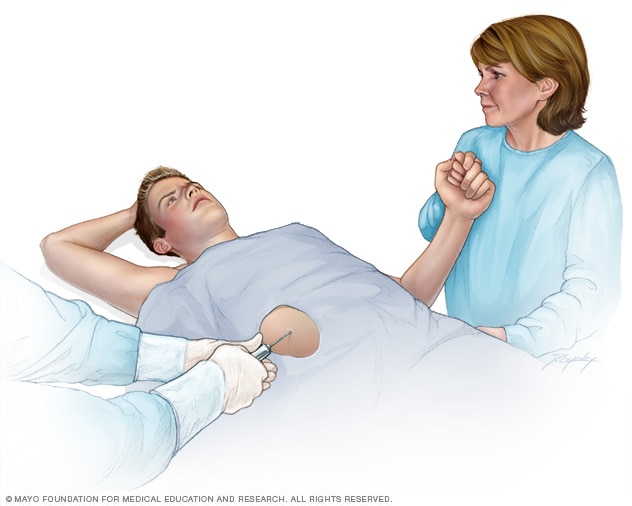
Biopsia de hígado
En una biopsia del hígado se extirpa una muestra pequeña de tejido hepático para analizar en el laboratorio. Por lo general, para hacer una biopsia del hígado se introduce una aguja delgada a través de la piel hasta el hígado.
Tratamiento
Para el tratamiento de la enfermedad de Wilson, el profesional de atención médica puede indicar inicialmente medicamentos denominados sustancias quelantes del cobre. Estos medicamentos se unen al cobre y hacen que los órganos liberen ese cobre en el torrente sanguíneo. Luego, los riñones filtran el cobre y lo eliminan en la orina.
El tratamiento posterior consiste en evitar que el cobre vuelva a acumularse. Esto suele hacerse con un medicamento de zinc. En el caso de un daño hepático grave, puede ser necesario realizar un trasplante de hígado.
¿Tiene cura la enfermedad de Wilson?
El tratamiento protege al cuerpo de un mayor daño por la enfermedad de Wilson y puede aliviar algunos síntomas. Los medicamentos no curan la enfermedad de Wilson. Un trasplante de hígado no puede revertir el cambio genético que causa la enfermedad de Wilson. Sin embargo, un hígado donado no presentaría el gen mutado, por lo que podría procesar el cobre correctamente sin requerir tratamiento adicional. Si la enfermedad de Wilson se detecta a tiempo y se trata, la persona puede llevar una vida completa y tener una expectativa de vida típica.
Medicamentos
Si toma medicamentos para la enfermedad de Wilson, deberá seguir tomándolos de por vida, a menos que le hagan un trasplante de hígado.
Sustancias quelantes para la eliminación del cobre
Estos medicamentos suelen usarse como primera opción de tratamiento para reducir rápidamente los niveles de cobre:
- Penicilamina (Cuprimine, Depen). La penicilamina, conocida en ocasiones como d-penicilamina, es un medicamento que elimina el exceso de cobre del organismo. Puede causar efectos adversos graves, entre ellos alteraciones cutáneas y renales. Asimismo, puede causar o agravar síntomas neurológicos, especialmente en personas que ya los presentan. También puede disminuir la capacidad de la médula ósea para producir una cantidad suficiente de glóbulos rojos y plaquetas. Use la penicilamina con cuidado si presenta alergia a la penicilina. Debido a que la penicilamina reduce el efecto de la vitamina B6, también llamada piridoxina, deberá tomar pequeñas dosis de un suplemento de vitamina B6.
- Trientina (Cuvrior, Syprine). Este es otro medicamento que elimina el exceso de cobre del organismo. Funciona de forma muy parecida a la penicilamina, pero suele causar menos efectos secundarios. Sin embargo, los síntomas neurológicos pueden empeorar al tomar trientina.
Tratamiento con zinc para evitar la absorción de cobre
El acetato de zinc (Galzin) bloquea la absorción de cobre de los alimentos que consume. Este medicamento suele usarse como terapia de mantenimiento para impedir que el cobre vuelva a acumularse después del tratamiento inicial con penicilamina o trientina. El acetato de zinc puede usarse como tratamiento principal si no puede tomar penicilamina o trientina, o si no presenta síntomas. El efecto secundario más frecuente del acetato de zinc es el malestar estomacal.
El profesional de atención médica también puede recomendar opciones para tratar otros síntomas de la enfermedad de Wilson.
Cirugía
Si el daño en el hígado es tan grave que se produce insuficiencia hepática, o si no puede revertirse con medicamentos, podría necesitar un liver transplant. Durante un trasplante de hígado, el cirujano extirpa el hígado dañado y lo reemplaza por el hígado sano de un donante.
La mayoría de los hígados trasplantados proviene de donantes fallecidos. En algunos casos, el hígado puede provenir de un donante vivo, por ejemplo, de un familiar. En ese caso, el cirujano le extirpa el hígado y lo reemplaza con una parte del hígado del donante.
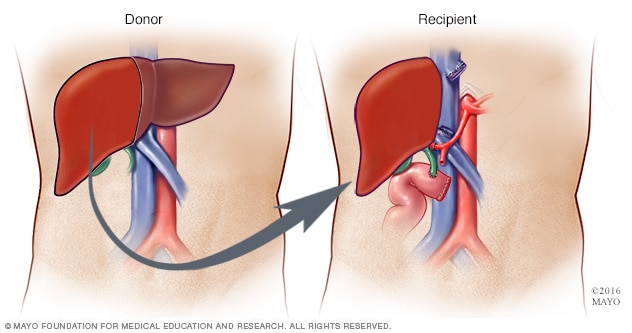
Trasplante de hígado de donante vivo
Durante un trasplante de hígado de donante vivo, los cirujanos extirpan aproximadamente del 40 % al 70 % del hígado del donante y lo colocan en el receptor.
Autocuidado
La enfermedad de Wilson se trata con medicamentos de por vida para eliminar y bloquear el exceso de cobre en el organismo, además de medidas de autocuidado para asegurarse de que la alimentación no contenga demasiado cobre.
Si le indican que limite el consumo de cobre en su alimentación, esto puede incluir el cobre presente en el agua, los suplementos y los alimentos.
Agua
Si su casa tiene tuberías de cobre, deje correr el agua hasta que se enfríe antes de usarla para cocinar o beber. Si utiliza agua de pozo, haga que la analicen para detectar cobre o utilice un filtro que elimine los oligoelementos.
Suplementos
Asegúrese de evitar los multivitamínicos o suplementos que contienen cobre.
Alimentos
Si padece la enfermedad de Wilson, hable con su equipo de atención médica sobre cómo ajustar su alimentación para cumplir con las restricciones y pautas dietéticas necesarias.
Es probable que su equipo de atención médica le recomiende que limite el consumo de cobre. Sin embargo, la cantidad adecuada puede depender de la fase del tratamiento en la que se encuentre, así como de otros factores de salud personales. Por ejemplo, es posible que inicialmente le pidan que no consuma más de 1 miligramo (mg) de cobre al día. Más adelante, en un plan de mantenimiento, es posible que le indiquen que puede consumir una cantidad moderada de cobre, como 2 mg o menos al día.
Alimentos que contienen mucha cantidad de cobre
Si padece la enfermedad de Wilson, es posible que le recomienden evitar o limitar el consumo de estos alimentos:
- Hígado y otras vísceras.
- Mariscos y camarones.
- Carne de cordero.
- Ganso, pato y codorniz.
- Tofu, proteína de soja y leche de soja.
- Frijoles secos.
- Hongos.
- Batatas y otras papas con cáscara.
- Frutas deshidratadas.
- Harina de soja, cereales de salvado y granos de maíz (elote).
- Frutos secos y semillas.
- Chocolate.
- Agua mineral.
Alimentos que contienen poca cantidad de cobre
Es posible que su equipo de atención médica le indique que puede incluir una mayor cantidad de estos alimentos como base de su dieta si padece la enfermedad de Wilson:
- Carne blanca de pollo y pavo.
- Bacalao, vieiras, fletán, atún y trucha.
- Huevos, manteca y margarina.
- Queso, queso cottage y crema de leche.
- Leche de almendras, leche de vaca y yogur, siempre que no sean de chocolate.
- Coles de Bruselas, brócoli y repollo.
- Coliflor, espinaca y pimiento verde.
- Cebolla.
- Shiitake y hongos enoki.
- Manzanas, arándanos azules, cerezas, ciruelas, melón, fresas y sandía.
- Café y bebidas carbonatadas.
Algunos alimentos saludables contienen una cantidad moderada de cobre y pueden consumirse en pequeñas cantidades. Pregunte al equipo de atención médica qué pautas alimenticias son adecuadas para usted.
Es habitual tener dudas o preocupaciones sobre si se puede llevar una vida normal con la enfermedad de Wilson. Empezar a tomar medicamentos de por vida y aprender nuevos hábitos alimenticios puede parecer una tarea abrumadora. Tómese su tiempo para adaptarse y comparta sus preocupaciones con su equipo de atención médica. También puede ser de ayuda saber que, con un diagnóstico precoz, un tratamiento médico adecuado y el autocuidado, la mayoría de las personas con la enfermedad de Wilson llevan una vida saludable.
Preparación para la cita médica
Es probable que primero consulte al profesional de atención primaria. Luego, es posible que le remitan a un profesional de atención médica especializado en el hígado, llamado hepatólogo.
Lo que puede hacer
Cuando programe la cita, pregunte si debe hacer algo para prepararse, como cambiar la alimentación antes de los análisis de sangre.
Se recomienda hacer una lista de lo siguiente:
- Los síntomas y cuándo comenzaron.
- Información personal importante, como situaciones estresantes, otras enfermedades que tenga y cualquier antecedente familiar de la enfermedad de Wilson.
- Todos los medicamentos, las vitaminas o los suplementos que toma y también las dosis.
- Preguntas que quiera hacer al profesional de atención médica.
Si es posible, lleve a un familiar o amigo para que le ayude a recordar la información que reciba.
Si cree que podría tener la enfermedad de Wilson o le han dicho que la tiene, puede hacer al profesional de atención médica preguntas como las siguientes:
- ¿Qué pruebas deben hacerme para confirmar la enfermedad de Wilson?
- ¿Qué detalles de los antecedentes familiares necesita?
- ¿Cómo se trata y se controla la enfermedad de Wilson a largo plazo?
- ¿Qué tratamiento me recomienda?
- ¿Cuáles son los efectos secundarios de este tratamiento?
- ¿Cuál es la mejor manera de controlar la enfermedad de Wilson junto con mis otras afecciones médicas?
- ¿Necesito limitar los tipos de alimentos que como?
- ¿Debería consultar a un especialista y, de ser así, cuál?
- ¿Deberían mis hermanos o hijos hacerse pruebas para verificar si tienen la enfermedad de Wilson?
- ¿Qué tipo de especialista deberían consultar mis familiares?
- ¿Hay folletos o algún otro material impreso que pueda consultar? ¿Qué sitios web me recomienda?
No dude en hacer cualquier otra pregunta que tenga. Además, asegúrese de informar al profesional de atención médica si algún familiar tiene la enfermedad de Wilson o síntomas hepáticos, neurológicos o de salud mental sin una causa clara, ya que la enfermedad es hereditaria.
¿Qué puede esperar del médico?
El profesional de atención médica puede hacerle varias preguntas, como las siguientes:
- ¿Los síntomas ocurren en forma continua, o aparecen y desaparecen?
- ¿Cuál es la gravedad de los síntomas?
- ¿Durante cuánto tiempo ha tenido estos síntomas?
- ¿Hay algo que parezca aliviar o empeorar los síntomas?
- ¿Tiene algún familiar la enfermedad de Wilson?
CON-20310631
Mayo Clinic no respalda empresas ni productos. Los ingresos por publicidad respaldan nuestra misión sin fines de lucro.
Avisos comerciales y patrocinio
Publicaciones de Mayo Clinic
Consulta estos éxitos de venta y ofertas especiales en libros y boletines informativos de Publicaciones de Mayo Clinic.
