Syringomyelia Symptoms and causes
Overview
Syringomyelia (sih-ring-go-my-E-lee-uh) happens when a fluid-filled cyst develops within the spinal cord. The cyst, which is sometimes called a syrinx, can grow larger over time. When it does, it can damage the spinal cord and cause pain, weakness, stiffness or loss of feeling.
Syringomyelia has several possible causes. Most seem to affect the way fluid flows around the spinal cord and brain. When this fluid doesn't flow as it should, it may lead to the condition. Syringomyelia is often connected with Chiari malformation. This is a condition in which brain tissue pushes into the spinal canal.
Other causes of syringomyelia include spinal cord tumors, spinal cord injuries, and damage caused by swelling or scarring around the spinal cord. Sometimes the cause of syringomyelia isn't known.
If syringomyelia doesn't cause issues, monitoring might be all that you need. But if the symptoms are bothersome, you might need surgery.
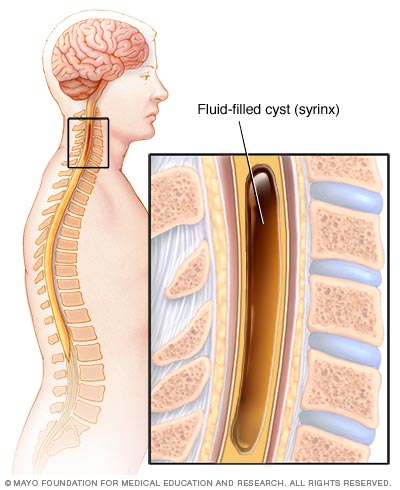
Syringomyelia cyst (syrinx) in the spinal cord
Cerebrospinal fluid usually flows around the outside of the brain and spinal cord. In people with syringomyelia, cerebrospinal fluid collects inside the spinal cord and forms a fluid-filled cyst. The cyst is also called a syrinx.
Symptoms
Syringomyelia symptoms usually happen slowly over time. Although both adults and children can have syringomyelia, symptoms tend to begin between ages 25 and 40.
In some people, coughing or straining can trigger symptoms of syringomyelia, although neither causes syringomyelia.
Syringomyelia symptoms often are felt in a capelike pattern across the neck, back, shoulders, arms and hands. If the syrinx extends lower in the spine, you may feel symptoms in the lower body. If the syrinx extends upward toward the brain, you may feel symptoms in the face.
Symptoms of syringomyelia include:
- Pain in the neck, arms and back.
- Loss of sensitivity to pain and temperature.
- Headache.
Other symptoms affect the muscles, joints and movement, including:
- Loss of reflexes.
- Stiffness in the back, shoulders, arms and legs.
- Loss of feeling or movement in the face.
- Muscle weakness and muscle wasting.
- Loss of grip strength.
- Scoliosis, a condition in which the spine curves sideways.
Syringomyelia symptoms that may change basic functions of the body include:
- Trouble breathing, especially during sleep.
- Changes in bladder, bowel or sexual function.
When to see a doctor
If you have any of the symptoms of syringomyelia, see your healthcare professional.
If you've had a spinal cord injury, watch for symptoms of syringomyelia. It may be months to years after an injury before syringomyelia happens. Make sure your healthcare professional knows about a spinal cord injury you've had.
Causes
It's not clear how or why syringomyelia happens. Most studies show a connection between the condition and how fluid pulses and flows around the brain and spinal cord. This fluid is called cerebrospinal fluid (CSF). CSF surrounds, cushions and protects the brain and spinal cord. When the CSF is blocked in any way, it may not pulse and flow as it should. This may cause the fluid to build up within the spinal cord itself. If the buildup forms a fluid-filled cyst, it is called a syrinx.
Many conditions may affect the flow of CSF and cause a syrinx to form. There are different types of syringomyelia linked to these conditions. They include:
- Chiari-related syringomyelia. This also may be called congenital syringomyelia or communicating syringomyelia. Chiari-related syringomyelia is the most common form of the condition. Many adults and children with Chiari malformation develop syringomyelia.
- Primary spinal syringomyelia. This also may be called acquired syringomyelia or noncommunicating syringomyelia. In this type, the flow of CSF may be affected due to an underlying issue with the spinal cord. Issues may include having a tethered spinal cord, trauma, tumors, swelling or scarring of the membrane that covers the spinal cord. This membrane is called the arachnoid. Thickened areas of swelling or scarring on this membrane are called arachnoid adhesions. They may form after surgery or illnesses such as meningitis.
- Posttraumatic syringomyelia. This type is caused by severe injury to the spine or spinal cord.
- Idiopathic syringomyelia. In this type, it's not clear what causes the syrinx to form. Tests may not show any clear signs of what could be affecting the flow of CSF.
Risk factors
Several conditions and diseases can lead to syringomyelia, including:
- Chiari malformation. In this condition, brain tissue pushes into the spinal canal and blocks the regular flow of cerebrospinal fluid.
- Meningitis. This condition causes swelling of the membranes surrounding the brain and spinal cord.
- Growths on or in the spine. These may include spinal cord tumors, cysts or thick areas on the membrane covering the spinal cord. These are called arachnoid adhesions. Also, bony growths on the spine called bone spurs can affect the regular flow of cerebrospinal fluid.
- Conditions present at birth. These may include spina bifida or a tethered spinal cord. Spina bifida is a condition in which the spine and spinal column don't form properly before birth. A tethered spinal cord is a condition that happens when tissue attached to the spinal cord limits its movement.
- Spinal cord injury. An injury that affects the spine can cause symptoms months or years later. As you age, symptoms connected to an old injury may become worse.
- Complications after surgery. Swelling or scarring of the spine after surgery may affect the flow of CSF. Also, treatments such as chemotherapy or radiation on or near the spine may raise the risk of syringomyelia.
- Family health history. Genetics may play a role in getting syringomyelia.
- Aging. As you age, wear and tear on the spine may put you at higher risk of developing the condition, especially if there has been trauma to the spine in the past.
Complications
Some people may never have symptoms of syringomyelia. But for others, syringomyelia can cause symptoms that get worse. If a syrinx grows and damages nerves within the spinal cord, it can lead to serious complications.
Complications include:
- Scoliosis. The spine may curve sideways if nerve damage weakens certain muscles that support the spine.
- Joint deformity. The joints of the shoulders, elbows or hands may change shape as their muscles weaken from nerve damage. A joint that changes shape like this is called a Charcot joint.
- Chronic pain. Nerve damage may cause ongoing feelings of burning, tingling, numbness or pain that feels like an electric shock.
- Numbness and sensory loss. Parts of the body may feel numb or not able to sense pain or changes in temperature. Often, this happens in a capelike pattern along the neck, shoulders and upper arms. If a syrinx extends upward, it may cause numbness in the face. If it extends downward, it may cause numbness in the lower body.
- Motor difficulties. The legs may feel stiff and weak. It may be hard to walk or stay balanced. Reflexes may be slow, or muscles may contract on their own. Also, it may be difficult to move the face, mouth or tongue.
- Changes in digestive, bladder, bowel or sexual function. If a syrinx grows and extends lower, it may impact these functions of the lower body. Digestive complications may include upset stomach, vomiting, and appetite and weight loss.
- Paralysis. In severe syringomyelia, total loss of movement or feeling in the face or one or more limbs is possible.
CON-20209449
Mayo Clinic does not endorse companies or products. Advertising revenue supports our not-for-profit mission.
Advertising & Sponsorship
Mayo Clinic Press
Check out these best-sellers and special offers on books and newsletters from Mayo Clinic Press.
