Overview
Osteoarthritis versus rheumatoid arthritis
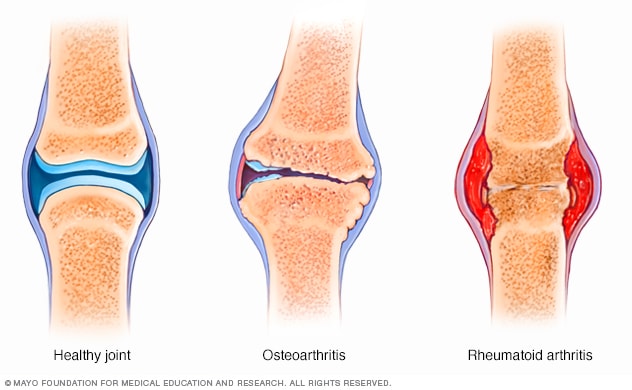
Osteoarthritis versus rheumatoid arthritis
Osteoarthritis, the most common form of arthritis, involves the wearing away of the cartilage that caps the bones in the joints. Rheumatoid arthritis is a condition in which the immune system attacks the joints, beginning with the lining of joints.
Arthritis isn't a single condition but a broad term for many conditions affecting the joints. Arthritis typically is associated with pain that affects the ability to move a joint. It causes swelling and tenderness of one or more joints. The main symptoms are joint pain and stiffness, which can impact daily activities and work. The most common types are osteoarthritis and rheumatoid arthritis.
Osteoarthritis happens when cartilage — the hard, slippery tissue that cushions the ends of bones at a joint — breaks down.
Rheumatoid arthritis is an autoimmune disease in which the immune system mistakenly attacks the joints, beginning with the lining of joints. This leads to inflammation and tissue damage.
Another form of arthritis is gout. Gout is caused by uric acid crystals depositing in the joints due to high levels of uric acid in the blood. And infections or underlying conditions such as psoriasis or lupus also can cause other types of arthritis.
Treatment depends on the type of arthritis, but the main goals are to relieve symptoms and improve quality of life.
Products & Services
Types
Symptoms
The most common signs and symptoms of arthritis involve the joints. Depending on the type of arthritis, symptoms may include:
- Pain.
- Stiffness.
- Swelling.
- Darkening of the skin around the joint.
- Decreased range of motion.
Causes
The two main types of arthritis — osteoarthritis and rheumatoid arthritis — damage joints in different ways.
Osteoarthritis
Osteoarthritis is the most common type of arthritis. It is caused by damage to the cartilage in a joint. Healthy cartilage allows for nearly frictionless movement. But as cartilage wears down, bones may begin to grind against each other. This leads to pain and reduced mobility. This damage happens over time, but it can be hastened by a joint injury or an infection.
In addition to causing cartilage loss, osteoarthritis may lead to bone changes and the breakdown of connective tissues. Connective tissues support the joint by attaching muscles to bones to keep the joint stable. If cartilage and connective tissues in a joint are damaged, the joint lining may become inflamed and swollen, further increasing discomfort and stiffness.
Rheumatoid arthritis
In rheumatoid arthritis, the body's immune system mistakenly attacks the lining of the joint capsule, a tough membrane that encloses all the joint parts. This lining is called the synovial membrane. It becomes inflamed and swollen. Over time, the ongoing immune response may lead to the destruction of cartilage and bone. This results in pain, stiffness and joint damage.
Risk factors
Risk factors for arthritis include:
- Family history. Some types of arthritis run in families, so you may be more likely to develop arthritis if your parents or siblings have the condition.
- Age. The risk of many types of arthritis — including osteoarthritis, rheumatoid arthritis and gout — increases with age.
- Your sex. Women are more likely than men to develop rheumatoid arthritis, while most of the people who have gout, another type of arthritis, are men.
- Previous joint injury. A past joint injury, such as one from sports or an accident, can increase the risk of arthritis in that joint later in life.
- Excess weight. Carrying excess pounds puts added stress on joints, particularly your knees, hips and spine. This increases the risk of developing arthritis.
Complications
Advanced arthritis, especially in the hands or arms, can make everyday tasks challenging. When arthritis affects weight-bearing joints, it may cause difficulty walking or keeping proper posture. Over time, arthritis also may lead to changes in joint alignment and shape.