Diagnosis
Pancreatic cancer FAQs
Get answers to the most frequently asked questions about pancreatic cancer from Mayo Clinic surgical oncologist Chee-Chee Stucky, M.D.
Hi. I'm Dr. Chee-Chee Stucky, a surgical oncologist at Mayo Clinic, and I'm here to answer some of the important questions you might have about pancreatic cancer.
Is pancreatic cancer preventable?
Technically, no. There are some risk factors associated with pancreatic cancer, like smoking and obesity. Those are both modifiable risk factors. So the healthier you are, the less risk you might have of pancreatic cancer. But ultimately if you have a pancreas, there's always a risk of developing pancreatic cancer.
Do all pancreatic cysts become cancerous?
The short answer is no. The vast majority of pancreatic cysts will not become cancerous. There are a few, but I would recommend asking your doctor about those.
How are breast cancer and pancreatic cancer connected?
The connection between breast cancer and pancreatic cancer is a genetic mutation called BRCA. So anybody who might have a newly diagnosed pancreatic cancer, but a family history of breast cancer, should definitely undergo genetic testing in order to see if there is a mutation present. If so, the rest of the family needs to undergo screening and possibly genetic testing with the hopes of potentially identifying cancer at an earlier stage.
What is the Whipple procedure?
The Whipple procedure is one of the most common procedures we do for pancreatic cancer, Specifically when located in the head or uncinate process of the pancreas. Because of where that tumor is located, we also have to remove everything that's connected to the pancreas, specifically the duodenum and the bile duct, as well as the surrounding lymph nodes. Once it's all removed, then we need to put everything back together, which includes the biliary tract, the pancreatic duct, and the GI tract.
Can you live without a pancreas?
You can definitely live without a pancreas. You will have diabetes. But fortunately with our new technologies, insulin pumps are much improved. And therefore, patients still have a good quality of life.
How can I be the best partner to my medical team?
You can be the best partner to your medical team by staying healthy, staying informed, ask a lot of questions and bring somebody with you to your appointments so they can be an additional set of eyes and ears. Never hesitate to ask your medical team any questions or concerns you have. Being informed makes all the difference. Thanks for your time and we wish you well.
To diagnose pancreatic cancer, a healthcare professional may ask you about your symptoms and do an exam. The healthcare professional may use imaging tests to make pictures of the pancreas to look for anything concerning. Other tests might include blood tests, genetic tests and removing some tissue for testing.
Imaging tests
Imaging tests take pictures that show the inside of the body. Imaging tests used to diagnose pancreatic cancer include ultrasound, CT scans and MRI scans. Sometimes, you may have positron emission tomography (PET) scans.
Pancreatic ultrasound
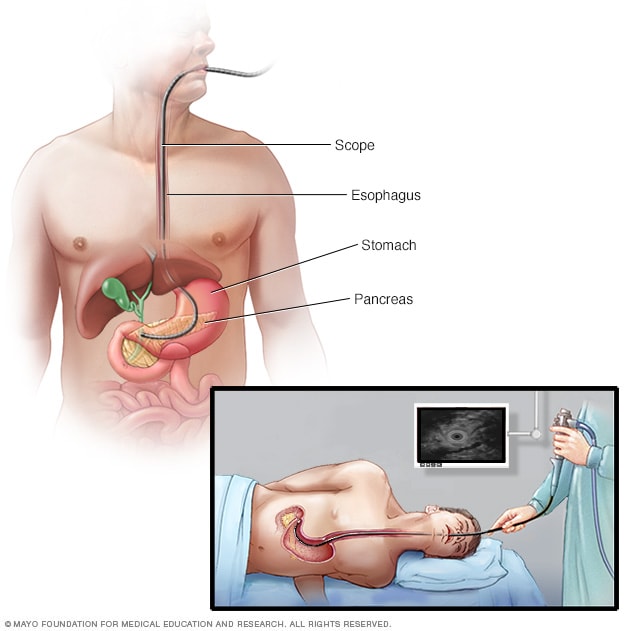
Pancreatic ultrasound
During an endoscopic ultrasound of the pancreas, a thin, flexible tube called an endoscope is inserted down the throat and into the chest. An ultrasound device at the end of the tube emits sound waves that generate images of the digestive tract and nearby organs and tissues.
Endoscopic ultrasound
Endoscopic ultrasound (EUS) is a test to make pictures of the digestive tract and nearby organs and tissues. EUS uses a long, thin tube with a camera, called an endoscope. The endoscope passes down the throat and into the stomach. An ultrasound device on the endoscope uses sound waves to make images of nearby tissues. It can be used to make pictures of the pancreas.
Biopsy
A biopsy is a procedure to remove a small sample of tissue for testing in a lab. Most often, a healthcare professional gets the tissue sample during EUS. Special tools are passed through the endoscope to take some tissue from the pancreas. Less often, a sample of tissue is collected from the pancreas by putting a needle through the skin and into the pancreas using a CT scan or ultrasound to guide the needle.
The tissue sample goes to a lab for testing to see whether it's cancer. Other specialized tests can show what DNA changes are in the cancer cells. The results help the healthcare team make a treatment plan.
Blood tests
Blood tests might show proteins called tumor markers that pancreatic cancer cells make. One tumor marker test used in pancreatic cancer is called CA 19-9. Healthcare professionals often repeat this test during and after treatment to see how the cancer responds to the treatment. Some pancreatic cancers don't make extra CA 19-9, so this test isn't helpful for everyone.
CA 19-9 isn't accurate enough to diagnose pancreatic cancer by itself, and it isn't used as a screening test for the general population.
Genetic testing
If you're diagnosed with pancreatic cancer, talk with your healthcare team about genetic testing. Genetic testing uses a sample of blood or saliva to look for inherited DNA changes that raise the risk of cancer. Results of genetic testing might help guide treatment. The results also can show whether family members might have a higher risk of pancreatic cancer.
More Information
Treatment
Treatment for pancreatic cancer depends on the stage of the cancer and its location. The healthcare team also considers a person's overall health and preferences when making a treatment plan. For most people, the first step is to start treatment. If that isn't possible, the focus may be on improving quality of life and keeping the cancer from growing or causing more harm or symptoms.
Pancreatic cancer treatments may include surgery, radiation, chemotherapy, immunotherapy, targeted therapy or a mix of those options. If the cancer is advanced, treatment may help slow the growth of the cancer and ease symptoms.
Surgery
Surgery is the only potential cure for pancreatic cancer. But it's not an option for everyone, and the cancer often comes back after surgery. Surgery might be used to treat cancer that hasn't spread to other organs. Surgery may be possible depending on how much the cancer affects nearby blood vessels. Treatment may start with chemotherapy, sometimes combined with radiation therapy. After treatment, surgery may be possible for some people.
Surgeries used to treat pancreatic cancer include:
- Surgery for cancers in the pancreatic head. The Whipple procedure, also called pancreaticoduodenectomy, is surgery to remove the head of the pancreas. It also involves removing the first part of the small intestine and the bile duct. Sometimes the surgeon removes part of the stomach and nearby lymph nodes. Then the remaining organs are joined together to allow food to move through the digestive system.
- Surgery for cancers in the body and tail of the pancreas. Surgery to remove the body and tail of the pancreas is called distal pancreatectomy. With this procedure, the surgeon also might need to remove the spleen.
- Surgery to remove the whole pancreas. This is called total pancreatectomy. If you have this surgery, you take medicine for the rest of your life to replace the hormones and enzymes that the pancreas makes.
- Surgery for cancers that affect nearby blood vessels. When cancer in the pancreas grows into nearby blood vessels, a more complex procedure might be needed. It may involve taking out and rebuilding parts of the blood vessels and other organs. These complex operations should be done at centers with a lot of experience in pancreatic and blood vessel surgery.
Each of these surgeries carries the risk of bleeding and infection. After surgery, some people have nausea and vomiting if the stomach has trouble emptying. This condition is called delayed gastric emptying. The recovery time is long for all of these surgeries. You'll likely spend several days in the hospital and then recover for several weeks at home.
Research shows that pancreatic cancer surgery tends to have fewer complications when done by highly experienced surgeons at centers that do many of these surgeries. Ask about your surgeon's and hospital's experience with pancreatic cancer surgery. If you have any doubts, get a second opinion.
Whipple procedure
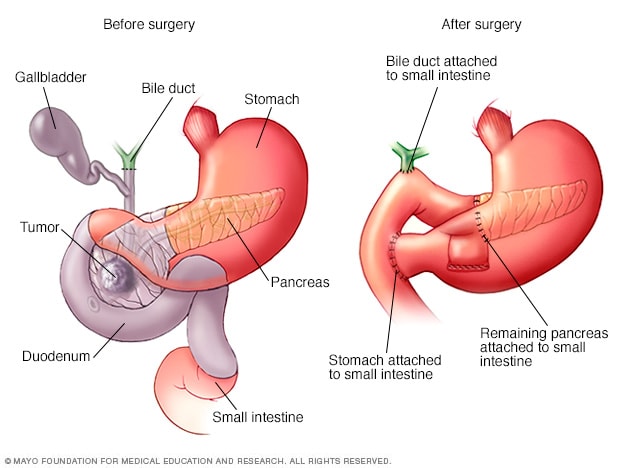
Whipple procedure
The Whipple procedure, also called pancreaticoduodenectomy, is an operation to remove the head of the pancreas. The operation also involves removing the first part of the small intestine, called the duodenum, the gallbladder and the bile duct. The remaining organs are rejoined to allow food to move through the digestive system after surgery.
Chemotherapy
Chemotherapy uses strong medicines to kill cancer cells. Treatment might involve one chemotherapy medicine or a mix of them. Most chemotherapy medicines are given through a vein. But some are taken in pill form.
Chemotherapy often is the first treatment when surgery cannot be done right away. Radiation therapy sometimes is given with chemotherapy. These treatments can shrink the cancer enough to make surgery possible. This approach usually is offered at centers with a lot of experience treating pancreatic cancer.
Chemotherapy often is used after surgery to kill any cancer cells that might be left behind.
When the cancer is advanced and has spread to other parts of the body, chemotherapy can help manage it. Chemotherapy might help ease symptoms, such as pain.
Radiation therapy
Radiation therapy uses powerful energy beams to kill cancer cells. The energy can come from X-rays, protons or other sources. During radiation therapy, you lie on a table while a machine moves around you. The machine directs radiation to precise points on your body.
Radiation therapy may be used before surgery, after surgery or when surgery isn't possible. When you can't have surgery right away, chemotherapy usually is the first treatment. You may have radiation therapy after chemotherapy, or sometimes with chemotherapy, to help control the cancer or make surgery possible.
When the cancer has spread to other parts of the body, radiation therapy can help ease symptoms, such as pain.
Immunotherapy
Immunotherapy is a treatment with medicine that helps the body's immune system kill cancer cells. The immune system fights off diseases by attacking germs and other cells that shouldn't be in the body. Cancer cells survive by hiding from the immune system. Immunotherapy helps the immune system cells find and kill the cancer cells. Immunotherapy might be an option when the pancreatic cancer has specific DNA changes that make the cancer likely to respond to these treatments. A healthcare professional can determine whether immunotherapy is right for you.
Targeted therapy
Targeted therapy uses medicines that attack specific features of cancer cells. In August 2026, the U.S. Food and Drug Administration (FDA) approved daraxonrasib (Rasonque) for adults with pancreatic adenocarcinoma that has spread to other parts of the body. It may be used after at least one treatment with medicines that travel throughout the body. It also may be an option for people who can't receive a combination of cancer medicines. Daraxonrasib blocks RAS proteins that can help cancer cells grow.
Daraxonrasib is taken as a pill. A healthcare professional can determine whether it may be an option for you.
Clinical trials
Clinical trials are studies of new therapies. These studies offer a chance to try the latest treatments. The risk of side effects might not be known. Ask your healthcare professional whether you may be able to join a clinical trial.
Palliative care
Palliative care is a special type of healthcare that helps people with a serious illness feel better. If you have cancer, palliative care can help ease pain and other symptoms. The palliative care team may include doctors, nurses and other specially trained professionals. The team's goal is to improve quality of life.
Palliative care specialists work with you and your care team to help you feel better. They provide an extra layer of support while you have cancer treatment. You can have palliative care while you get cancer treatments, such as surgery, chemotherapy or radiation therapy.
When palliative care is used along with other treatments, people with cancer may feel better and have an easier time managing symptoms.
More Information
More Information
Clinical trials
Explore Mayo Clinic studies testing new treatments, interventions and tests as a means to prevent, detect, treat or manage this condition.
Alternative medicine
Alternative therapies shouldn't replace medical treatments for pancreatic cancer. But some integrative medicine therapies may be used along with medical treatments to help manage symptoms or side effects.
Treatments to help you cope with distress
People with cancer often have distress. Distress might feel like worry, anxiety, anger or sadness. If you have these feelings, you may find it hard to sleep. You might think about your cancer all the time.
Talk about your feelings with a member of your healthcare team. Specialists can help you sort through your feelings. They can help you find ways to cope. Sometimes medicines may help.
Some therapies that also may help you cope with your feelings include:
- Art therapy.
- Exercise.
- Meditation.
- Music therapy.
- Relaxation exercises.
- Spirituality.
Talk with a member of your healthcare team if you'd like to try some of these options.
Coping and support
Learning that you have pancreatic cancer may feel stressful and overwhelming. To cope with these feelings, you may find some of the following suggestions helpful:
-
Learn about your cancer. Learn enough about your cancer to help you make decisions about your care. Ask a member of your healthcare team about the details of your cancer and your treatment options. Ask about trusted sources of more information.
If you're doing your own research, good places to start are the American Cancer Society and the Pancreatic Cancer Action Network.
- Find someone to talk with. Although friends and family might be a good source of support, sometimes they may find it hard to cope with your diagnosis. It might help to talk with a therapist, a counselor, a medical social worker, or a pastoral or spiritual counselor. Ask a member of your healthcare team for a referral.
- Connect with other people with cancer. You may find comfort in talking with other people living with cancer. To find cancer support groups in your area, ask a member of your healthcare team or contact your local chapter of the American Cancer Society. Find support online through Mayo Clinic Connect, a community where you can connect with others for support, practical information and answers to everyday questions.
- Consider hospice. Hospice care provides comfort and support to people at the end of life. Nurses, social workers and trained volunteers provide care and comfort in a person's home or in a hospice setting. Hospice care also offers emotional, social and spiritual support.
Preparing for your appointment
Start by seeing a healthcare professional if you have any symptoms that worry you. If your health professional thinks you may have pancreatic cancer, you might then be referred to:
- A gastroenterologist. This is a doctor who diagnoses and treats digestive conditions.
- An oncologist. This is a doctor who treats cancer.
- A radiation oncologist. This is a doctor who uses radiation to treat cancer.
- A surgical oncologist. This is a surgeon who specializes in surgery to remove cancer.
What you can do
When you make the appointment, ask if there's anything you need to do before your appointment, such as not eating or drinking for a certain amount of time. Make a list of:
- Your symptoms, including any that don't seem related to the reason for your appointment.
- Key personal information, including major stresses, recent life changes and family medical history.
- All medicines, vitamins and other supplements you take, including the doses.
- Questions to ask your healthcare professional.
Take a family member, friend or another trusted person with you, if possible, to help you remember the information you get.
For pancreatic cancer, basic questions to ask your healthcare professional include:
- Do I have pancreatic cancer?
- What is the stage of my cancer and has it spread?
- Will I need more tests?
- Can my cancer be cured?
- What are my treatment options?
- Can any treatment help me live longer?
- What are the potential risks of each treatment?
- Is there one treatment you think is best for me?
- What is your experience with pancreatic cancer diagnosis and treatment? How many surgeries for this type of cancer does this medical center do each year?
- What can be done to help ease my symptoms?
- What clinical trials are available for pancreatic cancer? Can I take part in any of them?
- Do you have brochures or other printed material that I can take? What websites do you recommend?
What to expect from your doctor
Your healthcare professional is likely to ask you questions, such as:
- When did your symptoms start?
- Are your symptoms always present, or do they come and go?
- What, if anything, makes your symptoms better?
- What, if anything, makes your symptoms worse?
Sept. 17, 2026