Overview
A donor nephrectomy is an operation to take out a healthy kidney from a living donor for transplant into a person whose kidneys no longer work as they should.
A living-donor kidney transplant offers another way to receive a kidney instead of waiting for one from a deceased donor. A living donor can donate one of their two kidneys, and the remaining kidney is still able to meet the body's needs.
The first successful organ transplant in the U.S. took place in 1954 and used a living kidney donor. At the time, it required open surgery. Today, most kidney donation surgeries are done using minimally invasive laparoscopic techniques, sometimes with the use of robot-assisted technology.
The most common living-donor surgery is kidney donation. In the U.S., about 6,000 living kidney donations take place each year.
Products & Services
Why it's done
The kidneys are two bean-shaped organs found below the rib cage, one on each side of the spine. Each one is about the size of a fist. The kidneys filter excess waste, minerals and fluid from the blood by making urine.
People with end-stage kidney disease, also called end-stage renal disease, need to have waste removed from their bloodstreams. This can be done using a machine, which is called hemodialysis; a procedure to filter the blood called peritoneal dialysis or by having a kidney transplant.
A kidney transplant is usually the treatment of choice for kidney failure, compared with a lifetime on dialysis.
Kidneys from living donors tend to have fewer complications and last longer than those from deceased donors.
As more people wait for kidney transplants, living kidney donations have become more common. Since there aren't enough kidneys from deceased donors to meet the need, living-donor kidney transplants offer another option.
Types of live kidney donation
Paired organ donation

Paired organ donation
In paired-organ donation, living donors and their recipients aren't compatible for a transplant. However, the donor of each pair is compatible with the recipient of the other pair. If both donors and recipients are willing, healthcare professionals may consider a paired-organ donation.
Living-donor organ donation chain
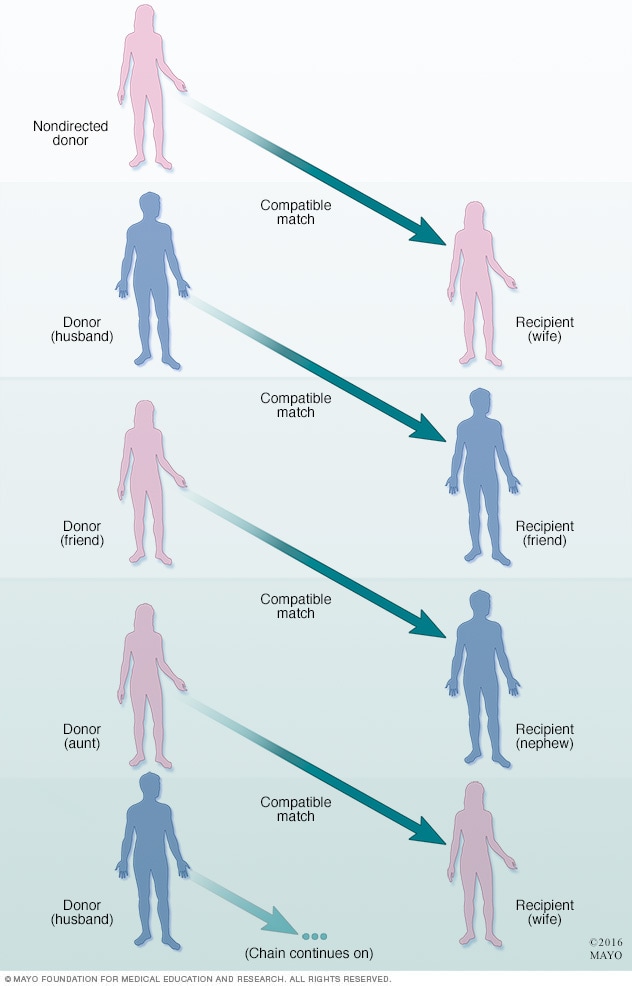
Living-donor organ donation chain
More than one pair of incompatible living donors and recipients may be linked with a nondirected living donor to form a donation chain that matches them with compatible organs.
You may choose to donate your kidney in one of two ways:
- Directed donation, in which you name a specific transplant recipient. This is the most common type of living-donor organ donation.
- Nondirected donation, also known as good Samaritan or altruistic donation, in which you do not name the recipient of the donated organ. The match is based on medical need and compatibility.
If you and your intended recipient aren't compatible, paired-organ donations or donation chain programs can help make transplants possible.
- Paired-organ donation. Two or more organ-recipient pairs trade donors so that each person gets an organ that matches their blood type. A nondirected living donor also may participate in paired-organ donation to help match incompatible pairs.
- Donation chain. More than one pair of incompatible living donors and recipients may be linked with a nondirected living donor to form a donation chain for compatible organs. When this happens, multiple recipients can benefit from a single nondirected living donor.
Risks
Donor nephrectomy comes with some risks. These may come from the surgery itself, from how well your remaining kidney works afterward, and from and the mental and emotional impact of donating an organ.
For people receiving a kidney, transplant surgery is often worth the small surgical risk because it is a potentially lifesaving procedure. For donors, however, kidney donation surgery involves the risk of and recovery from a procedure they don't need for their health.
Immediate, surgery-related risks of donor nephrectomy include:
- Pain.
- Infection.
- Hernia.
- Bleeding and blood clots.
- Wound complications and, in rare cases, death.
Living-donor kidney transplant is the most widely studied type of living organ donation, with more than 50 years of follow-up data. Studies show that people who have donated a kidney have a similar life expectancy to those who haven't donated.
Some studies show that living kidney donors may have a slightly higher risk of kidney failure compared with the general population. However, the risk of kidney failure after donor nephrectomy is still low.
Some long-term health risks of living kidney donation include high blood pressure and elevated protein levels in urine, a condition called proteinuria.
Donating a kidney or any other organ also may cause mental health issues, such as anxiety and depression. Donors may feel regret, anger, resentment or mental distress, particularly if the donated kidney fails.
Overall, most living organ donors are satisfied with their decision to donate.
Before you can donate a kidney, you'll undergo a thorough evaluation to ensure that you're eligible to donate and to reduce any risks from surgery.
How you prepare
Making an informed decision
Donating a kidney is a personal choice that deserves careful thought and consideration of both the risks and benefits. Talk through your decision with your friends, family and other people you trust.
You should not feel pressured to donate, and you may change your mind at any point.
In the U.S., living-donor transplant centers are required to provide an independent donor advocate to support the informed consent process. This advocate is often a social worker or counselor who can help you discuss your feelings and answer any questions you have.
General criteria for kidney donation include:
- Age 18 years or older.
- General good health.
- Two kidneys that work well.
- A willingness to donate.
- No history of high blood pressure, kidney disease, diabetes, certain cancers or major risk factors for heart disease.
- Completion of a thorough physical and psychological evaluation at the transplant center.
If you qualify to be a living donor, the transplant center is required to explain all aspects of organ donation and obtain your informed consent to the procedure.
Choosing a transplant center
If you're donating your kidney to a specific person, their care team may recommend a transplant center for your donor nephrectomy. If you're a nondirected donor, your healthcare professional may suggest a transplant center, or you can choose one yourself.
When considering a transplant center, you may want to:
- Learn about the number and type of transplants the center performs each year.
- Ask about the transplant center's organ donor and recipient survival rates.
- Compare transplant center statistics using the database maintained by the Scientific Registry of Transplant Recipients.
- See if the center is keeping up with the latest transplant technology and techniques. This usually means that the program is strong and growing.
- Look at additional services provided by the transplant center, such as support groups, travel arrangements and referrals to other resources.
- Find out if the transplant center participates in paired-organ donation or donation chain programs.
What you can expect
Before the procedure
After you complete the screening, evaluation and informed consent process for being a living organ donor, your donor nephrectomy surgery will be scheduled for the same day as the recipient's transplant surgery. Separate medical teams and surgeons usually perform the donor nephrectomy and the transplant surgery, but they work closely together.
You'll receive instructions about what to do the day before and the day of your kidney donation surgery. Make note of any questions you might have, such as:
- When do I need to begin fasting?
- Can I take my prescription medicines?
- If so, how soon before the surgery can I take a dose?
- Are there medicines I can buy at the store that I shouldn't use?
- When should I arrive at the hospital?
During the procedure
Donor nephrectomy
Donor nephrectomy
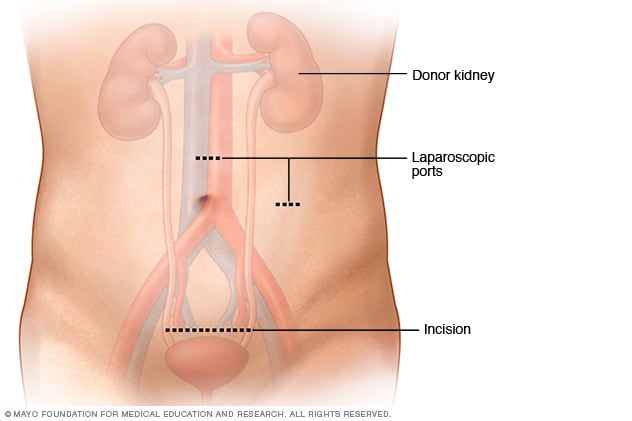
During a living-donor laparoscopic nephrectomy, two or three very small incisions (ports) about 5 to 12 millimeters in size are used to insert the laparoscopic equipment. A slightly larger, 5- to 7-centimeter incision is made above or below the bellybutton for removal of the kidney. The removal incision may be vertical or horizontal depending on your situation.
Living kidney donor laparoscopic nephrectomy
Living kidney donor laparoscopic nephrectomy
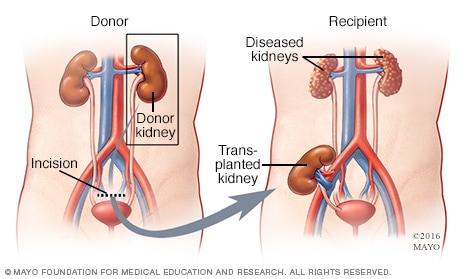
In a living-donor laparoscopic nephrectomy, the surgeon uses a special camera called a laparoscope to view the internal organs and guide the procedure to minimize scarring and recovery time. The donor kidney is removed through a small incision below the bellybutton and transplanted into the recipient.
Donor nephrectomy is done under general anesthesia. This means you will be in a sleeplike state during the procedure, which usually lasts 2 to 4 hours. The surgical team watches your heart rate, blood pressure and blood oxygen level throughout the procedure.
Surgeons almost always use a minimally invasive surgery called laparoscopic nephrectomy to take a living donor's kidney for transplant. This approach usually results in less scarring, less pain and a shorter recovery time than open nephrectomy.
In a laparoscopic nephrectomy, the surgeon usually makes two or three small cuts in the abdomen. Very small cuts are used as openings called ports to insert the surgical instruments. A slightly larger cut is used to take out the donor kidney. The tools used include a small knife, clamps and a special camera called a laparoscope. The laparoscope helps the surgeon see the internal organs and navigate during the procedure.
In an open nephrectomy, the surgeon makes a flank or upper abdominal cut to reach the kidney. Modern mini-incision techniques use a cut about 4 to 5 inches (roughly 10 to 12 centimeters) long, while the traditional approach requires a larger incision.
After the procedure
After your donor nephrectomy, you'll likely stay in the hospital for one or two days.
In addition, you can expect:
- Care after your surgery. If you live far from your transplant center, your care team will likely recommend that you stay close to the center for up to a week after you leave the hospital. This allows them to watch your health and see how well your remaining kidney is working.
You'll likely need to return to your transplant center several times after surgery for follow-up care and tests to make sure your recovery is going well. Transplant centers must submit follow-up data at six months, 12 months and 24 months after donation. Your primary care provider may conduct your laboratory tests one and two years after your kidney surgery and share the results with the transplant center. It's recommended to have regular visits with your healthcare professional at least once a year.
- Recovery. Your healthcare team will provide advice tailored to your health to help you recover and lower the risk of complications. This can include not sitting or lying in bed for long periods, not driving a car for one to two weeks, lifting restrictions for about six weeks, taking care of your surgery site, managing pain, and returning to your regular diet.
- Return to typical activities. After donating a kidney, most people are able to return to their regular daily activities after 4 to 6 weeks. You may be advised to avoid contact sports or other intense activities that could harm your kidney.
- Pregnancy. Donating a kidney typically does not affect the ability to become pregnant or have a safe pregnancy and childbirth. Some studies suggest that kidney donors may have a small increase in the risk of pregnancy complications. These complications can include gestational diabetes, pregnancy-induced hypertension, preeclampsia and protein in the urine.
Women are generally advised to wait at least six months to a year after donating a kidney before becoming pregnant. Discuss pregnancy plans with your healthcare professional.
Coping and Support
Becoming a living donor is a deeply personal choice that requires careful consideration of both the serious risks and the benefits. Reaching out to family members, friends, counselors or people who have gone through this process can be helpful.
Your transplant team also can help you with useful resources and coping strategies throughout the kidney donation and donor nephrectomy process, such as:
- Joining a support group for organ donors. Talking with others who have shared your experience can ease fears and anxiety.
- Sharing your experiences on social media. Connecting with others who have had a similar experience may help you adjust to your changing situation.
- Educating yourself. Learn as much as you can about your procedure and ask questions about things you don't understand. Knowledge is empowering.
Diet and nutrition
You should be able to go back to your regular diet soon after the kidney donation. If you don't have other health issues, you likely won't have any specific dietary restrictions related to your procedure.
Your transplant team includes a dietitian who can discuss your specific diet needs and questions with you.
Exercise
Keeping a healthy lifestyle through diet and exercise is just as important for living kidney donors as it is for everyone else.
You can usually return to your typical physical activity levels 4 to 6 weeks after a donor nephrectomy. It's important to talk with your healthcare professional before starting any new physical activity. Your transplant team can help you set physical activity goals and discuss your needs.
Some healthcare professionals advise living kidney donors to protect their remaining kidney by avoiding contact sports, such as football, boxing, hockey, soccer, martial arts or wrestling. They also may suggest wearing protective gear such as padded vests under clothing to protect the kidney from injury during sports.