Scabies Symptoms and causes
Overview
Scabies is a skin rash. A tiny mite called Sarcoptes scabiei causes it. The mite burrows into the skin, causing intense itching. The need to scratch may be stronger at night.
Scabies can spread through close, long-term person-to-person contact. This may be within a family, child care group, school class, or a place where people live together, such as a nursing home or prison. Because scabies spreads easily, healthcare professionals often treat the whole family or any close contacts.
Scabies is easy to treat. Medicated skin creams or pills kill the mites that cause scabies and their eggs. But itching may go on for weeks after treatment.
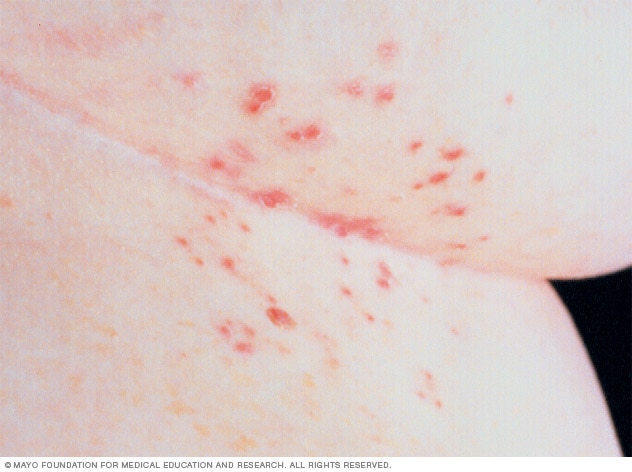
Scabies
Tiny mites that burrow into the skin cause scabies.
Symptoms
Scabies symptoms include:
- Intense itching and often worse at night.
- Thin, wavy tunnels made up of tiny blisters or bumps on the skin.
Scabies is often in the skin folds. But scabies can appear on many parts of the body. In adults and older children, scabies is most often found:
- Between the fingers and toes and on the soles of the feet.
- Around the waist.
- On the insides of the wrists, in the armpits and on the inner elbows.
- On the chest and buttocks.
- Around the nipples and belly button.
- Around the genitals.
In infants and young children, scabies most often are on the:
- Fingers.
- Scalp and face.
- Palms of the hands.
- Soles of the feet.
If you've had scabies before, symptoms may start within a few days after getting the mites. If you've never had scabies, it can take up to six weeks for symptoms to start. You can still spread scabies even if you don't have symptoms yet.
When to see a doctor
Talk to your healthcare professional if you have symptoms of scabies.
Many skin conditions, such as dermatitis or eczema, also cause itching and small bumps on the skin. Your healthcare professional can find the cause of your symptoms and prescribe the right treatment.
Causes
A tiny, eight-legged mite causes scabies. The female mite burrows just under the skin. It makes a tunnel where it lays eggs.
The eggs hatch, and the mite larvae travel to the surface of the skin, where they become adults. These mites can then spread to other areas of the skin or to the skin of other people. The itching comes from the body's allergic reaction to the mites, their eggs and their waste.
Close skin-to-skin contact and, less often, sharing clothing or bedding with a person who has scabies can spread the mites.
Pets don't spread scabies to humans. The scabies mites that affect animals don't survive or reproduce in people.
Risk factors
Risk factors for scabies include:
- Being in a child care group or school.
- Living in crowded places, such as nursing homes and prisons.
From Mayo Clinic to your inbox
Sign up for free and stay up to date on research advancements, health tips, current health topics, and expertise on managing health. Click here for an email preview.
Complications
A common complication of scabies is a bacterial infection. Scratching too much can break the skin and let in bacteria that cause the infection.
A worse type of scabies, called crusted scabies, may affect certain people including:
- Young children.
- People who live in a group setting.
- People with weakened immune systems, such as those with HIV or lymphoma, or people who have had organ transplants.
- Older people.
Crusted scabies makes the skin crusty and scaly. It affects large areas of the body. It spreads easily and can be hard to treat. People with crusted scabies need quick treatment with both a prescription pill and a skin cream.
People with crusted scabies have high numbers of mites. Crusted scabies might not itch, or itching may be mild.
Prevention
To prevent scabies from coming back and to keep the mites from spreading to other people, take these steps:
- Wash all clothes and linens. Heat kills the mites and their eggs. Use hot, soapy water to wash all clothing, towels and bedding used in the three days before beginning treatment. Dry with high heat. Dry-clean items you can't wash at home.
- Starve the mites. Place items you can't wash in sealed plastic bags. Leave them in an out-of-the-way place for a week. Mites die after a few days without food.
- Clean and vacuum. It's a good idea to clean your home to prevent scabies from spreading. This is especially true for people with crusted scabies. Vacuum furniture, carpets and floors to remove scales and crusts that may have scabies mites.
CON-20377362
Mayo Clinic does not endorse companies or products. Advertising revenue supports our not-for-profit mission.
Advertising & Sponsorship
Mayo Clinic Press
Check out these best-sellers and special offers on books and newsletters from Mayo Clinic Press.
