Overview
The canalith repositioning procedure can help relieve benign paroxysmal positional vertigo. Also called BPPV, this condition causes brief, intense feelings of dizziness and spinning. These feelings are called vertigo. They may happen with certain head movements.
Vertigo most often involves the part of the inner ear that handles balance. BPPV happens when tiny canalith particles in one part of the inner ear break loose. These particles, called otoconia, can move into the semicircular canals of the inner ear.
The particles that move into the semicircular canal make the canal sensitive to head position changes. This causes the dizziness.
The canalith repositioning procedure moves these particles to a part of the ear where they won't cause dizziness. The procedure uses several simple head movements. A healthcare professional can do it during an office visit.
The canalith repositioning procedure works for most people. It gives about 80% of people relief after one or two treatments. But the vertigo may happen again.
Products & Services
Why it's done
Inner ear and canalith repositioning
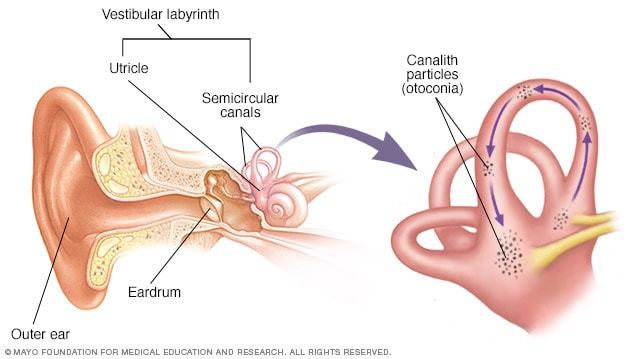
Inner ear and canalith repositioning
An issue with the nerves and structures in the inner ear that manage balance cause vertigo. This part of the inner ear is the vestibular labyrinth. It holds the semicircular canals of the inner ear. Benign paroxysmal positional vertigo, also called BPPV, happens when tiny canalith particles called otoconia break loose and fall into the wrong part of the semicircular canals. The goal of the canalith repositioning procedure is to move the particles from the inner ear to a part of the ear, called the utricle, where they won't cause vertigo.
The canalith repositioning procedure is done to relieve symptoms of BPPV. The procedure moves particles from the semicircular canals of the inner ear to an area of the ear called the utricle. Once in the utricle, these particles won't cause vertigo. The particles may dissolve or the body absorbs them.
Risks
The canalith repositioning procedure has risks that include:
- Neck or back injury.
- Moving the particles to a place where they still cause vertigo.
- Side effects, such as stomach upset, dizziness and feeling lightheaded.
Before you have the procedure, tell your healthcare professional about any medical conditions you have. These might include a neck condition, a back condition or rheumatoid arthritis.
How you prepare
You don't need to do anything to prepare for the canalith repositioning procedure. Wear clothing that lets you move freely through each position.
What you can expect
During the procedure
Canalith repositioning procedure
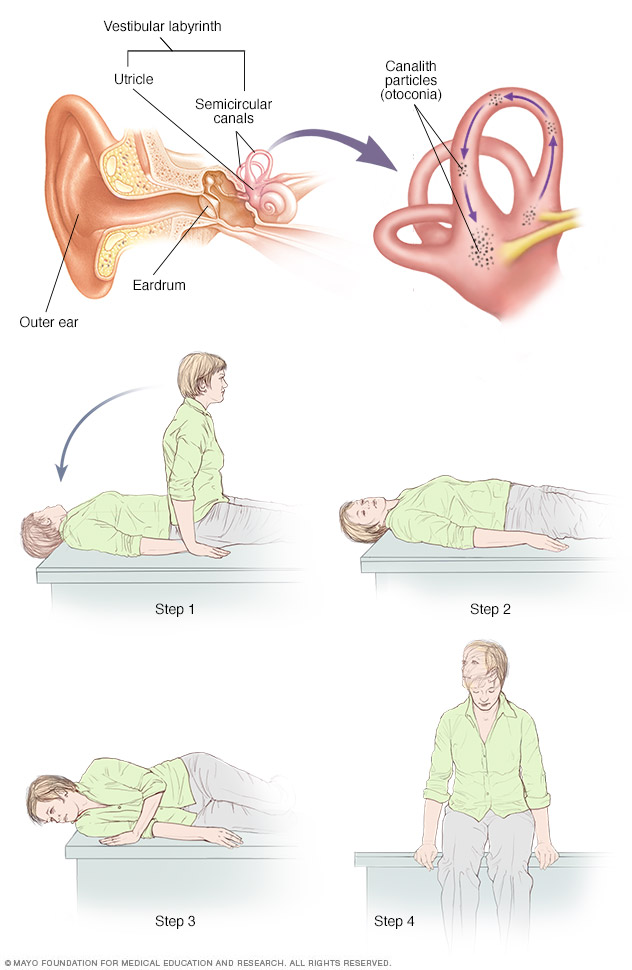
Canalith repositioning procedure
The canalith repositioning procedure can treat benign paroxysmal positional vertigo. Also called BPPV, the condition causes dizziness with certain head movements. The procedure includes head positions that move canalith particles that cause dizziness. The procedure moves the particles to a part of the ear, called the utricle, where they won't cause dizziness.
The canalith repositioning procedure involves holding four positions for about 30 seconds each or until symptoms stop. You stay in each position about 30 seconds after your symptoms have ended.
During the procedure, your healthcare professional watches your eyes for atypical movements, called nystagmus. You may repeat the procedure three or more times in one treatment session.
The canalith repositioning procedure includes these steps:
- You sit on a table and move from sitting to lying down with your head turned 45 degrees to the affected side. Your healthcare professional helps move your head over the edge of the table at a slight angle.
- You turn your head slowly to the other side.
- You roll onto your side. Your head is at a small angle while you look down at the floor.
- You return slowly to a sitting position. Your head is centered and tilted down. You may need to sit still for about 15 minutes.
After the procedure
After the procedure, do what your healthcare professional tells you. Your healthcare professional may teach you how to do the procedure on yourself. Then you can do it at home if needed. You may need to do these movements for many days before your symptoms go away.
Results
The procedure works well, with 80% of people who have the procedure getting relief. If your symptoms come back, your healthcare professional can repeat the canalith repositioning procedure. The procedure may need to be done many times to help your symptoms. Tell your healthcare professional if your symptoms don't improve.