June 26, 2026
Mayo Clinic neurosurgeons have deep experience in managing primary and metastatic spinal tumors. Optimal care requires expertise in a range of surgical techniques and the ability to determine the appropriate approach for each patient.
"En bloc resection of primary spinal tumors is highly complex and best performed at a tertiary academic center. For metastatic tumors, some patients might need a large tumor resection while others need minimally invasive surgery — or something in between," says Oluwaseun O. Akinduro, M.D., a neurosurgeon and director of spinal oncology at Mayo Clinic in Jacksonville, Florida. "The decision-making can be challenging and requires a multidisciplinary discussion with input from the oncologists, surgeons and radiation oncologists. Thankfully, all of this is fully integrated at Mayo Clinic."
Mayo Clinic uses 7T MRI and specialized MRI protocols to image spinal tumors and guide treatment plans. Carbon fiber implants, which optimize postsurgical radiation therapy and tumor surveillance, also are routinely used. The multidisciplinary care team includes neuroradiologists, neuropathologists, orthopedic surgeons, medical and radiation oncologists, and rehabilitation specialists.
"There are so many different tumor types and treatment options — so many nuances," Dr. Akinduro says. "If you don't do every single one of these things right, patients won't get the best possible care."
Complex surgery for spinal tumors is available across the enterprise.
Metastatic and primary tumor resection
The incidence of metastatic spinal tumors is increasing due to lengthening survival for people with cancer. The tumors can cause severe pain and loss of function, leading to depression. Surgery to relieve those symptoms isn't always considered.
"Yet these patients can have a reasonable prognosis, if treated at a major cancer center. They might be eligible for an immunotherapy, and targeted therapy based on their specific genetic mutations, which can improve survival," Dr. Akinduro says. "Spinal tumor surgery can help relieve these patients' pain and restore their ability to walk."
At Mayo Clinic, the multidisciplinary spinal team discusses each patient to determine the optimal strategy. The heterogeneity of metastatic tumors complicates these decisions. "Artificial intelligence (AI) algorithms and new treatment paradigms are part of our decision-making framework," Dr. Akinduro says.
Surgical options include:
- Minimally invasive tubular decompression, to relieve pressure on the spinal cord and nerves.
- Radiofrequency ablation, to ablate cancerous tissue and nerve endings.
- Cement augmentation, to stabilize the spine and relieve pain.
- Corpectomy, to decompress and stabilize the spine.
"We have had countless patients who were able to walk again after spinal tumor surgery," Dr. Akinduro says. "We've also seen a few patients who couldn't leave a hospital because their severe pain required intravenous pain medication. After surgery, those patients were able to go home to their families."
 Preoperative imaging
Preoperative sagittal (left) and axial (right) MRI demonstrates a T2 hyperintense tumor in the L3 vertebral body, causing severe compression of the caudal equina nerves.
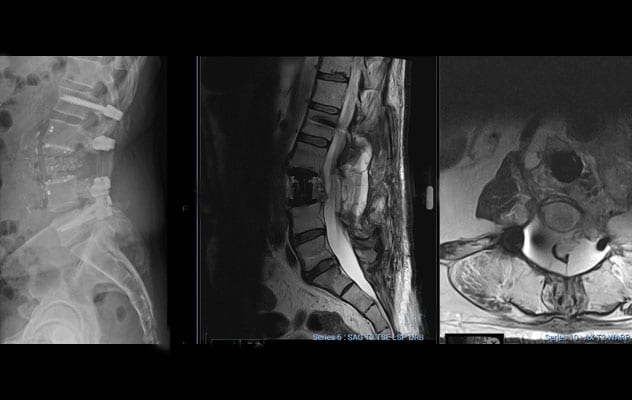 Postoperative imaging
Postoperative imaging after en bloc resection of malignant spinal undifferentiated pleomorphic sarcoma. X-ray (left) shows a hybrid carbon fiber-titanium construct, with carbon fiber at the tumor's levels and titanium at the top and bottom. MRI scans (middle and right) demonstrate resection with no residual tumor or spinal canal compression.
En bloc resection with wide tumor margins — the gold standard treatment for primary spinal tumors — requires surgical expertise and multidisciplinary care. Mayo Clinic's vascular, thoracic and plastic surgeons can assist with these time-consuming procedures as needed. Nurses and other professionals in the intensive care unit also have experience caring for these patients.
Radiation therapy typically follows surgical resection. Carbon ion radiotherapy — an advanced form of particle therapy that uses accelerated carbon ions to destroy tumor DNA — will soon be available. Mayo Clinic's campus in Florida is building the first carbon ion therapy facility in the Americas. "This technology will be very beneficial in treating these solid tumors," Dr. Akinduro says.
Treatment-focused research
Mayo Clinic is at the forefront of research to develop more-effective treatment of spinal tumors. One focus is yes-associated protein (YAP), which regulates gene transcription and cell proliferation. Researchers in Dr. Akinduro's spinal oncology laboratory found that inhibiting YAP decreases the growth of spinal tumors and sensitizes them to radiation.
"Our recent work indicates that YAP also reprograms the tumor microenvironment so that tumor cells are more visible to the immune system," Dr. Akinduro says. "Inhibiting YAP could potentially make primary and metastatic spinal tumors more responsive to immunotherapy."
The researchers use microparticles to deliver verteporfin — a potent YAP inhibitor — directly to spinal tumors in laboratory models. "Our ultimate goal is to one day use verteporfin microparticles to treat patients with advanced chordoma, sarcoma and metastatic tumors," Dr. Akinduro says. "We anticipate that would be a way to not only prevent tumor growth but also shrink tumors and improve the efficacy of radiation and immunotherapy." He notes that improving tumors' sensitivity to radiation might allow for lower radiation doses, to safeguard surrounding healthy tissue.
Another project involves developing an AI decision support tool to predict survival and ambulatory outcomes in patients with spinal metastases. The tool integrates MRI radiomics, CT bone features, X-ray alignment metrics, digital histopathology and structured clinical data.
The target of this laboratory research is to improve patient care. "As an academic institution, Mayo Clinic is able to combine translational research with a focus on patient outcomes," Dr. Akinduro says. "Our collaboration extends across the specialties in our institution but also with referring physicians. We strive to accommodate patients whose physicians contact us and to help when we can with any administrative roadblocks."
For more information
Refer a patient to Mayo Clinic.