Hearing loss Symptoms and causes
Overview
Hearing loss that comes on little by little as you age, also known as presbycusis (pres-bih-KU-sis), is common. Nearly half the people in the United States older than age 75 have some age-related hearing loss.
There are three types of hearing loss:
- Conductive, which involves the outer or middle ear.
- Sensorineural, which involves the inner ear.
- Mixed, which is a mix of the two.
Aging and being around loud noises both can cause hearing loss. Other factors, such as too much earwax, can make it harder to hear for a time.
You usually can't get hearing back. But there are ways to improve what you hear.
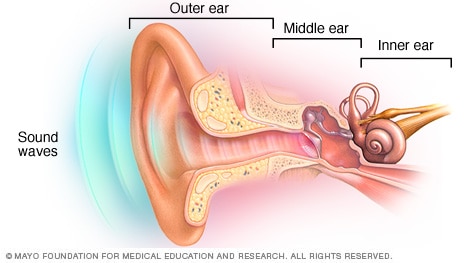
Parts of the ear
The ear is made up of three primary parts: the outer ear, middle ear and inner ear. Each section is composed of structures that play distinct roles in the process of converting sound waves into signals that go to the brain.
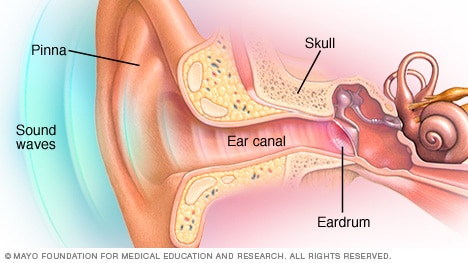
Outer ear
The outer ear is composed of the visible part of the ear (pinna) and the ear canal. The cup-shaped pinna (PIN-uh) gathers sound waves from the environment and directs them into the ear canal.
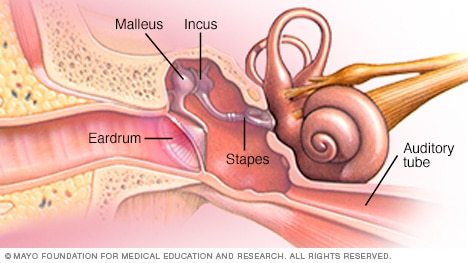
Middle ear
The middle ear is an air-filled cavity that holds a chain of three bones: the hammer (malleus), the anvil (incus) and the stirrup (stapes). These bones are separated from the outer ear by the eardrum (tympanic membrane), which vibrates when struck by a sound wave.
The middle ear is an air-filled cavity that holds a chain of three bones: the hammer (malleus), the anvil (incus) and the stirrup (stapes). These bones are separated from the outer ear by the eardrum (tympanic membrane), which vibrates when struck by a sound wave.
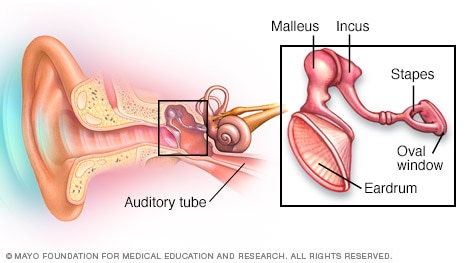
Bones of the middle ear
The middle ear contains three tiny bones:
- Hammer (malleus) — attached to eardrum
- Anvil (incus) — in the middle of the chain of bones
- Stirrup (stapes) — attached to the membrane-covered opening that connects the middle ear with the inner ear (oval window)
The vibration of the eardrum triggers a chain of vibrations through the bones. Because of differences in the size, shape and position of the three bones, the force of the vibration increases by the time it reaches the inner ear. This increase in force is necessary to transfer the energy of the sound wave to the fluid of the inner ear.
Inner ear
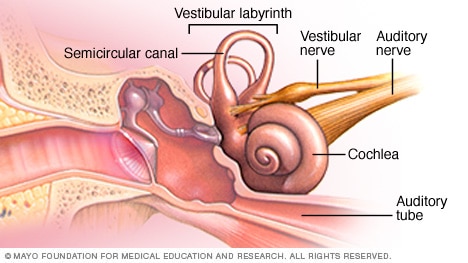
The inner ear contains a group of interconnected, fluid-filled chambers. The snail-shaped chamber, called the cochlea (KOK-lee-uh), plays a role in hearing. Sound vibrations from the bones of the middle ear are transferred to the fluids of the cochlea. Tiny sensors (hair cells) lining the cochlea convert the vibrations into electrical impulses that are transmitted along the auditory nerve to your brain. This is where the initial damage and hearing loss occur due to age, noise exposure or medication.
The other fluid-filled chambers of the inner ear include three tubes called the semicircular canals (vestibular labyrinth). Hair cells in the semicircular canals detect the motion of the fluid when you move in any direction. They convert the motion into electrical signals that are transmitted along the vestibular nerve to the brain. This sensory information enables you to maintain your sense of balance.
Traveling to the brain
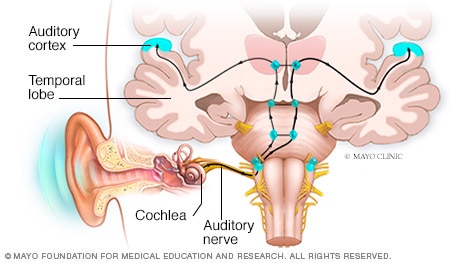
Electrical impulses travel along the auditory nerve and pass through several information-processing centers. Signals from the right ear travel to the auditory cortex located in the temporal lobe on the left side of the brain. Signals from the left ear travel to the right auditory cortex.
The auditory cortices sort, process, interpret and file information about the sound. The comparison and analysis of all the signals that reach the brain enable you to detect certain sounds and suppress other sounds as background noise.
Symptoms
Symptoms of hearing loss may include:
- Muffling of speech and other sounds.
- Trouble understanding words, especially when in a crowd or a noisy place.
- Trouble hearing the sounds of letters of the alphabet that aren't vowels.
- Often asking others to speak more slowly, clearly and loudly.
- Needing to turn up the volume of the television or radio.
- Staying clear of some social settings.
- Being bothered by background noise.
- Ringing in the ears, known as tinnitus.
When to see a doctor
If you have a sudden loss of hearing, particularly in one ear, seek medical attention right away.
Talk to your healthcare professional if loss of hearing is causing you trouble. Age-related hearing loss happens little by little. So you may not notice it at first.
Causes
To understand how hearing loss happens, it can be helpful to understand how hearing works.
How you hear
Middle ear
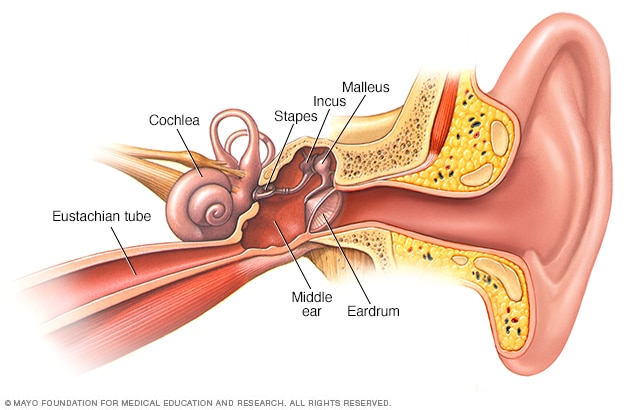
The middle ear has three small bones: the hammer, also called the malleus; the anvil, also called the incus; and the stirrup, also called the stapes. The eardrum lies between these bones and the outer ear. A narrow path called the eustachian tube joins the middle ear to the back of the nose and upper part of the throat. The cochlea, a snail-shaped structure, is part of your inner ear.
The ear has three main parts: the outer ear, middle ear and inner ear. Sound waves pass through the outer ear and cause the eardrum to vibrate. The eardrum and three small bones of the middle ear make the vibrations bigger as they travel to the inner ear. There, the vibrations pass through fluid in a snail-shaped part of the inner ear, known as the cochlea.
Attached to nerve cells in the cochlea are thousands of tiny hairs that help turn sound vibrations into electrical signals. The electrical signals are sent to the brain. The brain turns these signals into sound.
How hearing loss can occur
Causes of hearing loss include:
-
Damage to the inner ear. Aging and loud noise can cause wear and tear on the hairs or nerve cells in the cochlea that send sound signals to the brain. Damaged or missing hairs or nerve cells don't send electrical signals well. This causes hearing loss.
Higher pitched tones may seem muffled. It may be hard to pick out words against background noise.
- Buildup of earwax. Over time, earwax can block the ear canal and keep sound waves from passing through. Earwax removal can help restore hearing.
- Ear infection or unusual bone growths or tumors. In the outer or middle ear, any of these can cause hearing loss.
- Ruptured eardrum, also known as tympanic membrane perforation. Loud blasts of noise, sudden changes in pressure, poking an eardrum with an object and infection can cause the eardrum to burst.
Risk factors
Factors that damage or lead to loss of the hairs and nerve cells in the inner ear include:
- Aging. The inner ear breaks down over time.
- Loud noise. Being around loud sounds can damage the cells of the inner ear. Damage can happen by being around loud noises over time. Or the damage can come from a short blast of noise, such as from a gunshot.
- Traits passed down in families. Your genes may make you more likely to have ear damage from sound or from aging.
- Noises on the job. Jobs where loud noise is constant, such as farming, construction or factory work, can lead to damage inside the ear.
- Noises at play. Activities with dangerously high noise levels include snowmobiling, motorcycling, carpentry or listening to loud music. Also, exposure to explosive noises, such as from firearms and jet engines, can cause immediate, permanent hearing loss.
- Some medicines. These include the antibiotic gentamicin, sildenafil (Revatio, Viagra) and certain medicines used to treat cancer, which can damage the inner ear. Very high doses of aspirin, other pain relievers, antimalarial medicines or loop diuretics can cause short-term effects on hearing. These include ringing in the ears, also known as tinnitus, or hearing loss.
- Some illnesses. Illnesses such as meningitis that cause high fever can harm the cochlea.
Comparing loudness of common sounds
The chart below lists common sounds and their decibel levels. A decibel is a unit used to measure how loud sound is. The Centers for Disease Control and Prevention says noise above 70 decibels over time can start to damage hearing. The louder the noise, the less time it takes to cause lasting hearing damage.
| Decibels | Noise source |
|---|---|
| Safe range | |
| 30 | Whisper |
| 40 | Refrigerator |
| 60 | Normal conversation |
| 75 | Dishwasher |
| Decibels | Noise source |
| Risk range | |
| 85 | Heavy city traffic, school cafeteria |
| 95 | Motorcycle |
| 100 | Snowmobile |
| 110 | Chainsaw, jackhammer, rock concert, symphony |
| 115 | Sandblasting |
| 120 | Ambulance siren, thunder |
| 140-165 | Firecracker, firearms |
Longest amount of time to be around loud sounds
Below are the loudest noise levels people can be around on a job without hearing protection and for how long.
| Sound level, decibels | Duration, daily |
|---|---|
| 90 | 8 hours |
| 92 | 6 hours |
| 95 | 4 hours |
| 97 | 3 hours |
| 100 | 2 hours |
| 102 | 1.5 hours |
| 105 | 1 hour |
| 110 | 30 minutes |
| 115 | 15 minutes or less |
Based on The National Institute for Occupational Safety and Health (NIOSH), 2018.
From Mayo Clinic to your inbox
Sign up for free and stay up to date on research advancements, health tips, current health topics, and expertise on managing health. Click here for an email preview.
Complications
Hearing loss can make life less pleasant. Older adults with hearing loss often report being depressed. Because hearing loss can make it harder to talk with others, some people with hearing loss feel cut off from others. Hearing loss also is linked to loss of thinking skills, known as cognitive impairment.
Hearing loss also is linked to risk of falling.
Prevention
The following steps can help prevent hearing loss from loud noises and keep hearing loss due to aging from getting worse:
- Protect your ears. Staying away from loud noise is the best protection. In the workplace, plastic earplugs or glycerin-filled earmuffs can help protect hearing.
- Have your hearing tested. If you work around a lot of noise, think about regular hearing tests. If you've lost some hearing, you can take steps to prevent further loss.
- Avoid risks from hobbies and play. Riding a snowmobile or a jet ski, hunting, using power tools, or listening to rock concerts can damage hearing over time. Wearing hearing protectors or taking breaks from the noise can protect your ears. Turning down the volume when listening to music helps too.
CON-20373050
Mayo Clinic does not endorse companies or products. Advertising revenue supports our not-for-profit mission.
Advertising & Sponsorship
Mayo Clinic Press
Check out these best-sellers and special offers on books and newsletters from Mayo Clinic Press.
