Overview
Total anomalous pulmonary venous return
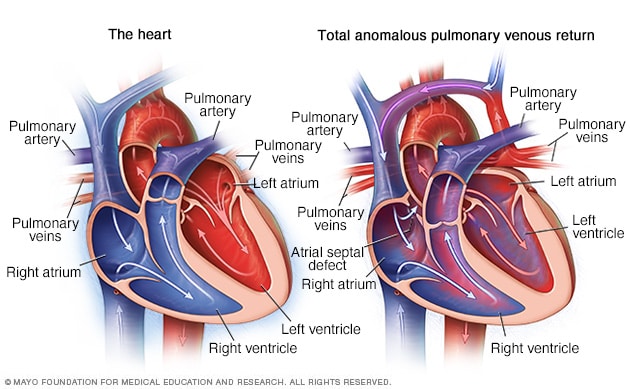
Total anomalous pulmonary venous return
In total anomalous pulmonary venous return (TAPVR), the pulmonary veins incorrectly send blood to the heart's upper right chamber. That chamber is called the right atrium. As a result, oxygen-rich blood, shown in red, mixes with oxygen-poor blood, as shown in blue. In a typical heart, shown on the left, oxygen-rich blood flows from the pulmonary veins to the heart's upper left chamber, called the left atrium.
Total anomalous pulmonary venous return (TAPVR) is a rare heart condition that's present at birth. That means it's a congenital heart defect. You also may hear this called congenital heart disease.
In this heart condition, blood vessels that return blood from the lungs to the heart, called the pulmonary veins, attach to the wrong place in the heart.
In a typical heart, oxygen-rich blood flows from the lungs to the upper left heart chamber, called the left atrium. Blood then goes to the rest of the body.
In TAPVR, where the veins connect is changed. Instead of flowing through the left atrium, blood flows through the upper right heart chamber, called the right atrium. This change in blood flow causes the oxygen-rich blood from the pulmonary veins to mix with oxygen-poor blood that also flows into the right atrium. As a result, blood flowing to the body doesn't have enough oxygen.
Another name for this condition is total anomalous pulmonary venous connection (TAPVC). The names TAPVR and TAPVC refer to the same congenital heart defect. Both terms are used and widely accepted.
TAPVR is different from partial anomalous pulmonary venous return (PAPVR). In PAPVR, only some of the pulmonary veins attach to the wrong place in the heart. Some veins are not affected.
Products & Services
Types
TAPVR types are classified by where the pulmonary veins connect and drain. There are four major types:
- Supracardiac: The pulmonary veins connect above the heart, usually through a vein that carries blood to the major vein, called the superior vena cava. The superior vena cava brings oxygen-poor blood to the right side of the heart.
- Infracardiac/infradiaphragmatic: The pulmonary veins connect below the heart and diaphragm, most often to a vein in the liver called the portal vein. Other connections are also possible.
- Intracardiac: The pulmonary veins connect directly to the right side of the heart, usually through a vein called the coronary sinus, or connect directly into the right atrium.
- Mixed: The pulmonary veins have more than one type of atypical connection. For example, three veins may drain together while the fourth drains through a different pathway.
Supracardiac TAPVR is the most common type. Between 40% and 50% of people with TAPVR have the supracardiac type.
There also are differences between obstructed and unobstructed TAPVR.
In obstructed TAPVR, the atypical pathway is narrowed or blocked. This makes it difficult for blood to leave the lungs, causing pressure and fluid to build up in the lungs. Newborns and infants with obstructed TAPVR can become very sick soon after birth.
In unobstructed TAPVR, there is no major narrowing or blockage in the atypical pathway. Blood can flow more easily, but it still returns to the wrong side of the heart. This causes too much blood to flow through the lungs and makes the right side of the heart work harder. Symptoms may be mild at first, but babies can develop serious symptoms over time.
Symptoms
Symptoms of total anomalous pulmonary venous return (TAPVR) in newborns and infants may include:
- Trouble breathing.
- Poor feeding.
- Weak pulse.
- A change in skin color due to low oxygen levels. This is called cyanosis. The skin may appear gray or blue. Depending on skin color, these changes may be easier or harder to see.
Symptoms of TAPVR may appear soon after birth. But some people don't have symptoms until later in life. Newborns and infants with obstructed TAPVR often become very sick soon after birth. Babies with unobstructed TAPVR may have milder symptoms at first. Serious symptoms may develop over time.
When to seek care
Serious congenital heart defects are often diagnosed before or soon after a child is born. If you think that your newborn or infant has symptoms of total anomalous pulmonary venous return (TAPVR), call your child's healthcare professional.
Causes
The exact cause of most congenital heart defects, including total anomalous pulmonary venous return (TAPVR), is not known. Most congenital heart defects result from changes that happen early as the baby's heart develops before birth.
Changes in the genes, some medicines or health conditions, and environmental or lifestyle factors, such as smoking, may play a role.
Risk factors
There are no known risk factors specifically for TAPVR. Possible risk factors for congenital heart defects in general may include:
- Rubella, also called German measles. Having rubella during pregnancy can change how the baby's heart develops. A blood test can be done before pregnancy to see if you're immune to rubella. If you're not, you can get a vaccine.
- Diabetes. Having type 1 or type 2 diabetes during pregnancy may change how the baby's heart grows during pregnancy. Diabetes that develops during pregnancy is called gestational diabetes. Gestational diabetes generally doesn't raise the risk of congenital heart disease.
- Genetics. Although TAPVR doesn't usually run in families, changes in genes have been linked to heart conditions at birth. For example, people with Down syndrome are often born with heart conditions.
- Smoking. If you smoke, quit. Smoking during pregnancy or exposure to secondhand smoke raises the risk of congenital heart defects in the baby.
- Alcohol use. Drinking alcohol during pregnancy has been linked to heart conditions in the baby.
- Some medicines. Some medicines taken during pregnancy may raise the risk of congenital heart defects. These medicines include lithium (Lithobid) for bipolar disorder and isotretinoin (Claravis, Myorisan, others), which is used to treat acne. Talk to your healthcare team about the medicines you take.
Sept. 30, 2026