Overview
Smallpox is a serious and often deadly viral infection. It's contagious, which means it spreads from person to person. It can cause lifelong scarring and affect appearance.
Smallpox affected humans for thousands of years. But by 1980, smallpox vaccines had wiped it out around the world. The last report of someone getting smallpox was in 1977.
The virus no longer lives in the natural world. But researchers have kept samples of smallpox virus for study. And they can make smallpox in a lab. Having smallpox samples in labs raises concerns that someone could use smallpox as a biological weapon to cause widespread disease and death.
Vaccines prevent smallpox. But most people are not likely to have contact with natural smallpox. So experts don't suggest vaccination for everyone. Also, there are newer medicines to treat people who get smallpox.
Products & Services
Symptoms
Smallpox
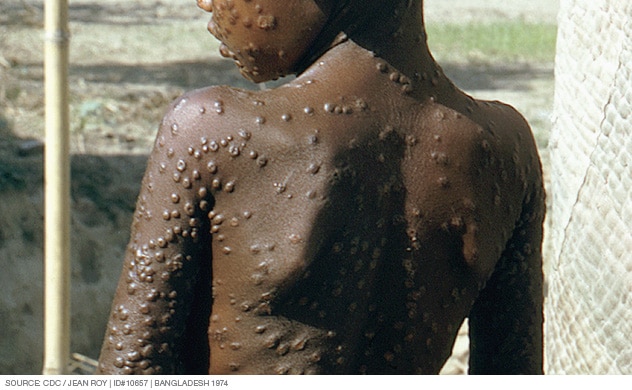
Smallpox
These are smallpox sores on the skin. This photograph was taken in Bangladesh in 1974.
When people got sick with smallpox, the first symptoms appeared within 7 to 19 days after contact with the smallpox virus. This is called the incubation period.
After the incubation period, smallpox symptoms include:
- Fever.
- Muscle aches.
- Headache.
- Extreme tiredness.
- Back pain.
- Vomiting.
A few days later, flat spots appear on the body. The spots may look red, purple or brown depending on skin color. The spots often start in the mouth and on the tongue and then spread to the skin.
The spots on the skin appear on the face, arms and legs first. Next, they show up on the main part of the body, called the trunk, and then the hands and feet.
Within a day or two, many of the spots turn into small blisters filled with clear fluid. Later, the blisters fill with pus. These sores are called pustules. Scabs form 8 to 9 days later and then fall off, leaving deep, pitted scars.
People who have smallpox can spread it to others from the time the rash starts until all the scabs fall off.
Causes
The variola virus causes smallpox. These are ways the virus spreads:
- From person to person. You can catch smallpox by being around someone who has it. People who are infected spread the virus when they cough, sneeze or talk. Having contact with smallpox skin sores also can lead to getting smallpox.
- From items. Smallpox can spread through contact with clothing and bedding touched by scabs and fluid from the sores. But people are less likely to get smallpox this way than by direct contact with a person who has been infected.
- Through the air. Rarely, smallpox can spread from an infected person through the air inside buildings. This may infect people in other rooms or on other floors.
- As a weapon. It's not likely that anyone would use smallpox as a weapon. But releasing the virus could spread the disease quickly. Governments are ready in case it happens.
Risk factors
There is no known natural risk of catching the virus that causes smallpox. There is a small risk of smallpox from laboratory work or if the virus is used as a biological weapon.
Complications
Complications of smallpox include:
- Bad scars, mainly on the face, arms and legs.
- Blindness.
- Death.
Prevention
A smallpox vaccine can protect people from getting sick. If someone who is vaccinated gets sick, the illness likely won't be as bad as it would be for someone who isn't vaccinated. You need to get the vaccine within a week of contact with the virus. Earlier is better.
If a smallpox outbreak happened, keeping people with the infection away from others, called isolation, would be a way to try to stop the spread of the virus. Those who had contact with someone infected with the virus would need a smallpox vaccine.
There are two vaccines for smallpox:
- The ACAM2000 vaccine uses a live virus that's like smallpox but is less harmful. It sometimes can cause serious side effects, such as infections in the heart or brain. That's why the vaccine is not given to everyone. Unless there is a smallpox outbreak, the risks of getting the vaccine outweigh the benefit for most people.
- A second vaccine called Jynneos uses a weak strain of the virus. It's safer than ACAM2000. People who can't take ACAM2000 because of weakened immune systems or skin disorders may be able to take Jynneos.
People vaccinated as children
People who had the smallpox vaccine as a child had full or partial protection against the smallpox virus, called immunity, for up to 10 years. Booster shots may have raised protection up to 20 years. If there were a smallpox outbreak today, people who were vaccinated as children likely would need a new vaccination if they had contact with the virus.
History of infectious disease outbreaks and vaccines timeline.
Learn about the history of major disease outbreaks, epidemics and pandemics, as well as the impact vaccines and research had on many infectious diseases.
Find out more at History of infectious disease outbreaks and vaccines timeline.