Diagnosis
Diagnosing invasive lobular carcinoma (ILC) and other kinds of breast cancer often begins with a breast exam and a discussion of your symptoms. Imaging tests, such as mammogram, ultrasound and MRI, can look at the breast tissue for anything that's not typical. To confirm whether there is cancer or not, a sample of tissue is removed from the area of concern in the breast. The tissue is tested for signs of cancer.
Breast exam
During a breast exam, a healthcare professional looks at the breasts for anything that's not typical. This might include changes in the skin or to the nipple. Then the health professional feels the breasts for lumps. The health professional also feels along the collarbones and around the armpits for lumps.
Mammogram
Receiving a mammogram
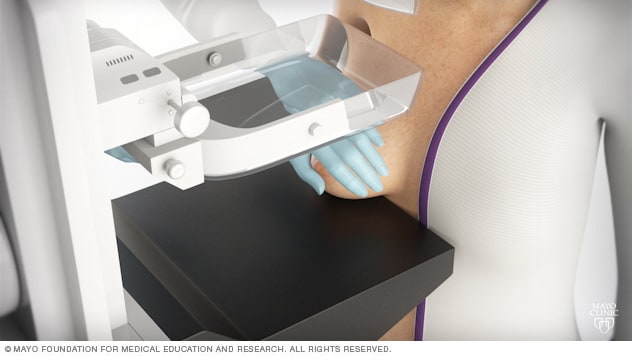
Receiving a mammogram
During a mammogram, you stand in front of an X-ray machine designed for mammography. A technician places your breast on a platform and positions the platform to match your height. The technician helps you position your head, arms and torso to allow a clear view of your breast.
A mammogram is an X-ray of the breast tissue. Mammograms are commonly used to screen for breast cancer. If a screening mammogram finds something concerning, you might have another mammogram to look at the area more closely. This more-detailed mammogram is called a diagnostic mammogram. It's often used to look closely at both breasts. Invasive lobular carcinoma is less likely to be detected on a mammogram than other types of breast cancer are. Still, a mammogram is a useful diagnostic test.
Breast ultrasound
Ultrasound uses sound waves to make pictures of structures inside the body. A breast ultrasound may give your healthcare team more information about a breast lump. For example, an ultrasound might show whether the lump is a solid mass or a fluid-filled cyst. The healthcare team uses this information to decide what tests you might need next. Invasive lobular carcinoma may be more difficult to detect with ultrasound than other types of breast cancer.
Breast MRI
Breast MRI
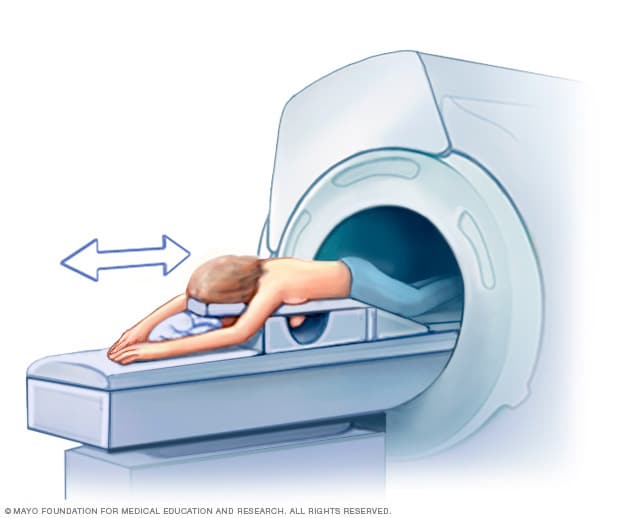
Breast MRI
Getting a breast MRI involves lying face down on a padded scanning table. The breasts fit into a hollow space in the table. The hollow has coils that get signals from the MRI. The table slides into the large opening of the MRI machine.
MRI machines use a magnetic field and radio waves to create pictures of the inside of the body. A breast MRI can make more-detailed pictures of the breast. Sometimes this method is used to look closely for any other areas of cancer in the affected breast. It also might be used to look for cancer in the other breast. Before a breast MRI, you usually receive an injection of contrast. The contrast material helps the tissue show up better in the images. MRI helps show the size of an invasive lobular carcinoma when the cancer is hard to see on other imaging tests.
Breast biopsy
Core needle biopsy
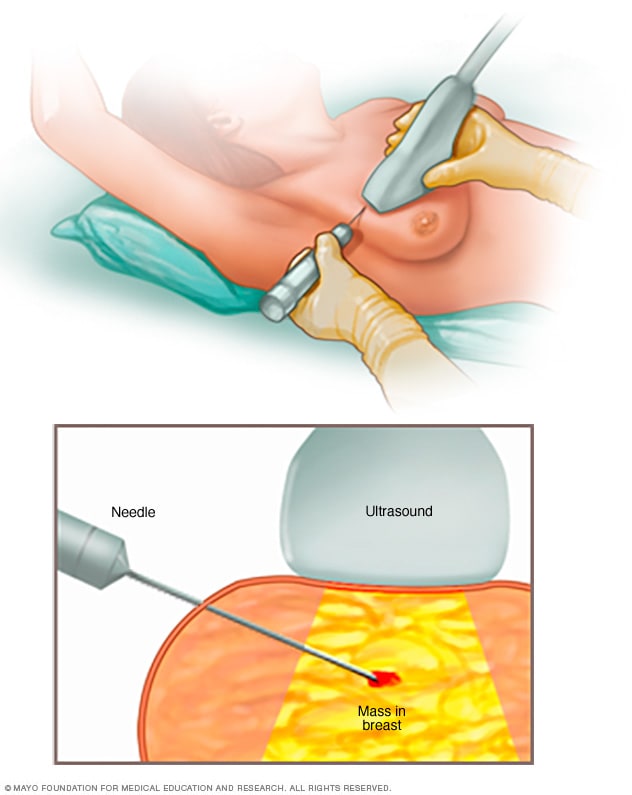
Core needle biopsy
A core needle biopsy uses a long, hollow tube to obtain a sample of tissue. The sample is sent to a lab for testing by doctors who specialize in analyzing blood and body tissue, called pathologists.
A biopsy is a procedure to remove a sample of tissue for testing in a lab. For a breast biopsy, a healthcare professional often puts a needle through the skin and into the breast tissue. The health professional guides the needle using images created with X-rays, ultrasound or another type of imaging. Once the needle reaches the right place, the health professional uses the needle to draw out tissue from the breast. Often, a marker is placed in the spot where the tissue sample was removed. This small metal marker will show up on imaging tests. The marker helps your healthcare team mark the area of concern.
Lab testing
The tissue sample from a biopsy goes to a lab for testing. Tests can show whether the cells in the sample are cancerous. Other tests give more details about the cells. The testing is done by pathologists. Pathologists are doctors who look for disease in cells, fluids and tissue removed from the body.
Results are often given in a pathology report. The results may show:
- Cell type. The results show whether the cancer cells are ductal cells, lobular cells or other kinds of cells. Invasive lobular carcinoma contains lobular cells.
- Cell grade. The grade of the breast cancer cells is based on how the cells look under a microscope. The grade tells the healthcare team whether the cancer is likely to grow slowly or quickly.
- E-cadherin status. Epithelial cadherin, which is often shortened to E-cadherin, is a protein that helps cells stick together. It's often missing from invasive lobular carcinoma cells. A test that looks for this protein may help the pathologist decide whether the cancer is lobular or ductal. This test isn't always needed.
- Hormone receptor status. Most breast cancer cells use the hormones estrogen and progesterone to help them grow. Cells that do this have receptors that help them catch the hormones circulating in the bloodstream. If testing finds receptors for one or both hormones, the cancer is hormone receptor positive. If testing doesn't find receptors, then the cancer is hormone receptor negative.
- HER2 status. Some breast cancer cells use a protein called human epidermal growth factor receptor 2 (HER2) to help them grow. Healthy breast cells make some HER2, but the cancer cells can make a lot more. If tests show the cancer cells have extra copies of the HER2 gene or increased levels of the HER2 protein, the cancer is HER2 positive. If testing doesn't find these, the cancer is HER2 negative.
- Ki-67 score. Ki-67 is a protein that marks how fast the cancer cells divide, also called the proliferation rate. The Ki-67 score goes from 0% to 100%. A higher score suggests a higher rate of dividing cells and faster growth.
The healthcare team uses the results from lab tests to decide on the cancer's stage, understand the prognosis and make a treatment plan.
Staging tests
Once your healthcare team diagnoses invasive lobular carcinoma, you may have other tests to figure out the extent of the cancer. This is called the cancer's stage. Your healthcare team uses your cancer's stage to understand your prognosis.
Complete information about your cancer's stage may not be available until after breast cancer surgery.
Tests and procedures used to stage invasive lobular carcinoma may include:
Not everyone needs all of these tests. Your healthcare team picks the tests based on your specific situation.
The stages of invasive lobular carcinoma are the same as the stages for other types of breast cancer. Breast cancer stages range from 0 to 4. A lower number means the cancer is less advanced and more likely to be cured. As the cancer grows into the breast tissue and gets more advanced, the stages get higher.
More Information
Grades
A cancer's grade is a number that tells the healthcare team how different the cancer cells look from healthy cells. The grades of invasive lobular carcinoma (ILC) go from 1 to 3.
To decide on the grade, doctors in the lab, called pathologists, use a microscope to look at the cancer cells from a biopsy. If the cancer cells look similar to healthy cells, then the cancer cells are low grade. Low-grade cancer grows slowly. If the cancer cells look very different from healthy cells, then the cancer cells are high grade. High-grade cancer grows quickly.
The grades of invasive lobular carcinoma include:
- Grade 1. Grade 1 is a low grade. The cancer cells look similar to healthy cells. Grade 1 invasive lobular carcinoma typically grows slowly and has a low risk of spreading. It's sometimes called well-differentiated cancer.
- Grade 2. Grade 2 is an intermediate grade. The cancer cells look a little different from healthy cells. Grade 2 invasive lobular carcinoma grows more quickly than a grade 1 cancer. It also has a higher risk of spreading. Sometimes it's called moderately differentiated cancer.
- Grade 3. Grade 3 is a high grade. The cancer cells look very different from healthy cells. Grade 3 invasive lobular carcinoma is considered a fast-growing cancer. It has the highest risk of spreading. Sometimes it's called poorly differentiated cancer.
Most invasive lobular carcinomas are grade 1 or 2. The grade helps the healthcare team understand the prognosis and make a treatment plan.
Coping and support
Learning you have invasive lobular carcinoma can be unexpected, and it's natural to have questions about what comes next. You may be receiving a lot of information and facing decisions about surgery, radiation and medical treatments. It's common to have a range of feelings that may change from day to day, and it can take time to process everything. As you move forward, here are some ideas that might be helpful.
Learn enough to make decisions about your care
If you'd like to know more about your cancer, ask your healthcare team for the details. Write down the type, stage and hormone receptor status. Ask for good sources of information where you can learn more about your treatment options.
Knowing more about your cancer and your options may help you feel more confident when making treatment decisions. Still, some people don't want to know the details of their cancer. If this is how you feel, let your care team know that too.
Find a good listener
Finding someone who is willing to listen to you talk about your hopes and fears can be helpful as you manage a cancer diagnosis. This could be a friend or family member. A counselor, medical social worker or clergy member also may offer helpful guidance and care.
Talk with other breast cancer survivors
You may find it helpful and encouraging to talk to others who have been diagnosed with breast cancer. Ask your healthcare team about support groups in your area, or contact the American Cancer Society or another cancer organization in your area to find resources. Find support online through Mayo Clinic Connect, a community where you can connect with others for support, practical information and answers to everyday questions.
Preparing for your appointment
Make an appointment with a doctor or other healthcare professional if you have any symptoms that worry you. If an exam or imaging test shows you might have invasive lobular carcinoma, your healthcare team will likely refer you to a specialist.
Specialists who care for people with breast cancer include:
- Breast health specialists.
- Breast surgeons.
- Doctors who specialize in diagnostic tests, such as mammograms, called radiologists.
- Doctors who specialize in treating cancer, called oncologists.
- Doctors who treat cancer with radiation, called radiation oncologists.
- Genetic counselors.
- Plastic surgeons.
What you can do to prepare
- Write down any symptoms you're experiencing, including any that may seem unrelated to the reason for which you scheduled the appointment.
- Write down key personal information, including any major stresses or recent life changes.
- Write down your family history of cancer. Note any family members who have had cancer. Note how each member is related to you, the type of cancer, the age at diagnosis and whether each person survived.
- Make a list of all medicines, vitamins or supplements that you're taking.
- Keep all of your records that relate to your cancer diagnosis and treatment. Organize your records in a binder or folder that you can take to your appointments.
- Consider taking a family member or friend along. Sometimes it can be difficult to remember all the information given during an appointment. Someone who goes with you may remember something that you missed or forgot.
- Write down questions to ask your healthcare professional.
Questions to ask your doctor
Your time with your healthcare professional is limited. Prepare a list of questions so that you can make the most of your time together. List your questions from most important to least important in case time runs out. For invasive lobular carcinoma, some basic questions to ask include:
- What type of breast cancer do I have?
- What is the stage of my cancer?
- Can you explain my pathology report to me? Can I have a copy for my records?
- Do I need any more tests?
- What treatment options are available for me?
- What are the benefits from each treatment you recommend?
- What are the side effects of each treatment option?
- How will each treatment option affect my daily life? Can I continue working?
- Is there one treatment you recommend over the others?
- How do you know that these treatments will benefit me?
- What would you recommend to a friend or family member in my situation?
- How quickly do I need to make a decision about cancer treatment?
- What happens if I don't want cancer treatment?
- What will cancer treatment cost?
- Does my insurance plan cover the tests and treatment you're recommending?
- Should I seek a second opinion? Will my insurance cover it?
- Are there any brochures or other printed material that I can take with me? What websites or books do you recommend?
- Are there any clinical trials or newer treatments that I should consider?
In addition to the questions that you've prepared, don't hesitate to ask other questions you think of during your appointment.
What to expect from your doctor
Be prepared to answer some questions about your symptoms and your health, such as:
- When did you first begin experiencing symptoms?
- Have your symptoms been continuous or occasional?
- How severe are your symptoms?
- What, if anything, seems to improve your symptoms?
- What, if anything, appears to worsen your symptoms?
Aug. 07, 2026
- Bleiweiss IJ. Pathology of breast cancer. https://www.uptodate.com/contents/search. Accessed May 8, 2026.
- Dabbs DJ. Lobular neoplasia and invasive lobular carcinoma. In: Breast Pathology. 3rd ed. Elsevier; 2024. https://www.clinicalkey.com. Accessed May 8, 2026.
- Niederhuber JE, et al., eds. Cancer of the breast. In: Abeloff's Clinical Oncology. 6th ed. Elsevier; 2020. https://www.clinicalkey.com. Accessed May 8, 2026.
- Breast cancer. National Comprehensive Cancer Network. http://www.nccn.org/professionals/physician_gls/f_guidelines.asp. Accessed May 8, 2026.
- Breast cancer risk reduction. National Comprehensive Cancer Network. http://www.nccn.org/professionals/physician_gls/f_guidelines.asp. Accessed May 8, 2026.
- AskMayoExpert. Hot flashes. Mayo Clinic; 2026.
- Hebbard P, et al. Diffuse gastric and lobular breast cancer syndrome. https://www.uptodate.com/contents/search. Accessed May 8, 2026.
- Tyler DS, et al., eds. Diseases of the breast. In: Sabiston Textbook of Surgery: The Biological Basis of Modern Surgical Practice. 22nd ed. Elsevier; 2026. https://www.clinicalkey.com. Accessed April 13, 2026.
- Abraham J, et al., eds. Breast cancer. In: The Bethesda Handbook of Clinical Oncology. 6th ed. ProQuest Ebook Central. Wolters Kluwer; 2023. Accessed April 13, 2026.
- DeVita VT Jr, et al., eds. Breast cancer. In: DeVita, Hellman, and Rosenberg's Cancer: Principles and Practice of Oncology. 12th ed. ProQuest Ebook Central. Wolters Kluwer; 2023. Accessed April 13, 2026.
- AskMayoExpert. Breast cancer screening and options for supplemental screening in the dense breast. Mayo Clinic; 2024.
- Breast cancer screening and diagnosis. National Comprehensive Cancer Network. https://www.nccn.org/guidelines/guidelines-detail?category=2&id=1421. Accessed April 13, 2026.
- Breast cancer. RadiologyInfo.org. https://www.radiologyinfo.org/en/info/breast-cancer. Accessed April 16, 2026.
- Tumor grade. National Cancer Institute. https://www.cancer.gov/about-cancer/diagnosis-staging/diagnosis/tumor-grade. Accessed April 16, 2026.
- Protocol for the examination of biopsy specimens from patients with invasive carcinoma of the breast. College of American Pathologists. https://www.cap.org/protocols-and-guidelines/cancer-reporting-tools/cancer-protocol-templates. Accessed April 13, 2026.
- Template for reporting results of biomarker testing of specimens from patients with carcinoma of the breast. College of American Pathologists. https://www.cap.org/protocols-and-guidelines/cancer-reporting-tools/cancer-protocol-templates. Accessed April 13, 2026.
- Ki-67 proliferation index. National Cancer Institute. https://www.cancer.gov/publications/dictionaries/cancer-terms/def/ki-67-proliferation-index. Accessed April 16, 2026.
- American College of Surgeons. Breast. In: AJCC Cancer Staging System. American College of Surgeons; 2026. https://online.statref.com. Accessed April 7, 2026.
- Cancer stat facts: Invasive lobular carcinoma. National Cancer Institute. https://seer.cancer.gov/statfacts/html/ilc.html. Accessed May 8, 2026.
- Cancer stat facts: Female breast cancer. National Cancer Institute. https://seer.cancer.gov/statfacts/html/breast.html. Accessed April 27, 2026.
- Klimberg VS, et al., eds. Bland and Copeland's The Breast: Comprehensive Management of Benign and Malignant Diseases. 6th ed. Elsevier; 2024. https://www.clinicalkey.com. Accessed April 13, 2026.
- Cutaneous presentations of breast cancer. VisualDx. https://www.visualdx.com. Accessed April 13, 2026.
- Corso G, et al. Invasive lobular carcinoma: Strategies and perspectives from the lobular breast cancer research group. Cancer Treatment Reviews. 2025; doi:10.1016/j.ctrv.2025.103001.
- Cancer stat facts: Female breast cancer subtypes. National Cancer Institute. https://seer.cancer.gov/statfacts/html/breast-subtypes.html. Accessed May 14, 2026.
- Rock CL, et al. American Cancer Society nutrition and physical activity guide for cancer survivors. CA A Cancer Journal for Clinicians. 2022; doi:10.3322/caac.21719.
- Breast SPOREs. National Cancer Institute. https://dctd.cancer.gov/research/spores/focus-area/breast. Accessed April 17, 2026.
- FES-PET for breast cancer. Society of Nuclear Medicine & Molecular Imaging. https://snmmi.org/Patients/Patients/Procedures/FES-PET-for-Breast-Cancer.aspx. Accessed May 8, 2026.
- Member institutions. Alliance for Clinical Trials in Oncology. https://www.allianceforclinicaltrialsinoncology.org/main/public/standard.xhtml?path=%2FPublic%2FInstitutions. Accessed April 17, 2026.
Related
Associated Procedures
Products & Services
Invasive lobular carcinoma (ILC)