Canker sore Symptoms and causes
Overview
Canker sores are small sores that form on the soft tissues inside your mouth. They may appear on the inside of your cheeks or lips. They also can appear under or on your tongue, at the base of your gums, or on the soft roof of your mouth, called the palate. Canker sores usually have a white or yellow center with a red border. They can be painful and may make it hard to eat and talk.
Canker sores, also called aphthous ulcers, are not the same as cold sores. Canker sores do not form on the lips and are not caused by a herpes virus infection. They cannot be spread to other people.
Most canker sores go away on their own in 1 to 2 weeks.
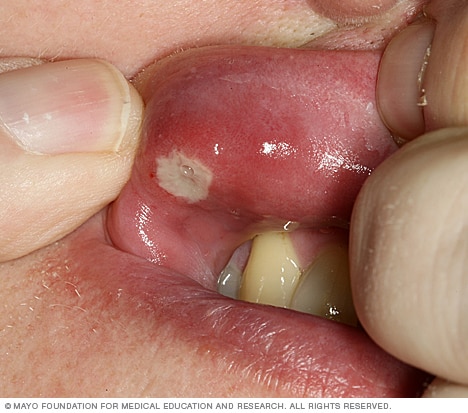
Canker sore
Canker sores occur singly or in clusters on the inside surfaces of your cheeks or lips, on or under your tongue, at the base of your gums, or on your soft palate. They usually have a white or yellow center and a red border and can be extremely painful.
Symptoms
Canker sores:
- Are usually round or oval with a white or yellow center and a red border.
- Form inside the mouth on or under the tongue, inside the cheeks or lips, at the base of the gums, or on the soft palate.
- May cause a tingling or burning feeling a day or two before the sores appear.
- Are painful and may make it hard to eat and talk.
- Can occur alone or in groups.
There are three types of canker sores. These include minor, major and herpetiform (her-PET-ih-form) canker sores.
Minor canker sores
Minor canker sores are the most common. They:
- Are usually small.
- Are oval shaped with a red border.
- Heal in 1 to 2 weeks.
- Usually do not leave a scar.
Major canker sores
Major canker sores are less common. They:
- Are larger and deeper than minor canker sores.
- Are usually round with defined borders but may have edges that are not evenly shaped when large.
- Can be very painful.
- May take up to six weeks to heal.
- Can leave scars.
Herpetiform canker sores
Herpetiform canker sores are not common, and they are not caused by herpes virus infection. These canker sores:
- Usually develop later in life.
- Are very small — each one is about the size of the head of a pin.
- Often occur in clusters of 10 to 100 sores. They may join together to form one large sore.
- Have edges that are not even.
- Heal in 1 to 2 weeks.
- Don't leave a scar.
When to see a doctor
Talk with your healthcare professional or dentist if you have:
- Large mouth sores.
- Sores that don't go away or that keep coming back, such as new ones appearing before old ones heal.
- Sores that last two weeks or longer.
- Sores that spread onto the lips.
- Pain that you can't control.
- Trouble eating or drinking.
- High fever along with mouth sores.
Causes
The exact cause of canker sores isn't clear. Experts believe that several factors may play a role. Possible triggers for canker sores include:
- Food sensitivities or allergies, such as to chocolate, eggs, nuts, and spicy or acidic foods.
- Certain toothpastes and mouth rinses that have sodium lauryl sulfate, a foaming agent.
- An injury to your mouth from dental work, brushing too hard, biting your cheek or playing sports.
- Some medicines, including certain medicines used to treat heart conditions and osteoporosis and nonsteroidal anti-inflammatory drugs (NSAIDs) such as ibuprofen (Advil, Motrin IB, others) and naproxen sodium (Aleve, Anaprox DS, others).
- Hormonal changes during menstruation.
- Emotional stress.
Canker sores also may occur because of certain medical conditions, such as:
- Celiac disease, which is an autoimmune condition where the immune system reacts to gluten, sometimes causing damage to the small intestine. Gluten is a protein found in foods that have wheat, barley or rye.
- Low levels of vitamin B-12, zinc, folate or iron in the body that can happen from not eating a balanced diet.
- Inflammatory bowel diseases, such as Crohn's disease and ulcerative colitis.
- Behcet disease, which is a rare condition that causes blood vessel inflammation throughout the body and mouth sores.
- A change in the immune system that causes the body to attack healthy cells in the mouth instead of germs such as viruses and bacteria.
- HIV/AIDS, which is a condition that damages the immune system so that the body is less able to fight infection and disease.
Canker sores are not caused by a herpes virus infection.
Risk factors
Anyone can get canker sores. But they're more common in teens and young adults. They're also more common in women than in men.
Some people who get canker sores often have a family history of the condition. This may be passed down from parents to children. It also could be due to shared factors in the environment, such as certain foods or allergens.
From Mayo Clinic to your inbox
Sign up for free and stay up to date on research advancements, health tips, current health topics, and expertise on managing health. Click here for an email preview.
Prevention
You may be able to lessen how often canker sores occur. These tips may help:
- Stay away from foods that irritate your mouth. These may include nuts, certain spices, salty foods and acidic fruits, such as pineapple, grapefruit and oranges. Don't eat foods to which you're sensitive or allergic.
- Choose healthy foods. Eat a balanced diet. Include a variety of fruits, vegetables and whole grains.
- Follow good mouth care habits. Regular brushing after meals and flossing once a day can keep your mouth clean and free of foods that might trigger a sore. Use a soft toothbrush to keep from irritating your mouth. Don't use toothpastes and mouth rinses that have sodium lauryl sulfate.
- Protect your mouth. See your dentist if you have sharp tooth surfaces or dental appliances that seem to trigger the sores. Ask about orthodontic waxes to cover sharp edges. Try a mouthguard during sports activities.
- Lower your stress. If your canker sores seem to be linked to stress, practice ways to lower your stress, such as meditation and guided imagery.
CON-20370599
Mayo Clinic does not endorse companies or products. Advertising revenue supports our not-for-profit mission.
Advertising & Sponsorship
Mayo Clinic Press
Check out these best-sellers and special offers on books and newsletters from Mayo Clinic Press.
