Broken wrist Diagnosis and treatment
Diagnosis
Diagnosing a broken wrist typically involves a physical examination of the injured area and X-rays.
Other imaging tests
Sometimes, other imaging tests can give your doctor more detail. They are:
- CT scan. CT scans can detect wrist fractures that X-rays may miss. A CT scan also helps identify injuries to soft tissues and blood vessels by combining multiple X-ray images to create detailed cross-sectional views of the injured area.
- MRI. Using radio waves and a strong magnet, an MRI produces highly detailed images of bones and soft tissues. It is much more sensitive than X-rays and can detect tiny fractures and ligament injuries.
Treatment
If the broken bone ends aren't aligned, there may be gaps between the pieces of bone or overlapping fragments. To correct this, your healthcare professional does a procedure called a reduction. A reduction repositions the bone pieces so they have the best chance to heal well. Depending on your level of pain and swelling, you may need anesthesia before the procedure. Local anesthesia numbs a specific area of the body so you don't feel pain, but you remain alert and awake. General anesthesia puts you into a deep sleep. Often, a reduction may be done during surgery using general anesthesia.
Whatever your treatment, it's important to move your fingers regularly as you heal to prevent stiffness. Ask your healthcare professional about the best ways to move them. If you smoke, quit. Smoking can delay or prevent bone healing.
Immobilization
Limiting movement in a broken wrist is called immobilization. Whether your treatment is surgical or nonsurgical, you may need to wear a cast or splint for up to six months for proper healing. To reduce pain and swelling, you also will be advised to keep your hand elevated above heart level as much as possible.
Medicines
To manage pain, your healthcare professional may recommend a pain reliever you can buy without a prescription. For more serious pain, an opioid medicine may be prescribed.
NSAIDs can help with pain relief but may slow bone healing, especially with long-term use. Talk to your healthcare professional before taking NSAIDs.
If you have an open fracture, you'll likely be given an antibiotic to prevent infection from reaching the bone. An open fracture happens when the bone breaks through the skin or when there is a wound near the fracture.
Therapy
After your cast or splint is removed, you'll likely need rehabilitation exercises or physical therapy to improve flexibility and restore movement in your wrist. While rehab can help, full recovery may take several months or longer.
Surgical and other procedures
If immobilization isn't an option, you might need surgery to implant pins, plates, rods or screws to hold your bones in place while they heal. Or a bone graft may be used to help healing. These may be needed if you have any of the following:
- An open fracture.
- A fracture where the bone pieces move before they heal. This is called an unstable or displaced fracture.
- Loose bone fragments that could enter a joint.
- Damage to the surrounding ligaments, nerves or blood vessels.
- Fractures that extend into a joint.
Even after reduction and immobilization with a cast or splint, the bones can shift. Your healthcare professional typically monitors your progress with X-rays. If your bones move, you may then need surgery.
In some cases, a surgeon may stabilize the fracture using an external fixation device. This device includes a metal frame with two or more pins that go through the skin and into the bone on both sides of the fracture. This helps to hold the fracture in place during healing.
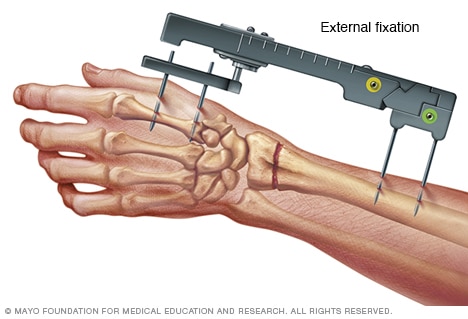
External fixation of the wrist
With external fixation, a metal frame outside your body immobilizes the fracture with two or more pins that pass through your skin and into the bone on both sides of the fracture.
Clinical trials
Explore Mayo Clinic studies testing new treatments, interventions and tests as a means to prevent, detect, treat or manage this condition.
Preparing for your appointment
If you have a broken wrist, you may first seek treatment in an emergency room or urgent care clinic. If the broken bones aren't properly aligned for healing with immobilization, you may be referred to an orthopedic surgeon for further treatment.
What you can do
You may want to write a list that includes:
- A description of your symptoms and how, where and when the injury occurred.
- Information about your and your family's medical histories.
- All the medicines and dietary supplements you take, including doses.
- Questions you want to ask your healthcare professional.
For a broken wrist, questions to ask include:
- What tests do I need?
- What's the best course of action?
- Will I need surgery?
- Will I need to wear a cast? If so, for how long?
- Will I need physical therapy when the cast comes off?
- Are there restrictions that I need to follow?
- Should I see a specialist?
What to expect from your doctor
Your healthcare professional may ask:
- What is your occupation?
- Was your wrist or hand bent backward or forward when the injury occurred?
- Are you right-handed or left-handed?
- Where does it hurt: Do certain movements make it hurt more or less?
- Have you had previous hand or wrist injuries or surgery?

CON-20310622
Mayo Clinic does not endorse companies or products. Advertising revenue supports our not-for-profit mission.
Advertising & Sponsorship
Mayo Clinic Press
Check out these best-sellers and special offers on books and newsletters from Mayo Clinic Press.
