Achilles tendon rupture Symptoms and causes
Overview
Achilles (uh-KILL-eez) tendon rupture is an injury that affects the tendon in the back of the lower leg. It mainly happens while playing sports, especially jumping sports, for fun. But it can happen to anyone.
The Achilles tendon is a strong fibrous cord that joins the muscles in the back of the calf to the heel bone. Stretching the Achilles tendon too far can make it tear partway or all the way. The tear is called a rupture.
The Achilles tendon helps with pointing the foot downward, rising on the toes and pushing off on the foot while walking. People use their Achilles tendons every time they walk and move their feet.
If the Achilles tendon ruptures, there may be a pop, then a sharp pain in the back of the ankle and lower leg. This is likely to make walking hard. Many people have surgery to repair the tear. But for many people, treatment without surgery works just as well.
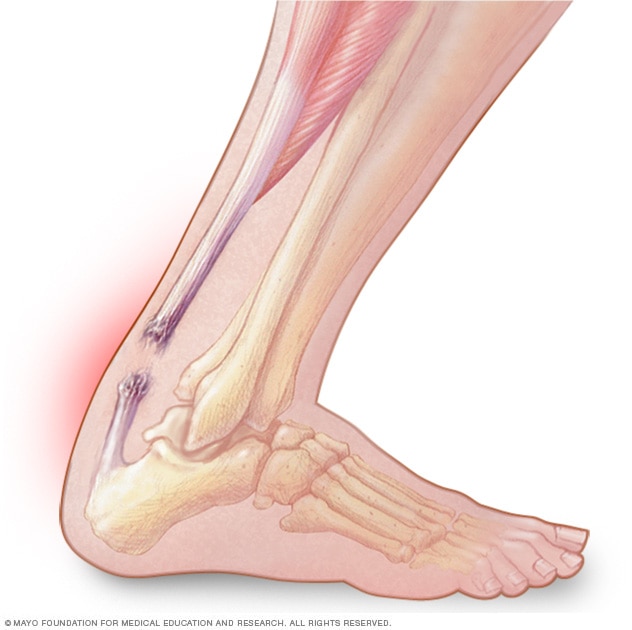
Achilles tendon rupture
The Achilles tendon is a strong cord that joins the muscles in the back of the calf to the heel bone. Stretching the tendon too far can cause it to tear, called a rupture.
Symptoms
Some people have no symptoms with an Achilles tendon rupture. But most people:
- Have a feeling of having been kicked in the calf.
- Have sharp pain and swelling near the heel.
- Find it hard to bend the foot downward or "push off" the injured foot when walking.
- Find it hard to stand on the toes on the injured foot
- Hear a popping or snapping sound at the time of the injury.
When to see a doctor
Talk with a healthcare professional right away if you hear a pop in your heel, especially if it's hard to walk after that.
Causes
The cause of Achilles tendon rupture is often an injury that puts sudden force on the Achilles tendon. It can happen from:
- Jumping or sharp cutting and pivoting in a sport.
- Falling from a height or landing from a jump.
- Stepping into a hole.
Risk factors
Factors that may raise the risk of Achilles tendon rupture include:
- Age. The peak age for Achilles tendon rupture is 30 to 40.
- Sex assigned at birth. People assigned male at birth are up to five times more likely to have Achilles tendon rupture than are people assigned female at birth.
- Sports played for fun. Achilles tendon injuries happen more often during sports that involve running, jumping, and sudden starts and stops. These include soccer, basketball, volleyball and tennis.
- Steroid shots. Healthcare professionals sometimes inject steroids into an ankle joint to reduce pain and swelling. But steroid medicines can weaken nearby tendons. They've been linked to Achilles tendon ruptures.
- Certain antibiotics. Fluoroquinolone antibiotics, such as ciprofloxacin (Cipro) or levofloxacin, raise the risk of Achilles tendon rupture.
- Obesity. Excess weight puts more strain on the tendon.
From Mayo Clinic to your inbox
Sign up for free and stay up to date on research advancements, health tips, current health topics, and expertise on managing health. Click here for an email preview.
Prevention
To reduce your chance of having Achilles tendon issues follow these tips:
- Stretch and strengthen calf muscles. Stretch your calf muscles until you feel a pull, but not pain. Don't bounce during a stretch. Calf-strengthening exercises also can help the muscle and tendon take on more force and protect against injury.
- Vary your exercises. Mix high-impact sports, such as running, with low-impact sports, such as walking, biking or swimming. Limit activities that put a lot of stress on your Achilles tendons, such as activities that involve hill running and jumping.
- Choose safer running surfaces. Don't run on hard or slippery surfaces. Wear athletic shoes that fit well and have good cushioning.
- Add to your training slowly. Achilles tendon injuries often happen after training harder or all of a sudden. Add to how long, how far, how hard and how often you train by no more than 10% a week.
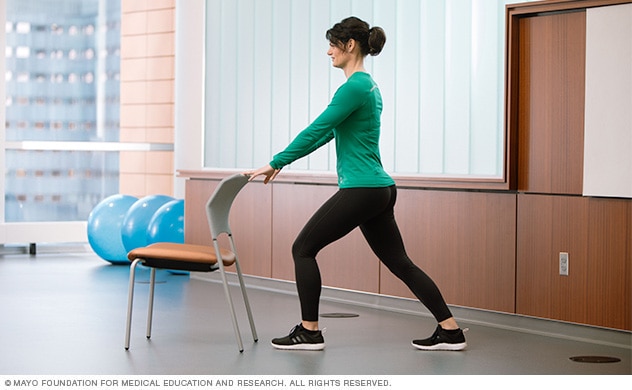
Calf stretch exercise
The Achilles tendon links the muscles in the back of the leg to the heel bone. This calf stretch exercise can help prevent an Achilles tendon rupture. To do the stretch, follow these steps: 1. Stand at arm's length from a wall or a chair. Put your palms flat against the wall or hold on to the chair. 2. Keep one leg back with your knee straight and your heel flat on the floor. 3. Slowly bend your elbows and front knee and move your hips forward until you feel a stretch in your calf. 4. Hold for 30 to 60 seconds. 5. Switch legs and repeat with the other leg.
CON-20310634
Mayo Clinic does not endorse companies or products. Advertising revenue supports our not-for-profit mission.
Advertising & Sponsorship
Mayo Clinic Press
Check out these best-sellers and special offers on books and newsletters from Mayo Clinic Press.
