概述

听神经瘤是发生在从内耳到脑的主要神经上的一种非癌性肿瘤。这根神经被称为前庭神经。神经分支直接影响平衡和听力。听神经瘤产生的压力可能会导致听力减退、耳鸣和平衡问题。听神经瘤也被称为前庭神经鞘瘤。

听神经瘤起源于覆盖前庭神经的施万细胞。施万细胞帮助保护和支持身体内的其他神经细胞。听神经瘤通常生长缓慢。但在极少数情况下,它可能会增大到足以压迫脑并影响重要功能。

治疗听神经瘤的方法包括监测、放疗和外科手术切除。

症状

听神经瘤的症状通常容易被忽略,可能需要很多年才会显现出来。肿瘤对听力和平衡神经的影响可能引起症状。肿瘤还可能对控制面部肌肉的面部神经和影响面部感觉的三叉神经造成压力。血管或其他脑结构也可能受听神经瘤影响。

随着肿瘤生长,其更有可能引起更明显或更严重的症状。

听神经瘤的常见体征和症状包括:

  • 听力减退,通常在数月至数年内逐渐发生。在极少数情况下,可能突然发生听力减退。听力减退通常只发生在一侧,或者一侧的情况加重。
  • 受影响的耳内出现鸣响(称为耳鸣)。
  • 失去平衡或感觉不稳。
  • 头晕。
  • 面部麻木,以及极少数情况下,肌肉无力或活动能力丧失。

在极少数情况下,听神经瘤可能长大到足以压迫脑干,从而危及生命。

Hearing loss and acoustic neuroma

Hearing loss related to acoustic neuroma is considered sensorineural hearing loss. This means that the hearing loss is caused by damage to the inner ear or the nerves responsible for hearing, rather than some sort of buildup or blockage that affects hearing.

There can be a particular pattern to hearing loss caused by acoustic neuroma. Most people with an acoustic neuroma lose hearing in just one ear. About 9 out of 10 people with acoustic neuroma experience this.

Hearing loss that's related to acoustic neuroma often starts with trouble hearing higher pitched sounds. Difficulty hearing usually gets worse over time. For some people, hearing fades slowly over time. For others, it may decline more suddenly. Sudden hearing loss is rare. Sometimes hearing can partly come back. But typically hearing loss continues to decline, even if the tumor itself is not growing.

People with hearing loss from acoustic neuroma may find that they:

  • Rely more on one ear to listen.
  • Ask people to speak into their "better" ear in conversations.
  • Find it hard to tell where voices are coming from.
  • Struggle to follow conversations in crowded rooms.
  • Feel that voices sound unclear or muffled even when the volume seems loud enough.
  • Have ringing in the ears, called tinnitus.

Typically, acoustic neuroma tumors don't cause symptoms often seen with other brain tumors, such as headaches, memory loss, neck pain or thinking difficulties. These symptoms are rare and generally occur only if the tumor becomes large enough to press on nearby brain structures.

Rarely, an acoustic neuroma may grow large enough to compress the brainstem and become life-threatening.

何时应就医

如果您发现一只耳朵出现听力减退、耳鸣或平衡问题,请前往医务人员处就诊。

尽早诊断听神经瘤可能有助于防止肿瘤长大到足以引起并发症,例如听力完全丧失。

病因

听神经瘤的病因有时可能与 22 号染色体上的一个基因的改变有关。通常,该基因会产生肿瘤抑制蛋白,帮助控制包裹神经的施万细胞生长。专家尚不清楚这种基因改变的原因。通常病因不明。在一些人中,基因改变与一种称为 NF2 相关性神经鞘瘤病(也称为 NF2)的罕见状况有关。该状况之前被称为 2 型神经纤维瘤病。NF2 患者的肿瘤通常生长在头部两侧的听力和平衡神经上。这些肿瘤称为双侧前庭神经鞘瘤。

风险因素

NF2 相关神经鞘瘤病

听神经瘤的唯一已确认风险因素是父母一方患有 NF2 相关神经鞘瘤病(也称为 NF2)这种罕见的遗传性状况。然而,只有少数听神经瘤患者患有 NF2。

NF2 的标志性特征是头部两侧的平衡神经上出现非癌性肿瘤。其他神经上也可能出现肿瘤。

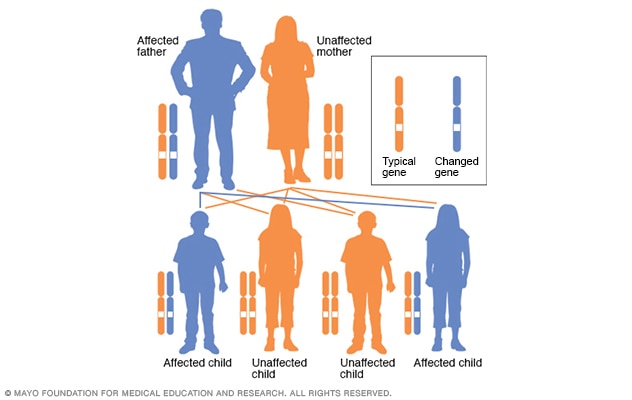
NF2 被称为常染色体显性状况。这意味着,只要父母中有一方携带与该状况相关的基因,就能遗传给孩子。受累父亲或母亲的每个孩子都有 50% 的概率遗传该基因。

NF2-related schwannomatosis and acoustic neuroma risk

The only confirmed risk factor for acoustic neuromas is having a parent with the rare genetic condition NF2-related schwannomatosis, also known as NF2. However, only a small number of people with acoustic neuromas have NF2.

A hallmark feature of NF2 is the growth of acoustic neuromas on the vestibulocochlear nerve on both sides of the head. People with NF2 also may develop tumors on other nerves.

NF2 is known as an autosomal dominant condition. This means that the gene related to the condition can pass to a child from just one parent. Each child of an affected parent has a 50-50 chance of inheriting the gene.

Noise exposure and acoustic neuroma risk

Research shows that being around loud noise for many years may affect more than your hearing. It also may be linked to a slightly higher chance of developing an acoustic neuroma. The overall risk is still low. But these findings suggest that long-term noise exposure might influence your health in more ways than just causing hearing loss.

并发症

If an acoustic neuroma, now called vestibular schwannoma, grows larger or is left untreated, it can lead to complications. The most common complications involve hearing loss and balance issues. But larger tumors also may affect nearby nerves and brain structures, causing more serious health issues.

Common in many acoustic neuromas

  • Hearing loss in one ear that is usually permanent.
  • Ringing in the ear, also called tinnitus.
  • Balance trouble or unsteadiness, sometimes with brief periods of vertigo.

More likely with large or untreated acoustic neuromas

  • Facial numbness when the trigeminal nerve is affected, and facial weakness when the facial nerve is involved.
  • Headaches or pressure caused by crowding of the brainstem.
  • Worsening balance and walking difficulties, also called ataxia.
  • Hydrocephalus, a buildup of fluid in the skull that can occur when a large acoustic neuroma blocks the flow of cerebrospinal fluid between the brain and spinal cord. Hydrocephalus raises pressure inside the head and can lead to upset stomach, vomiting, sleepiness or vision changes.
  • Swallowing or voice changes, which may occur rarely if very large tumors affect lower cranial nerves.

Special situations

  • In NF2, tumors can occur on both sides of the head, leading to hearing loss in both ears.

June 10, 2025

Living with 听神经瘤?

Connect with others like you for support and answers to your questions in the Brain Tumor support group on Mayo Clinic Connect, a patient community.

Brain Tumor Discussions

khauert
Pituitary tumor symptoms: joint, muscle and body aches

180 Replies Sat, Dec 06, 2025

pixie49247
Meningioma: Anyone else? I'm frightened

605 Replies Sat, Nov 29, 2025

lisamorris4272
Offering hope: Dad's journey with Glioblastoma stage 4

39 Replies Sun, Nov 23, 2025

See more discussions
  1. What is acoustic neuroma. Acoustic Neuroma Association. https://www.anausa.org/learn-about-acoustic-neuroma/what-is-acoustic-neuroma#important-points. Accessed April 19, 2023.
  2. Common balance disorders and more. American Hearing Research Foundation. https://www.american-hearing.org/disease/common-balance-disorders/. Accessed April 19, 2023.
  3. Vestibular schwannoma. Merck Manual Professional Version. https://www.merckmanuals.com/professional/ear,-nose,-and-throat-disorders/inner-ear-disorders/vestibular-schwannoma?query=acoustic%20neuroma#. Accessed April 19, 2023.
  4. Park JK, et al. Vestibular schwannoma (acoustic neuroma). https://www.uptodate.com/contents/search. Accessed Jan. 3, 2025.
  5. Ferri FF. Vestibular schwannoma. In: Ferri's Clinical Advisor 2025. Elsevier; 2025. https://www.clinicalkey.com. Accessed Jan. 3, 2025.
  6. Lalwani AK. Vestibular schwannoma (acoustic neuroma). In: Current Diagnosis &Treatment in Otolaryngology — Head & Neck Surgery. 4th ed. McGraw Hill; 2020. https://accessmedicine.mhmedical.com. Accessed April 19, 2023.
  7. Flint PW, et al., eds. Neoplasms of the posterior fossa. In: Cummings Otolaryngology: Head & Neck Surgery. 7th ed. Elsevier; 2021. https://www.clinicalkey.com. Accessed April 19, 2023.
  8. Winn HR, ed. Genetics of pediatric brain tumors. In: Youmans and Winn Neurological Surgery. 8th ed. Elsevier; 2023. https://www.clinicalkey.com. Accessed April 19, 2023.
  9. Is a support group for me? Acoustic Neuroma Association. https://www.anausa.org/programs/support-groups/is-a-support-group-for-me. Accessed April 19, 2023.
  10. Cazzador D, et al. Tumor microenvironment in sporadic vestibular schwannoma: A systematic, narrative review. International Journal of Molecular Sciences. 2023; doi:10.3390/ijms24076522.
  11. Carlson ML, et al. Vestibular schwannomas. New England Journal of Medicine. 2021; doi:10.1056/NEJMra2020394.
  12. Plotkin SR, et al. Updated diagnostic criteria and nomenclature for neurofibromatosis type 2 and schwannomatosis: An international consensus recommendation. Genetics in Medicine. 2022; doi:10.1016/j.gim.2022.05.007.
  13. Marinelli JP, et al. Quality of life in sporadic vestibular schwannoma. Otolaryngologic Clinics in North America. 2023; doi:10.1016/j.otc.2023.02.016.
  14. Kim BH, et al. NF2-related schwannomatosis (NF2): Molecular insights and therapeutic avenues. International Journal of Molecular Sciences. 2024; doi:10.3390/ijms25126558.
  15. NF2-SWN. Children's Tumor Foundation. https://www.ctf.org/nf2-swn/. Accessed Jan. 11, 2025.
  16. Nimmagadda R. Allscripts EPSi. Mayo Clinic. Dec. 24, 2024.