Overview
Urostomy is surgery that creates a new way for urine to leave the body without passing through the bladder. It is a type of urinary diversion. It often is done when the bladder is removed as part of cancer treatment or when the bladder does not work as it should.
Urine may drain through an opening in the belly, called a stoma, into a pouch worn outside the body. Or it may collect in a pouch inside the body that you empty through a catheter.
A urostomy may be permanent, especially when it is created after the bladder is removed. Adjusting to life with a urostomy pouch takes time. As you recover and become more comfortable caring for your urostomy, you can return to your usual activities. Learning to manage the pouch tends to become easier with practice.
Types
There are a few types of urostomy.
Ileal conduit
This is the most common type. A short section of the small intestine, called the ileum, is made into a tube called an ileal conduit. The conduit lets urine pass directly from the ureters — the tubes that carry urine from the kidneys — to an opening in the belly called a stoma. Urine flows continuously through the stoma into a pouch worn outside the body. An ileal conduit is generally a less complicated surgery than a continent urostomy.
Continent urostomy
A continent urostomy, also called a continent cutaneous urinary diversion, stores urine in a pouch made from a piece of the intestine. But the pouch stays on the inside of the body. You drain it using a thin tube called a catheter.
Cutaneous ureterostomy
A cutaneous ureterostomy is a less common type of urostomy. It connects one or both ureters directly to the skin of the belly so urine can drain outside the body. This procedure may be considered when a shorter, less complex surgery is preferred, such as for infants.
Other ways to redirect urine
Other procedures may drain urine from the kidneys or bladder in different ways.
- Neobladder. A neobladder is a pouch that sits inside the body. It connects to the urethra so urine can leave the body through the urethra.
- Nephrostomy. A nephrostomy drains urine directly from a kidney. A tube is placed through the skin of the back into the kidney. Urine drains through the tube into a collection bag outside the body.
- Suprapubic catheter. A suprapubic catheter is a tube that drains urine directly from the bladder through a small opening in the lower belly. This may be used when the bladder stays in place.
- Vesicostomy. A vesicostomy creates an opening between the bladder and the lower belly so urine can drain. It may be used in some infants and children to lower bladder pressure.
Other ostomy procedures
The procedures for colostomies and ileostomies also create stomas in the belly, but these stomas do not carry urine. They carry stool from the digestive tract. Some people may have both a urinary ostomy and a bowel ostomy, or one ostomy for urine and stool, if their medical conditions or surgeries require it.
Why it's done
The most common reason for a urostomy is:
- Bladder cancer. A urostomy is most often done after the bladder is removed to treat bladder cancer. The procedure to remove the bladder is called radical cystectomy. It is followed by a urinary diversion, such as an ileal conduit.
Less often, a urostomy may be used when the bladder cannot store or pass urine because of other conditions. These may include:
- Nerve damage that affects bladder function, called neurogenic bladder. Conditions that may cause nerve damage include spinal cord injury, multiple sclerosis or spina bifida, a condition present at birth. Urinary diversion generally is considered when other treatments have not worked.
- Long-term bladder inflammation or serious damage. Examples include interstitial cystitis and bladder damage after radiation therapy. Surgery and urinary diversion may be a last resort for severe bladder conditions that do not improve with other treatments.
Risks
Urostomy can have risks soon after surgery and complications that develop later. The risks depend in part on the type of urinary diversion and whether the urostomy is done at the same time as bladder removal.
Risks after surgery
Issues that can happen during the early recovery period include:
- Bleeding, blood clots and infection. These are possible after any major surgery.
- Bowel issues. When tissue from the intestine is taken out to create the urostomy, the bowel may be slow to start working again. Less commonly, a blockage or a leak where the bowel was put back together can occur.
- Urinary tract infection or kidney infection. Infection can develop after surgery. Symptoms may include fever, chills, back or side pain, nausea, or vomiting.
- Blocked urine flow. Swelling, a blood clot or another blockage can interfere with urine flow through the new passageway.
- Skin irritation or pouch leaks. A new stoma may change size and shape as swelling goes down. This can affect how well the pouch fits and may lead to leaks and irritated skin. An ostomy nurse can help adjust the pouching system.
Late complications
Some issues can develop months or years after a urostomy. These may include:
- Stoma issues. The stoma may narrow, pull inward or stick out farther than expected. A bulge called a parastomal hernia also can form around the stoma. These issues may affect urine drainage or make it harder to get a good pouch fit.
- Narrowing where the ureter joins the diversion. Scar tissue can narrow this area and block urine flow. Over time, blockage can contribute to infection or kidney damage.
- Kidney stones or reduced kidney function. These issues can happen over time, especially when infection or blockage happens again and again.
- Repeated urinary tract or kidney infections. People with urinary diversions may have bacteria in the urine even when they do not have symptoms. Your care team considers your symptoms along with urine test results.
- Changes in body salts and nutrients. Using intestine for urinary diversion can affect the body's balance of acids, salts and certain nutrients. This issue may happen gradually and is more likely with some types of diversion than others.
How you prepare
Before surgery, you meet with members of your care team to review your health and anything that may affect surgery or recovery. Your care team may ask about:
- Health conditions and past surgeries. Tell your care team about long-term health conditions, previous operations, medicine allergies, past reactions to anesthesia and conditions such as obstructive sleep apnea.
- Medicines and supplements. Review with your team all prescription and nonprescription medicines, vitamins, herbal products and other supplements you take. Your care team tells you whether you need to stop taking any of them before surgery.
- Alcohol, tobacco and other substances. Tell your care team about alcohol, cigarettes and other substance use. If you smoke, ask about help quitting. Smoking can affect anesthesia and can slow recovery.
- Food and drink instructions. Your care team tells you what you may eat or drink and when to stop before surgery.
- Overall strength and health. Your care team may work with you to improve your health before surgery. This can include making changes to nutrition and activity level or treating other medical conditions that could affect recovery.
Choosing the stoma site
If your planned urostomy has a stoma, choosing its location before surgery is an important part of preparation. An ostomy nurse and your surgeon can help choose and mark a site that is easy for you to see and reach.
The care team looks for an area that is fairly flat and away from scars, skin folds and bony areas. Your care team may check the site while you sit and stand because the shape of your belly can change with position.
Meet with an ostomy nurse
Before you leave the hospital, your care team teaches you how to care for your urinary diversion. Education may begin before surgery so you know what to expect and you learn how to care for the stoma and pouch.
If you will have an external pouch, an ostomy nurse can explain how the pouching system works and answer questions about daily care.
Plan for your hospital stay
You'll likely spend at least a few days in the hospital after your urostomy. How long you stay depends on your situation. Plan for someone else to take care of your responsibilities at home and at work.
Think ahead about what you might like to have with you while you're recovering in the hospital. Bring loose-fitting clothes that may be more comfortable after surgery.
What you can expect
Urostomy is major surgery. What happens during the procedure depends on the type of urostomy you have and whether your bladder is removed at the same time.
Before the procedure
You receive general anesthesia, which keeps you asleep during surgery. Your care team also takes steps to lower the risk of complications after surgery.
During the procedure
Once you're asleep, your surgeon cuts into your belly. If your bladder is being removed, that is done first. Surgery may be done through one larger cut in the belly or through several smaller cuts using minimally invasive or robotic surgery. The urostomy is usually created during the same operation, right after bladder removal.
The procedure depends on the type of urostomy:
-
Ileal conduit. The surgeon uses a short section from the small intestine, called the ileum, to make a tube for urine to pass through. The ureters — the tubes that carry urine from the kidneys — are connected to one end of the passageway. The other end is brought through the belly to form a stoma.
Urine flows continuously through the stoma into a pouch worn outside the body. Because there is no muscle to control urine flow, the pouch stays in place to collect urine.
Sometimes, a section of the colon is used to make a passageway for urine. This is called a colonic conduit.
- Continent urostomy. The surgeon uses a piece of your intestine to make an internal pouch, called a reservoir. The ureters connect to the pouch. A small channel connects the pouch to a stoma in the belly. You put a thin tube called a catheter through the stoma to empty the pouch.
- Cutaneous ureterostomy. Instead of using a piece of intestine to make a passageway, the surgeon brings one or both ureters directly to the skin of the belly so urine can drain outside the body. You may need a catheter or a small tube called a stent to help keep the ureter open.
Ileal conduit
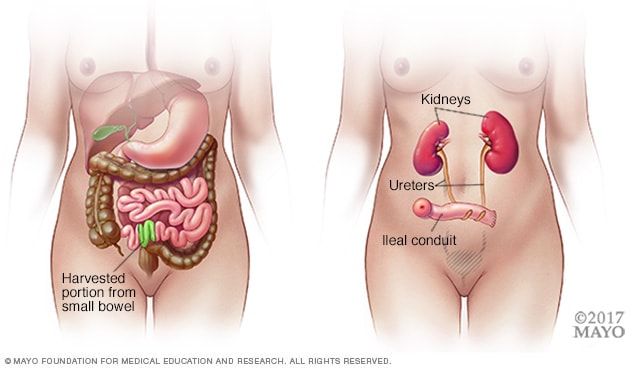
Ileal conduit
During an ileal conduit procedure, a surgeon makes a new tube from a piece of intestine. That allows the kidneys to drain and urine to exit the body through a small opening called a stoma.
After the procedure
After surgery, you stay in the hospital while your care team monitors your recovery and teaches you how to care for the urostomy.
If you have an ileal conduit, urine begins draining continuously from the stoma into a pouch. If you have a continent urostomy, you empty it by passing a catheter through the stoma.
You may notice these expected changes as you heal:
- The stoma looks swollen, red and moist. The swelling decreases over time, and the stoma becomes smaller over the first few weeks.
- Urine may be tinged with blood at first. It should become clearer as you recover.
- Mucus may appear in the urine or catheter. This is expected when intestine is used to make the urostomy because the intestinal tissue continues to make mucus.
- Stents may extend from the stoma. They usually stay in place for a short time while the connections between the ureters and conduit heal. Some people still have the stents when they leave the hospital.
- The external pouch may look different from the one you use later. Hospitals often use a clear pouch so the care team can see the stoma and urine. The pouch also may be connected to a larger drainage bag so urine output can be measured.
Your care team generally encourages you to start moving after surgery as soon as you are able. Early movement is part of recovery after cystectomy and urinary diversion. It can help your bowel begin working again and lower the risk of blood clots.
Before you go home, an ostomy nurse and other members of your care team teach you how to empty and change your pouch and care for the stoma and the skin around it. They also help you recognize issues that need medical care.
Stoma and pouching system
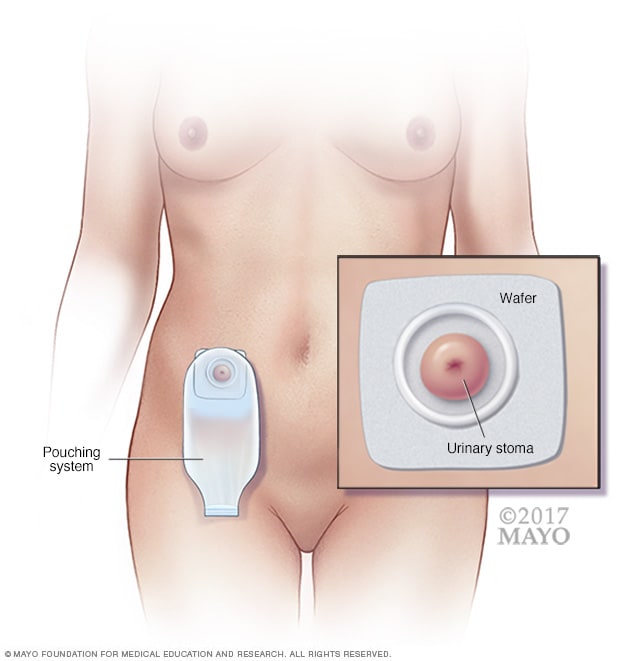
Stoma and pouching system
A urinary conduit is a surgically made pathway that allows urine to exit the body. A urinary conduit doesn't store urine. After surgery, you need to wear a pouching system all the time to collect urine. Pictured is one example of a pouching system used to collect urine, which drains from an opening in the abdomen, called a urinary stoma. The wafer acts as a barrier to protect the skin around the stoma from exposure to urine. A bag to collect urine connects to the wafer.
At home
Your body continues to heal after you leave the hospital. Your stoma may change in size during the first several weeks, so the fit of your pouch may need to be adjusted. You also may still have an incision, a drain or ureteral stents while you heal.
Caring for your ileal conduit
If you have an ileal conduit, you wear a pouch over the stoma to collect urine. Urostomy pouches have a drain at the bottom and usually contain a valve that helps keep urine from flowing back toward the stoma.
Your pouching system may be one piece or two pieces. The part that sticks to the skin is called the skin barrier, also known as a wafer. The right pouching system depends on the shape of your stoma and belly, your skin, and what is easiest for you to manage.
Empty the pouch before it gets heavy. Your care team may recommend emptying it when it is about one-third to one-half full because the weight of urine can loosen the seal and lead to leaks.
How often you change the pouching system varies. Wear time depends on the pouch, your skin and the shape of your stoma. Ask your care team for tips specific to your pouching system.
Caring for your continent urostomy
If you have a continent urostomy, you do not wear an external pouch. Instead, urine collects in a reservoir inside the body. The reservoir does not have the sensation of being full and cannot squeeze out urine on its own.
To empty it, you put a thin tube, called a catheter, through the stoma and into the reservoir. Most people do this about every 4 to 5 hours. Your care team teaches you how to insert the catheter and empty the reservoir.
Preventing pouch leaks and skin issues
A close fit around the stoma helps keep urine off the skin. Your stoma may change in size during the first several weeks after surgery, so the opening in the skin barrier may need to be adjusted as you heal.
Tell your care team if you often have leaks, the skin around the stoma becomes sore or irritated, or you have trouble keeping the external pouch in place. Different barriers, pouch shapes and accessories can help improve the fit.
Night drainage
At night, an ileal conduit pouch can be connected to a larger drainage bag beside the bed. This lets urine drain continuously and may keep you from needing to get up to empty the pouch.
Follow the instructions you receive for cleaning and replacing the night drainage system.
Mucus in the urine
If tissue from your intestine was used to make your urostomy, you can expect to see mucus in the urine. Intestinal tissue naturally makes mucus and continues to do so after it becomes part of the urinary diversion. The amount is often greater during the first few months and may decrease over time. The mucus may show up in the external pouch or in the catheter used to drain an internal pouch.
Results
After you recover from surgery and learn how to care for the stoma or internal pouch, you might find that you get more comfortable living with a urostomy. Many people return to work, travel and other usual activities.
Follow-up care
You need ongoing follow-up after urinary diversion surgery. Early visits check how you are healing and may include removal of ureteral stents if they are still in place. Continue to check in with an ostomy nurse if you have issues with your pouching system, stoma or surrounding skin.
Long-term follow-up also is important because urinary diversion can affect the kidneys and the body's balance of salts and nutrients over time. Your care team may use blood tests and imaging to look for these issues. The type and timing of follow-up depend on your urinary diversion and the condition that led to surgery.
When to call your care team
Call your care team if you notice these changes:
- Fever or chills.
- Back or side pain.
- Nausea or vomiting.
- Dark, cloudy or strong-smelling urine along with not feeling well.
- A large decrease in urine flow or no urine flow.
- Repeated pouch leaks or skin irritation that is not getting better.
- Heavy bleeding from the stoma.
- A stoma that changes to a dark color, pulls inward or suddenly sticks out much farther than usual.
Seek emergency care if you have a continent urostomy and cannot pass a catheter through the stoma.
Diet and nutrition
Most people do not need a special long-term diet just because they have a urostomy. If your care team has recommended a diet for another health condition, continue to follow those instructions.
Getting enough fluid is important. Fluid helps keep urine moving through the urinary diversion and may help lower the risk of urinary issues. Unless your care team tells you to limit fluid, aim to drink regularly throughout the day.
Some foods, medicines and supplements can change the color or smell of urine. For example, eating beets may make urine look pink, while foods such as asparagus may give it a stronger odor. These effects are short-term.
If part of the small intestine was used for your urinary diversion, your care team may check you for vitamin or nutrient issues over time. Ask your care team whether you need blood tests or supplements.
Exercise
After you recover from surgery, a urostomy usually does not prevent you from being active. People with urostomies can take part in many forms of exercise and sports, including swimming.
Your care team tells you when it is safe to increase your activity. Start a little at a time as your strength returns.
Some activities may need extra planning:
- Swimming. A well-fitted pouching system can be worn in the water.
- Heavy lifting. Ask your care team when you can resume lifting. Heavy lifting can put stress around the stoma and may increase the risk of a parastomal hernia.
- Contact sports. A strong blow to the stoma could cause injury. Ask your care team whether you need a stoma guard or other protection.
- Work and travel. Most people can return to work and travel after recovery. Carry extra ostomy supplies when you are away from home.
Coping and support
You may have concerns about body image, pouch leaks, returning to work or social activities, intimacy and managing the stoma. These concerns are common after urinary diversion surgery. People adjust at different speeds.
As you become more comfortable caring for your urostomy, daily routines often become easier. An ostomy nurse can help with pouch fit, skin care, clothing concerns, questions about travel and other practical issues.
Intimacy and sexual health
A urostomy pouch itself does not prevent intimacy. But it may take time to feel comfortable with a urostomy in place. In addition, urinary diversion surgery — especially when bladder removal is part of the operation — can affect sexual function.
Before having sex, some people feel better emptying the pouch and making sure it is secure. Clothing, pouch covers or support garments also may help if appearance or movement of the pouch is a concern.
Talk with your care team if you have pain with sex, trouble with sexual function or concerns about intimacy. Treatments and practical strategies may help.
Finding support
Talking with someone who is living with an ostomy may be useful. Ostomy support groups can provide practical tips and a chance to talk with people who understand the adjustment. Counseling also may help if changes in body image, relationships or mood are hard to manage.
Sept. 16, 2026