July 21, 2026
Mayo Clinic routinely uses magnetoencephalography (MEG) and 7T MRI to identify seizure origin sites for patients with focal epilepsy. Those technologies can help locate epileptogenic zones that standard imaging doesn't reveal.
"When we can't see any abnormalities on regular workup or normal imaging, MEG and 7T MRI are distinctly valuable for identifying candidate locations for intracranial monitoring," says Jamie J. Van Gompel, M.D., a neurosurgeon at Mayo Clinic in Rochester, Minnesota. "MEG and 7T are the crux of what we do now for focal epilepsy testing."
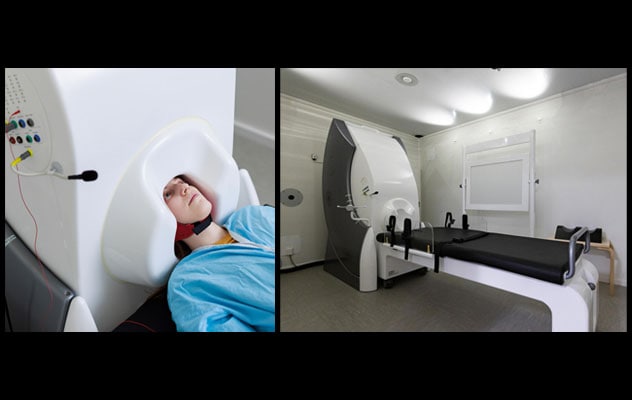 Recording magnetic fields
A patient with epilepsy (left) undergoes testing in Mayo Clinic's magnetoencephalography (MEG) machine (right).
Mayo Clinic's campus in Minnesota is one of the few centers in the United States that commonly offers MEG for patient care. The system is used to record, analyze and localize minute magnetic fields produced by the brain's electrical currents. With the help of mathematical modeling, abnormal magnetic fields are then superimposed onto an MRI scan of the patient's brain to pinpoint the source of abnormal activity.
MEG analysis is complex. "There's high variance in how people analyze the data and interpret the results. But at Mayo Clinic, we have assembled an unusual level of expertise," says Brian N. Lundstrom, M.D., Ph.D., a neurologist at Mayo Clinic's campus in Minnesota. "We are committed to using this technology in ways that optimize patient care."
Neurologists at Mayo Clinic's campuses in Phoenix/Scottsdale, Arizona, and Jacksonville, Florida, can access test results for their patients who travel to Minnesota for MEG studies. 7T MRI — which offers more than twice the resolution of standard 3T MRI — is available across the enterprise.
Intelligent use of technology
Dr. Lundstrom notes that people might assume MEG and MRI are similar because both tests include the term "magnet."
"But there's a crucial difference," Dr. Lundstrom says. "MRI applies a magnetic field to the brain, and a neuroradiologist identifies changes. With MEG, no magnet is applied. Instead, we record very subtle magnetic fields from the brain and note abnormalities. It's a neurophysiology functional test, not a structural imaging test."
For that reason, at Mayo Clinic MEG is analyzed by one of three neurologists with extensive training. "MEG is very similar to electroencephalography (EEG). We think it's a significant advantage to have neurophysiologists — who know how to read EEG — read MEG," Dr. Lundstrom says. "That optimizes our workflow for clinical results."
And the results can be striking. "It's amazing how much MEG helps us identify potential seizure onset zones," Dr. Van Gompel says. "We've had many cases in which we had nothing we could see on typical imaging, but MEG pointed us right to where we should put our electrodes to sample. Those samples turned out to be right about where we could treat for epilepsy."
Patients also benefit from Mayo Clinic's use of 7T MRI. Compared with standard MRI, 7T provides lower noise, increased spatial resolution and increased contrast resolution. "7T gives a really detailed view of brain anatomy. It is super helpful in identifying very subtle malformations of the cortex or cortical dysplasia," Dr. Van Gompel says.
Mayo Clinic is committed to intelligent use of technology to optimize patient care. "It's always very satisfying to see patients have notable improvement in seizures after having years of difficulty," Dr. Lundstrom says.
That level of care requires a multidisciplinary approach. "Epilepsy workups are extraordinarily complicated. Cooperation among Neuroradiology, Neurology and Neurosurgery is key," Dr. Lundstrom says. "At Mayo Clinic, people with different sets of expertise weigh in for a particular patient, and the information is readily synthesized. There's a collegiality and fluid flow of information that can be difficult to achieve when specialists are siloed."
For more information
Refer a patient to Mayo Clinic.