May 27, 2026
Mayo Clinic is committed to rapid referrals for patients with brain tumors. Patients or physicians who contact the Mayo Clinic Brain Tumor Program across the enterprise are automatically connected to a human agent.
"The agent picks up the phone within seconds to talk to the patient and ensure that the person is able to get an appointment in short order," says Alyx B. Porter, M.D., a neurologist in Mayo Clinic Comprehensive Cancer Center at Mayo Clinic in Phoenix/Scottsdale, Arizona. "We want patients to have an exceptional experience from the moment they see their referring providers until they're sitting across from a Mayo Clinic physician."
Patients referred to Mayo Clinic receive comprehensive, coordinated brain tumor care from specialists who often are located in the same clinical building. Using the latest technology, subspecialized experts manage imaging, pathology, surgery, radiation and other treatment modalities. Treating symptoms is a priority throughout the care process.
"We want to take care of the whole person, not just focus on the brain cancer itself," Dr. Porter says. "We recognize that patients have better quality of life when supportive medicine is brought into care early. We put the patient at the very center of everything we do."
Mayo Clinic specialists also can provide a second opinion and information about clinical trials. Additional pathology reviews and molecular testing are available, to guide personalized treatment from Mayo Clinic or local healthcare specialists.
"We are happy to provide whatever service a referring physician is looking for — whether that's receiving the patient for total care or just offering additional information and recommendations about that patient," Dr. Porter says. "We also look forward to working with referring physicians once it's time for the patient to return home, with seamless communication between the practices."
Advanced imaging and multidisciplinary care
Patients who contact the Bain Tumor Program or who are referred by their physicians can anticipate speaking with an appointment scheduler that same day. "Patients should expect to be sitting in front of a Mayo Clinic physician within days of when the referral is received," Dr. Porter says.
"We want patients to have an exceptional experience from the moment they see their referring providers until they're sitting across from a Mayo Clinic physician."
Care begins with a thorough physical exam and often additional imaging tests. "We have advanced neuroimaging that can give us information to better plan surgery or tailor radiation therapy," Dr. Porter says. "Sometimes that testing results in an adjustment to the diagnosis or treatment plan."
Advanced imaging provides key information beyond conventional MRI. Mayo Clinic uses:
- Dynamic susceptibility contrast (DSC) perfusion MRI, which can identify tumor type, distinguish high-grade tumor from nontumor mimics and tumor recurrence from treatment effects, and guide surgical and radiotherapy treatment.
- Diffusion tensor imaging (DTI), for presurgical mapping of white matter tracts to reduce postoperative morbidity and deficits.
- Magnetic resonance spectroscopy (MRS), to distinguish tumor from nontumor processes and recurrence from posttreatment effects.
- 18F-DOPA positron emission tomography (PET), to identify invasive tumor burden in glioblastoma multiforme.
- Gallium-68-DOTATATE PET, to identify specific tumors such as meningioma and to distinguish tumor from nontumor processes.
"Our neuroradiologists subspecialize in neuro-oncologic imaging," says Leland S. Hu, M.D., a neuroradiologist at Mayo Clinic's campus in Arizona. "That focus helps improve the accuracy and clinical impact of interpreting advanced imaging. We also are involved with innovations to advance the field, to maximize patient care."
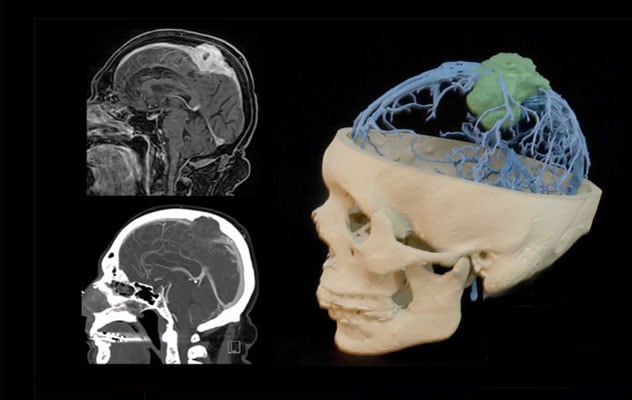 Personalized tumor imaging
Life-size, patient-specific 3D anatomic model manufactured at Mayo Clinic shows a complex intracranial tumor.
Advanced CT and MRI scans can be used to manufacture life-size, personalized 3D models of patient anatomy and pathology. Created in-house by Mayo Clinic's unique anatomic modeling unit, the models help guide individualized treatment.
Neuropathologists use advanced molecular testing to analyze brain tumor biopsies. Test results can help target treatment for individual patients.
A multidisciplinary tumor board reviews all cases to recommend optimal treatment approaches. As a nonprofit quaternary center, Mayo Clinic has specialists who can provide the best treatment, without bias toward any specific approach. "Our teams across the enterprise focus on what's best for the patient and work closely together to support the patient throughout this journey," Dr. Porter says. "It can be difficult for patients to figure out where one specialty starts and stops because of how well integrated we are."
Treatment modalities use state-of-the-art technology, including computer-assisted brain surgery, intraoperative MRI, awake brain surgery and laser surgery. Mayo Clinic neurosurgeons perform more than 2,900 brain tumor surgeries each year. "We use the most innovative approaches to surgery to reduce surgical complication rates and to shorten hospital stays and the time before initiating treatment after surgery," Dr. Porter says.
Radiation therapy typically involves external beam radiation or radiosurgery. Small tumors might be treated with Gamma Knife stereotactic radiosurgery or proton beam therapy. Hypofractionated stereotactic radiotherapy might be an option.
"We look to innovate — to provide therapies and treatments never offered before," Dr. Porter says. "But we also are able to execute standard care in an unparalleled way. While we drive the science forward, we continue to maximize the tools already available."
To help manage patients' symptoms during treatment, the care team includes specialists in physical, speech, occupational and cognitive therapies. Social work, nutrition and chaplain services are also available.
"We are trying to expand the idea of palliative medicine beyond posttreatment end-of-life care to being supportive care throughout the treatment course," Dr. Porter says. "All of the wraparound services in our Comprehensive Cancer Center aim to improve patients' quality of life."
That commitment is the cornerstone of brain tumor care at Mayo Clinic. "Our multiple specialists look with their unique lenses at each patient," Dr. Porter says. "That's how we ensure we're bringing the very best experience for that patient."
For more information
Brain Tumor Program. Mayo Clinic.
Mayo Clinic Comprehensive Cancer Center. Mayo Clinic.
Refer a patient to Mayo Clinic.