Your pulse rate is your heart rate. It's the number of times your heart beats in one minute. Learning how to check your pulse the correct way may help you know if your heart is beating too slow or too fast.
You can feel your pulse in an artery in your wrist or in your neck. The wrist artery is called the radial artery. The neck artery is called the carotid artery.
Some smartwatches and similar devices have heart rate monitors that can check pulse rate. But they may not always be accurate, especially if you have some heart conditions. Ask your healthcare team if this is a good choice for you.
General instructions for checking your pulse by hand
You can check your pulse in your wrist or your neck. Before you start, sit down and rest quietly for a few minutes.
When you are ready, count your pulse for 60 seconds unless your healthcare team tells you to do it a different way. For example, some people count for 15 seconds and multiply the answer by 4.
Checking your pulse in your wrist
You can check your pulse on either wrist.
- Turn your hand so your palm faces up.
- Find the spot between your wrist bone and the tendon on the thumb side of your wrist.
- Use the tips of your index and middle fingers on your other hand to feel the pulse in this spot.
- Press lightly so you can feel each beat. Do not push too hard. Doing so might block blood flow.
- Look at the second hand on a watch or clock or set a timer for one minute. Count how many beats you feel. The number of beats you feel in one minute is your pulse rate.
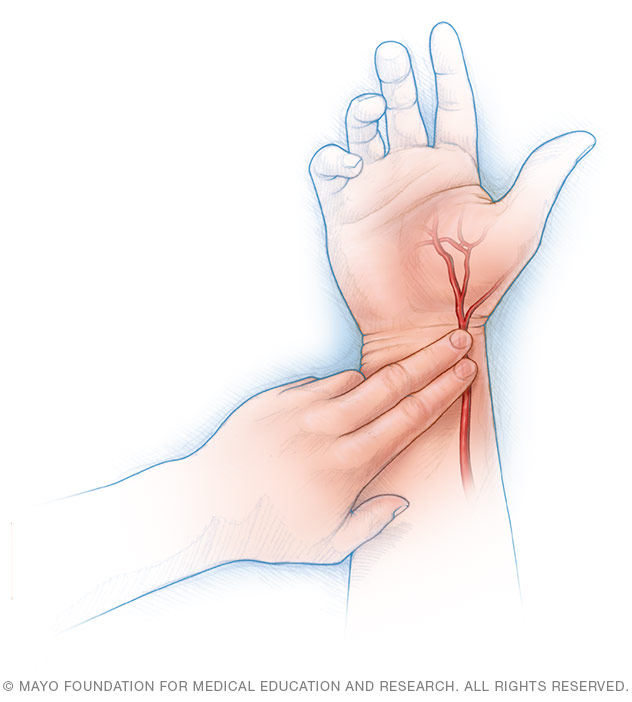
Taking your pulse using your radial artery
Use the tips of your index and middle fingers to feel the pulse in your radial artery. This is the area between your wrist bone and the tendon on the thumb side of your wrist.
Checking your carotid pulse
Find the artery on one side of your neck near your windpipe. You can check your carotid pulse on either side of your neck. Do not do this if your healthcare team has told you that you have plaque in your neck arteries.
- Place the tips of your index and middle fingers in the groove next to your windpipe to feel your carotid pulse. Do not press on both sides of your neck at the same time. This may make you feel dizzy or lightheaded or cause you to faint.
- Press lightly so you can feel each beat. Do not push too hard. Doing so might block blood flow.
- Look at the second hand on a watch or clock or set a timer for one minute. Count how many beats you feel. The number of beats you feel in one minute is your pulse rate.
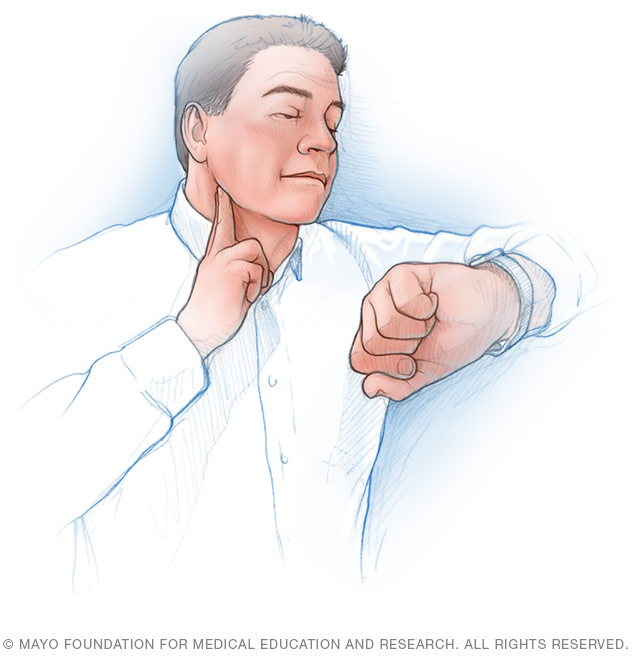
Taking your pulse using your carotid artery
Put the tips of your index and middle fingers in the groove of your neck along your windpipe. Press lightly to feel the pulse in your carotid artery.
Many things can affect your pulse rate, also called your heart rate. They include your age, some medicines, health conditions, pregnancy and exercise. Ask your healthcare team what your target heart rate should be.
