Dupuytren contracture Symptoms and causes
Overview
Dupuytren contracture is a condition that makes one or more fingers bend toward the palm of the hand. Over time, the affected fingers can't fully straighten. This happens because tough tissue under the skin of the palm slowly thickens and shortens into cords that pull the fingers down.
This condition often gets worse slowly, over years. It most often affects the ring finger and little finger, but any finger or thumb can be affected. The limited motion can make everyday activities difficult. These include putting on gloves, shaking hands and reaching into pockets.
There's no cure for Dupuytren contracture. But treatments can relieve symptoms and slow how quickly the condition gets worse.
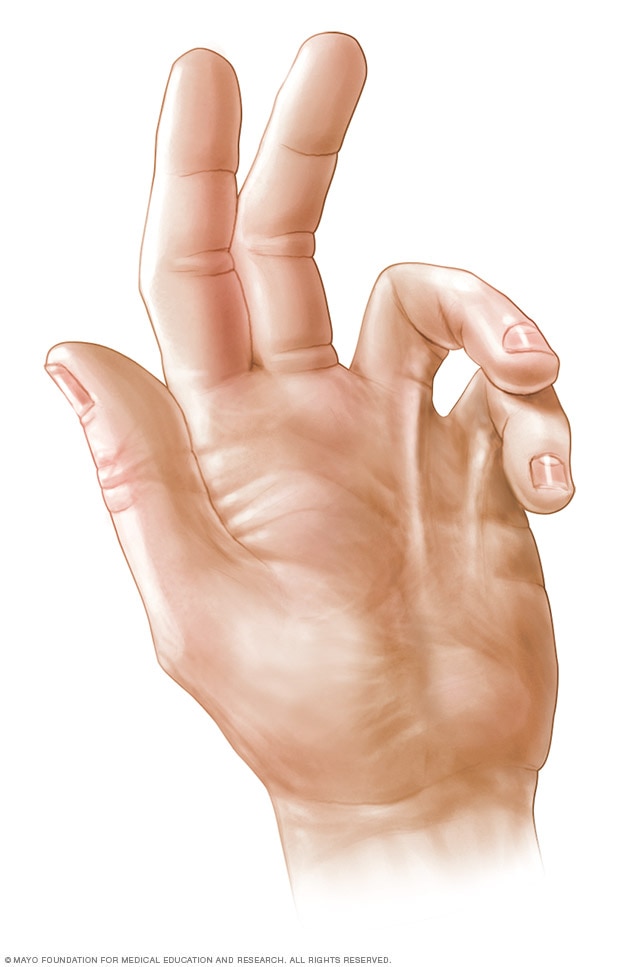
Dupuytren contracture
Dupuytren contracture is a condition that causes one or more fingers to bend toward the palm of the hand. The affected fingers can't fully straighten. It most often affects the ring finger and little finger.
Symptoms
In Dupuytren contracture, the first symptom typically is a thickening of the skin on the palm of your hand. Over the years, the skin on your palm may look puckered or dimpled, and a firm lump of tissue can form. This lump usually is painless. But sometimes it is painful.
Over time, the lump can form a hard cord that extends into the fingers. The finger is pulled into a bent position. Dupuytren contracture typically affects both hands.
When to see a doctor
See your healthcare professional if you notice:
- A lump in your palm that doesn't go away.
- A finger that starts to bend toward your palm.
- Trouble placing your hand flat on a table.
- Difficulty with everyday tasks, such as putting on gloves, shaking hands or reaching into pockets.
Causes
The cause of Dupuytren contracture is not known, but it tends to run in families.
Risk factors
People with certain diseases or health conditions may be more likely to develop Dupuytren contracture. Risk factors include:
- Age. Dupuytren contracture occurs most commonly after the age of 50.
- Sex. Men are much more likely to develop Dupuytren than are women. In men, symptoms may be worse and progress more quickly.
- Ancestry. People of Northern European descent are at higher risk of the disease.
- Family history. Dupuytren contracture often runs in families.
- Job. Some studies show a connection between Dupuytren contracture and people who use vibrating tools.
- Diabetes. People with diabetes have an increased risk of Dupuytren contracture.
- Tobacco and alcohol use. Smoking tobacco and drinking alcohol have both been linked with an increased risk of Dupuytren contracture in some studies.
From Mayo Clinic to your inbox
Sign up for free and stay up to date on research advancements, health tips, current health topics, and expertise on managing health. Click here for an email preview.
CON-20371927
Mayo Clinic does not endorse companies or products. Advertising revenue supports our not-for-profit mission.
Advertising & Sponsorship
Mayo Clinic Press
Check out these best-sellers and special offers on books and newsletters from Mayo Clinic Press.
