An episiotomy is a cut, also called an incision, made in the tissue between the vaginal opening and the anus during childbirth. That area is called the perineum.
An episiotomy was once a typical part of childbirth. But now the procedure is used much less often. If you're planning a vaginal delivery, here's what you need to know about episiotomy and childbirth.
The history
For years, episiotomies were thought to help prevent larger vaginal tears during childbirth. Experts believed a cut would heal better than a natural tear. An episiotomy also was thought to help protect the muscles and connective tissue that support the pelvic floor. Now research suggests that episiotomies don't prevent these problems after all.
Today's approach
Healthcare professionals no longer recommend episiotomies for most people giving birth. But they are needed in some situations.
An episiotomy might be useful if a baby needs to be delivered quickly because:
- The baby has a heart rate pattern during pushing that is very concerning.
- Forceps or a vacuum device are needed for delivery, and the risk of a tear that affects the anus is high without an episiotomy.
- The baby's shoulder is stuck behind the pelvic bone, a condition called shoulder dystocia.
How it works
There are two main types of episiotomies:
- Midline incision. A midline incision is done vertically. This kind of cut is easier to repair. But it has a higher risk of tearing into the anal area.
- Mediolateral incision. A mediolateral incision is done at an angle. This kind of cut is less likely to tear into the anal area. But it may be more painful during recovery.
If you get an episiotomy and have an epidural block, you typically won't feel the incision or repair. If you haven't had anesthesia or if the anesthesia has worn off, you'll likely receive a shot of local anesthetic to numb the tissue.
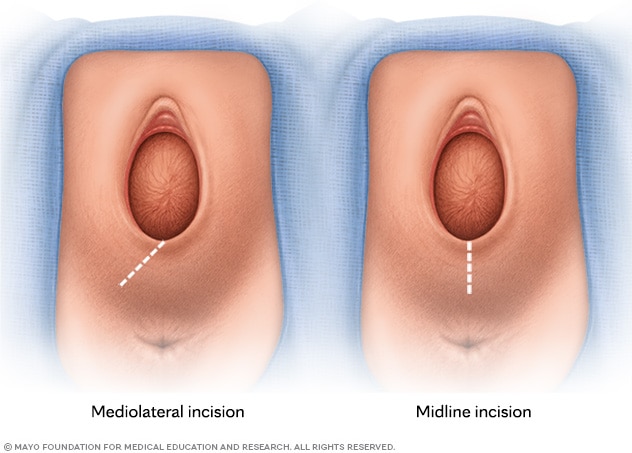
Episiotomy
An episiotomy is a cut made in the tissue between the vaginal opening and the anus. A mediolateral incision (shown at left) is done at an angle. A midline incision (shown at right) is done vertically.
Episiotomy risks
Episiotomy recovery often involves some discomfort. Sometimes the cut is bigger or deeper than a natural tear would have been. Infection is possible after an episiotomy. And for some people, an episiotomy causes pain during sex in the months after childbirth.
A midline episiotomy raises the risk of serious vaginal tears. These tears can go into the anus and effect the rectum. That can make it hard to hold in bowel movements, a condition called fecal incontinence.
Healing after an episiotomy
Stitches used to repair an episiotomy typically don't need to be removed. They are absorbed slowly by the body.
Pain after an episiotomy typically goes away over time. To help ease pain during healing, your healthcare professional may prescribe pain medicine. Or you might use a pain reliever that you can buy without a prescription.
Your healthcare professional may suggest you take a stool softener or a laxative to help prevent constipation. You also might need to take an antibiotic to help prevent infection.
Contact your healthcare professional if you develop any of the following symptoms after an episiotomy. They could mean you have an infection.
- Pain, tenderness or swelling that gets worse over time.
- Pain that isn't helped by pain medicines.
- Fever.
- Chills.
- Pus coming out of the episiotomy site.
- A bad-smelling odor.
Learn what to expect
Try to keep an open mind about getting an episiotomy. But know that it's rare to need one. At your prenatal visits, talk with your healthcare professional about when an episiotomy may be necessary. Be sure to talk about what you prefer and ask any questions you may have.
Mayo Clinic's Ultimate Guide to Pregnancy
This guide offers research-backed advice to help you and your baby experience a healthy pregnancy, written by some of the world's leading medical experts.
