Ulcerative colitis Symptoms and causes
Overview
Ulcerative colitis is a type of inflammatory bowel disease (IBD) that causes inflammation and sores, called ulcers, in the colon. Ulcerative colitis (UL-sur-uh-tiv koe-LIE-tis) affects the innermost lining of the colon and rectum. The condition typically begins in the rectum and then may extend upward through part or all of the colon. The colon also is called the large intestine.
Ulcerative colitis symptoms usually develop over time, rather than starting suddenly. It is a chronic condition that sometimes can lead to life-threatening complications if not properly treated.
While there is no current cure with medicine, treatment can greatly reduce symptoms and heal the lining of the colon, which can lead to long-term remission.
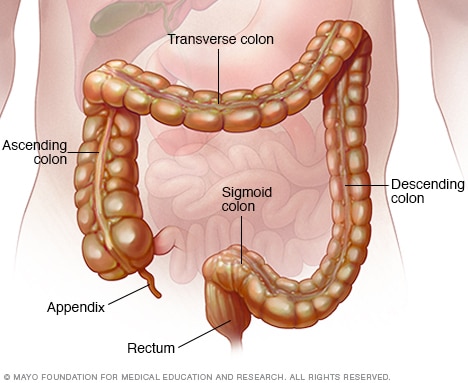
Colon and rectum
The colon is a long tubelike organ in the belly. It is part of the digestive system. The colon processes and removes waste that's left from digesting foods. Waste leaves the body as stool through the rectum and anus.
Types
Healthcare professionals often classify ulcerative colitis according to its location. Types of ulcerative colitis include:
- Ulcerative proctitis. Inflammation is limited to the rectum. This is the area closest to the anus. Rectal bleeding or urgency may be the only sign of the disease. But constipation also can be a symptom.
- Left-sided colitis. In left-sided colitis, inflammation extends from the rectum up through the sigmoid colon and descending colon. Proctosigmoiditis is a type of left-sided colitis. Inflammation involves the rectum and sigmoid colon, which is the lower end of the colon. Symptoms of left-sided colitis include bloody diarrhea, belly cramps and pain, and not being able to pass stool despite the urge to do so, called tenesmus.
- Widespread colitis. This sometimes is called pancolitis. This type often affects the entire colon and causes bouts of bloody diarrhea that may be severe, belly cramps, and pain, fatigue and weight loss.
Crohn's disease and microscopic colitis are other conditions that cause inflammation in the digestive tract. Crohn's disease can affect any part of the gastrointestinal system, often including the small intestine, and it may involve deeper layers of the bowel wall. This differs from ulcerative colitis, which is limited to the colon and rectum.
Microscopic colitis, which includes lymphocytic and collagenous colitis, also can cause ongoing watery diarrhea, but it is different from ulcerative colitis. In microscopic colitis, the colon shows no signs of disease during colonoscopy, and inflammation is visible only under a microscope.
Symptoms
Ulcerative colitis symptoms can vary depending on how serious the inflammation is and where it is located. Symptoms may include:
- Diarrhea, often with blood, mucus or pus.
- Blood in the stool.
- Belly pain and cramping.
- Rectal pain.
- Urgency to pass stool.
- Not being able to pass stool despite urgency.
- Weight loss.
- Fatigue.
- Fever.
- In children, failure to grow.
About half the people with ulcerative colitis have mild to moderate symptoms. How ulcerative colitis affects people over time may vary. Some people have long periods without symptoms, called remission.
When to see a doctor
See a healthcare professional if you notice a change in your bowel habits that lasts a while or if you have symptoms such as:
- Belly pain.
- Blood in the stool.
- Ongoing diarrhea that doesn't get better with medicines you can get without a prescription.
- Diarrhea that awakens you from sleep.
- An unexplained fever that lasts more than a day or two.
Ulcerative colitis usually isn't fatal. But it's a serious disease that can cause life-threatening complications.
Gastroenterology & GI Surgery Blog
Causes
The cause of ulcerative colitis isn't known. In the past, diet and stress were thought to be causes. But today healthcare professionals understand that these factors may make symptoms worse rather than cause the disease. Stress, in particular, can affect the immune system and gut function. This may increase urgency to pass stool, diarrhea or belly pain during a flare.
Possible causes may include:
- Immune system issue. Something may go wrong with the immune system. When the immune system tries to fight off an invading virus or bacterium, an irregular immune response causes the immune system to attack the cells in the digestive tract too.
- Genetic traits. Several genetic markers have been associated with ulcerative colitis. Heredity also seems to play a role. The condition is more common in people who have family members with the disease. However, genetic testing is not helpful to diagnose or screen for the condition.
- Gut bacteria. The natural bacteria in the gut make up the gut microbiome. An imbalance in the gut microbiome may contribute to the immune response.
- Environmental factors. Where a person lives and other environmental influences such as diet and the use of antibiotics also may increase risk, though the exact role is still unclear.
Get the latest health information from Mayo Clinic delivered to your inbox.
Risk factors
Ulcerative colitis can happen to anyone. Risk factors may include:
- Age. Ulcerative colitis usually begins before the age of 30. But it can occur at any age, and some people may not develop the disease until after age 60.
- Race or ethnicity. Although white people have the highest risk of the disease, ulcerative colitis can happen in any race. The risk is even higher for those of Ashkenazi Jewish descent.
- Family history. You're at higher risk if you have a close relative, such as a parent, sibling or child, with the disease.
Complications
Possible complications of ulcerative colitis include:
- Severe bleeding.
- Severe dehydration.
- Loss of red blood cells, known as anemia.
- Bone loss, called osteoporosis.
- Inflammation of the skin, joints and eyes.
- An increased risk of colon cancer.
- A rapidly swelling colon, called toxic megacolon.
- Increased risk of blood clots in veins and arteries.
- Delayed growth and development in children.





CON-20312397
Mayo Clinic does not endorse companies or products. Advertising revenue supports our not-for-profit mission.
Advertising & Sponsorship
Mayo Clinic Press
Check out these best-sellers and special offers on books and newsletters from Mayo Clinic Press.
