Gaucher disease Symptoms and causes
Overview
Gaucher (go-SHAY) disease is a rare, inherited condition that leads to the buildup of a fatty substance in tissues. This buildup causes damage and dysfunction of tissues and organs. The spleen, liver and bones are most often affected.
There are three general types of Gaucher disease. More than 90% of cases are type 1.
Primary treatments either break down the fatty substance or limit its production. Regular tests are done to monitor treatments and look for signs of tissue damage.
Type 1 Gaucher disease is more common among people with Eastern and Central European Jewish ancestry, also called Ashkenazi Jews.
Symptoms
Some symptoms are shared by all types of Gaucher disease, but each type varies in important ways.
Type 1
Symptoms vary in severity. In some cases, a healthcare professional may find signs of the disease before symptoms appear. Symptoms most often appear in childhood or teenage years, but they can begin at any age. Signs and symptoms of type 1 Gaucher disease include:
- Enlarged organs. The spleen becomes greatly enlarged. The liver also may become enlarged. The effects may include:
- Easy bruising or bleeding because of blood platelets trapped in the spleen.
- Tissue damage or scarring in the spleen or liver.
- Belly pain or discomfort.
- Bone conditions. Weakened and irregular bones may cause:
- Bone pain.
- Bone fractures, even with no apparent injury.
- Bone marrow disorders. Bone marrow may not produce enough healthy blood cells causing:
- Low blood platelet production that leads to easy bruising or bleeding.
- Low red blood cell production that causes fatigue.
- Lung disease. Less often, the disease may affect breathing because of:
- Damage to lung tissues.
- Restrictions on the lungs caused by an enlarged spleen or liver.
- High blood pressure in the lungs.
- Growth disorders. Some children with type 1 Gaucher disease experience:
- Delayed or limited growth.
- Delayed puberty.
Type 2
Type 2 Gaucher disease is the least common. The disease causes the rapid loss of cells in the brain stem. This part of the brain controls breathing, muscle control and other important functions.
Symptoms appear within the first few months of life. Death usually occurs within two years.
Type 3
Type 3 Gaucher disease causes symptoms of type 1. It also causes some nervous system disorders and the progressive loss of brain cells. Symptoms begin during childhood. They include:
- Eye movement disorders.
- Muscle spasms.
- Seizures.
- Loss of muscle control in adolescents or early adulthood.
- Dementia in adolescents or early adulthood.
When to see a doctor
If you or your child has symptoms associated with Gaucher disease, make an appointment with your healthcare professional.
Causes
A fatty substance, called glucocerebroside, is a part of a cell's wall and plays an important role in cell activity. When a cell dies, a particular enzyme breaks down this fatty substance.
In Gaucher disease, the gene responsible for making this enzyme has an irregular change, called a mutation. The fatty substances aren't broken down. Instead, they build up in white blood cells that are responsible for eating up the debris from dead cells.
These irregular white blood cells, called Gaucher cells, damage tissues.
Inheritance pattern
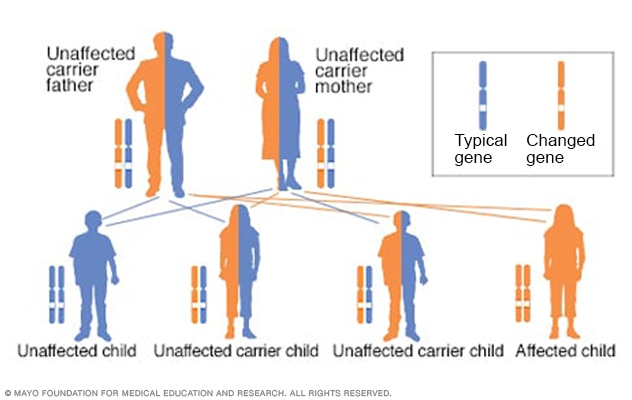
Autosomal recessive inheritance pattern
In an autosomal recessive disorder, two changed genes are inherited, one from each parent. The parents' health is rarely affected because they have only one changed gene. Two carriers have a 25% chance of having an unaffected child with two unaffected genes. They have a 50% chance of having an unaffected child who also is a carrier. They have a 25% chance of having an affected child with two changed genes.
Gaucher disease is passed along to a child when both parents carry a Gaucher-related gene mutation. A child gets one mutated gene from each parent. This inheritance pattern is called autosomal recessive.
Children who inherit only one mutated gene do not get the disease. But they can, in turn, pass along the mutation.
Risk factors
People of Eastern and Central European Jewish ancestry, called Ashkenazi Jews, are at a higher risk than the general population of developing type 1 Gaucher disease.
Complications
Complications of type 1 Gaucher disease include:
- Parkinson's disease risk. People with type 1 Gaucher disease have a greater risk of developing Parkinson's disease than the general population. People who carry one copy of a Gaucher-related gene mutation also have an increased risk. Also, there's an increased risk of the related disorder called Lewy body dementia.
- Cancer risk. People with type 1 Gaucher disease have an increased risk of cancers of bone marrow and blood.
- Pregnancy complications. Gaucher disease symptoms may worsen during pregnancy. Also, there's an increased risk of bleeding after delivery.
CON-20248806
Mayo Clinic does not endorse companies or products. Advertising revenue supports our not-for-profit mission.
Advertising & Sponsorship
Mayo Clinic Press
Check out these best-sellers and special offers on books and newsletters from Mayo Clinic Press.
