Breast cysts Diagnosis and treatment
Diagnosis
To diagnose a breast cyst, a healthcare professional usually reviews your symptoms and does a breast exam. Imaging tests, such as a breast ultrasound or mammogram, also may be done. Your healthcare professional also may do a fine-needle aspiration or a biopsy if needed.
Breast exam
After talking with you about your symptoms and your health, your doctor or other healthcare professional will feel the lump in your breast and check for other problems. Other tests might be needed to make sure it's a cyst, such as an imaging test or fine-needle aspiration.
Imaging tests
Imaging tests that can help diagnose a breast cyst include:
- Mammography. Large cysts and clusters of small cysts can usually be seen with mammography. But microcysts may not show on a mammogram. Mammograms also may not show if a lump is filled with fluid.
- Ultrasound. With an ultrasound of the breast, your healthcare professional is better able to tell if a breast lump is fluid-filled or solid. A fluid-filled area usually means it's a breast cyst. A lump that appears to be solid is likely a noncancerous breast lump, such as a fibroadenoma. But solid lumps also could be breast cancer.
Imaging tests may be skipped if a breast lump is easy to feel. In that case, a fine-needle aspiration may be done to drain the fluid and collapse the cyst.
Fine-needle aspiration
During a fine-needle aspiration, your healthcare professional inserts a thin needle into the breast lump to draw out the fluid. This is called aspiration. Often, fine-needle aspiration also uses ultrasound to guide the needle to the right place in the breast. If fluid comes out and the breast lump goes away, your healthcare professional may quickly be able to diagnose the lump as a breast cyst.
After a fine-needle aspiration, the breast cyst can fill with fluid again.
- If the fluid is straw-colored and not bloody and the breast lump goes away, you need no further testing or treatment.
- If the fluid is bloody or the breast lump doesn't go away, your healthcare professional may send a sample of the fluid for lab testing. You may be referred to a breast surgeon or a radiologist for follow-up. A radiologist is a doctor trained to perform imaging exams and procedures.
- If no fluid can be drawn out of the breast lump, your healthcare professional may recommend an imaging test, such as a diagnostic mammogram or ultrasound. When there is no fluid or a breast lump doesn't go away after aspiration, the lump or a part of it may be solid. A procedure called a core needle biopsy may be done to look more closely at a mass that appears solid. A core needle biopsy is like a fine-needle aspiration but uses a wider needle and collects more cells and tissue for testing.
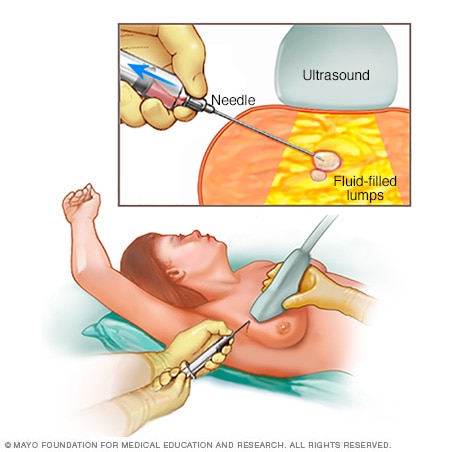
Fine-needle aspiration
During fine-needle aspiration, a special needle is inserted into a breast lump, and any fluid is removed. Your healthcare professional may use ultrasound, which uses sound waves to create images of your breast on a monitor, to help place the needle.
Treatment
No treatment is needed for simple breast cysts. Simple cysts are filled with fluid and don't cause any symptoms. Your doctor or other healthcare professional may find them with a breast ultrasound or after a fine-needle aspiration. Many simple cysts disappear on their own. If, after a few months, you notice the cyst hasn't gone away, it feels firmer or you see skin changes on your breast, make an appointment to follow up with your healthcare professional.
Fine-needle aspiration
Fine-needle aspiration may be used both to diagnose and treat a breast cyst. If all the fluid can be removed from the cyst during the procedure and your breast lump disappears and symptoms go away, no other treatment is usually needed.
Sometimes after using a thin needle to drain a breast cyst, it can fill up with fluid again. If that happens, you may need to have the fluid drained more than once. It's common for cysts to go away and come back, or for new cysts to show up. But if a breast cyst stays after a few periods and gets bigger, see your healthcare professional to get it checked.
Hormone use
For severe symptoms, a healthcare professional may recommend using birth control pills, also called oral contraceptives. This also is called hormone therapy. Hormone therapy medicine may regulate your periods and reduce how often breasts cysts happen. But they also may include side effects such as headaches, upset stomach, breast tenderness and mood changes. Stopping hormone therapy after menopause also may help prevent breast cysts.
Surgery
You usually don't need surgery to remove a breast cyst. But if a cyst keeps coming back every month and causes pain, or if the fluid inside looks like it has blood or something unusual in it, surgery might be needed.
Clinical trials
Explore Mayo Clinic studies testing new treatments, interventions and tests as a means to prevent, detect, treat or manage this condition.
Alternative medicine
Talk with your doctor or other healthcare professional about any vitamins, herbs or other supplements you take or want to try. Some people use evening primrose oil to help with cyst pain, but doctors aren't sure if it really works. Talk to your care team about what may help you before trying any supplements.
Self-care
If you have breast cysts, here are some ways to feel better:
- Wear a bra that fits well. A good bra that supports your breasts can help reduce pain.
- Use a warm or cold pack. Putting something warm or cold on your breast may help with the pain.
- Try cutting out caffeine. Even though studies don't prove it, some people feel better when they stop having caffeine. That means skipping things like coffee, tea, soda and chocolate. You can try it and see if it helps you.
- Ask your care team about medicine you can buy off the shelf. Some pain relievers such as acetaminophen (Tylenol, others), ibuprofen (Advil, Motrin IB, others) or naproxen sodium (Aleve) might help with breast pain. Talk with your doctor or other healthcare professional to see what might work for you
Get the latest breast cancer information from Mayo Clinic delivered to your inbox.
Sign up for free and receive the latest on breast cancer treatment, care and management.
Preparing for your appointment
You'll likely see your primary healthcare professional to check a new breast lump or other change in your breasts. Based on a clinical breast exam or findings on an imaging test, you may be referred to a breast health specialist.
What you can do
The first evaluation focuses on your medical history. You'll talk about your symptoms, how they relate to your periods and any other relevant information. To get ready for this discussion, take note of:
- All your symptoms, even if they seem unrelated to the reason you scheduled the appointment.
- Key personal information, including major stresses or recent life changes.
- All medicines, vitamins, herbs and supplements you regularly take and doses.
- Questions to ask during your appointment, to be sure you cover everything you want to talk about.
Basic questions to ask your healthcare professional include:
- What might be causing my symptoms?
- Does having cysts increase my risk of breast cancer?
- What kinds of tests do I need?
- Will I need treatment? If so, what treatments are available?
- Are there any restrictions I need to follow?
- Are there any printed materials that I can take home? What websites do you recommend?
Feel free to ask questions anytime you don't understand something.
What to expect from your doctor
Be prepared to answer questions about your condition, such as:
- When did you first notice the breast cyst or lump?
- Have there been any changes in the size of the breast cyst or lump?
- What symptoms do you have, and how long have you had them?
- Do your symptoms happen in one breast or both breasts?
- Have your symptoms changed over time?
- Do you have breast pain? If so, how bad is it?
- Do you have nipple discharge in one or both breasts?
- How do your periods affect the breast cyst or lump?
- When was your last mammogram?
- Does anyone in your family have a history of breast cysts or lumps?
- Have you previously had a breast cyst or lump, a breast biopsy, or breast cancer?
CON-20370271
Mayo Clinic does not endorse companies or products. Advertising revenue supports our not-for-profit mission.
Advertising & Sponsorship
Mayo Clinic Press
Check out these best-sellers and special offers on books and newsletters from Mayo Clinic Press.
