Diagnosis
To diagnose atrioventricular (AV) heart block, a healthcare professional examines you and asks about your medical history and symptoms. The health professional:
- Checks your blood pressure.
- Listens to your heart with a tool called a stethoscope.
You may have tests to check your heart and to look for health conditions that can cause AV heart block.
Electrocardiogram
An electrocardiogram (ECG or EKG) is the main test used to find AV heart block. This quick test measures the electrical activity of the heart. Sticky patches with sensors on them go on the chest and sometimes the arms or legs. Wires connect the sensors to a computer, which displays or prints results.
An ECG tells a healthcare professional how fast or how slow the heart is beating. The test can show whether heart signals are delayed or blocked.
An ECG also shows how much time passes from the start of electrical activity in the heart's upper chambers to the start of electrical activity in the lower chambers. This time is called the PR interval.
AV block can have different patterns on an ECG:
- First-degree AV block. Every electrical signal from the upper heart chambers reaches the lower heart chambers. The PR interval is longer than 200 milliseconds.
- Second-degree AV block. Some electrical signals from the upper heart chambers do not reach the lower heart chambers. The pattern of signals that get through and signals that are blocked helps your care team learn the type of second-degree AV block.
- Third-degree AV block. The electrical activity in the upper and lower heart chambers happens separately. The signals do not follow a consistent pattern on the ECG.
Electrocardiogram
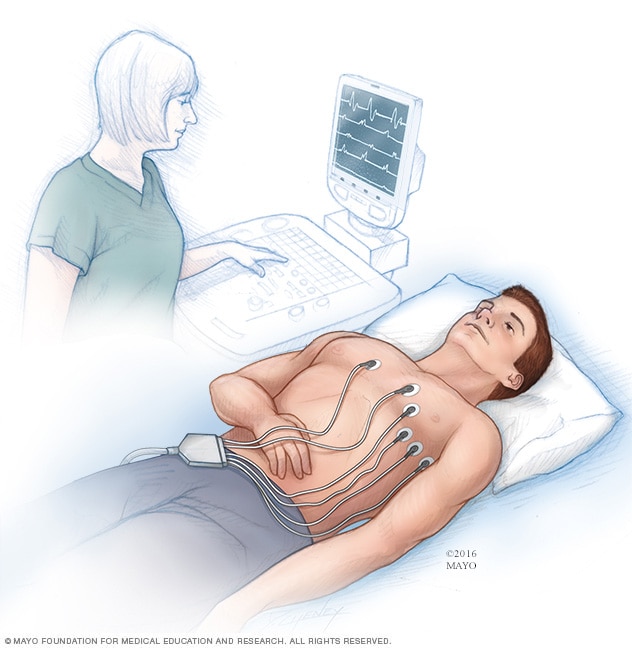
Electrocardiogram
An electrocardiogram (ECG or EKG) is a test to record the electrical signals in the heart. It shows how the heart is beating. Sticky patches called electrodes are placed on the chest and sometimes on the arms or legs. Wires connect the patches to a computer, which prints or displays results.
Holter monitor
If an AV block comes and goes, a regular electrocardiogram may not find the heartbeat changes. Your healthcare professional may want you to wear a heart monitor during your regular activities. One type of wearable heart monitor is a Holter monitor. It records your heart's rhythm, usually for 1 to 2 days.
Stress test
If you have symptoms when you exercise, you may need a stress test. A stress test shows how the heart works during physical activity. It also may be called an exercise stress test. Exercise makes the heart pump harder and faster. A stress test can show changes in blood flow within the heart.
Echocardiogram
Your healthcare professional may want you to have an echocardiogram. An echocardiogram uses sound waves to create pictures of the heart. This test can show blood flow through the heart and heart valves. Your healthcare professional can use the pictures from the test to find heart disease and other heart conditions.
Blood tests
Your healthcare professional may do blood tests to look for conditions that could be causing AV block. For example, you may have a blood test to check how much thyroid hormone is in your blood.
EP study
An electrophysiology (EP) study is a series of tests that check the heart's electrical activity. It's also called invasive cardiac electrophysiology. An EP study can help find the cause of irregular heartbeats, called arrhythmia. If you have fainted suddenly, an EP study can help find the cause.
More Information
Treatment
Treatment of atrioventricular (AV) heart block depends on the type of AV block, your symptoms, the cause and whether the cause can be reversed.
Treatment for causes that can be reversed
Some types of AV block may get better when the cause can be treated. For example, AV block from an infection may get better after the infection is treated.
If a medicine causes AV block, your care team may review your medicines. Some medicines may slow heart signals. You and your care team can talk about whether to continue, change or stop a medicine. Do not stop taking a prescribed medicine on your own.
Changing or stopping a medicine does not always stop AV block.
Emergency treatment
If you have atrioventricular heart block that causes a very slow heartbeat with poor blood flow or trouble breathing, you need treatment right away.
You may receive a medicine called atropine through a vein to raise the heart rate. If atropine does not work, your care team may give you other medicines.
Some people may need a heart procedure called transcutaneous pacing. During this treatment, a healthcare professional puts pads on the chest. Electrical signals go through the pads to help speed up the heartbeat. This treatment may be used until a pacemaker can be placed.
Pacemaker
You may need a permanent pacemaker if you have Mobitz type 2, high-grade or third-degree AV block. You also may need a pacemaker if the cause of the AV block cannot be treated or the AV block comes from an ongoing issue with your heart's electrical system.
A pacemaker is a small, battery-powered device that prevents the heart from beating too slowly. The device is placed under the skin near the collarbone.
For other types of AV block, you may need a pacemaker if your symptoms are caused by the heart's electrical issue.
Prognosis
Prognosis means what may happen with AV heart block over time. It also may be called your outlook.
Prognosis differs from person to person. Your outlook depends on:
- The type of AV block.
- Whether you have symptoms.
- Whether the cause can be treated or reversed.
- Whether the AV block continues or returns after treatment.
First-degree AV block often causes no symptoms and may not need treatment.
Some forms of AV block may improve when a reversible cause is treated. For example, AV block may improve after a medicine is changed or stopped. But the block may continue or return.
High-grade AV block that can't be reversed is more likely to need ongoing treatment, such as a permanent pacemaker.
Preparing for your appointment
Medical appointments can feel short. You may have a lot to talk about. It may help to prepare before your visit.
What you can do
- Write down any symptoms and when you have them. Include symptoms such as feeling faint, dizzy or very tired or having trouble breathing.
- Write down important personal information. Tell your healthcare team if you have a family history of heart or heart signaling conditions.
- Make a list of all the medicines, vitamins and supplements you take. Include prescription medicines and the medicines you buy without a prescription. Also include the dosages.
- If possible, ask someone to go with you to help take notes or remember what your care team says.
Also write down questions to ask your care team. Questions you may want to ask include:
- What type of AV block do I have?
- What tests do I need?
- Is this likely to get worse?
- What could be causing my heart block?
- What treatment do I need?
- How do you decide whether I need a pacemaker?
What to expect from your doctor
Your care team usually asks many questions, such as:
- When did your symptoms start?
- How bad are they?
- Do the symptoms come and go, or do you have them all the time?
- Does anything make your symptoms better or worse?
- Do you feel dizzy, faint or more tired than usual? Do you find it hard to breathe?
- Have you ever fainted?
- Do symptoms happen during activity or at rest?
- Are you able to work and do your usual everyday tasks?
- Has anyone in your family ever been diagnosed with a heart rhythm disorder or heart signaling condition?
Sept. 18, 2026