Overview
The liver
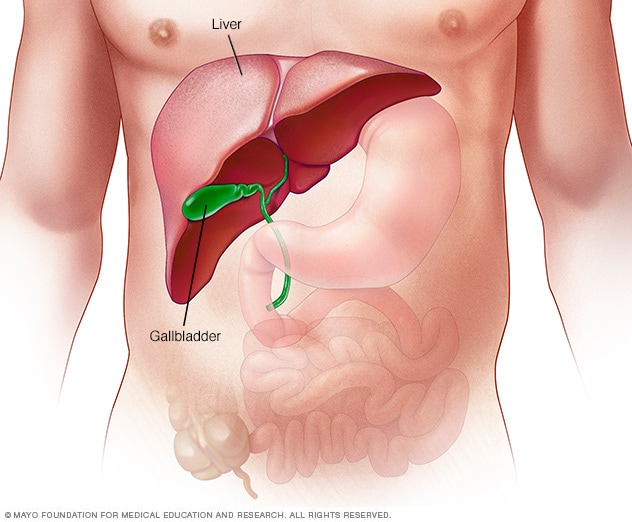
The liver
The largest organ inside the body, the liver is located mainly in the upper right portion of the abdomen, beneath the diaphragm and above the stomach.
Start your donor evaluation
Begin the process of becoming a living kidney or liver donor by clicking here to complete a health history questionnaire.
A liver transplant is a surgery to remove a liver that no longer works properly and replace it with a healthy liver. The new liver may come from a donor who has died or from a living person who donates part of the liver.
Your liver is your largest internal organ. It does many important jobs, including:
- Processing nutrients, medicines and hormones.
- Producing bile, which helps the body absorb fats, cholesterol and vitamins.
- Making proteins that help the blood clot.
- Removing bacteria and toxins from the blood.
- Helping the body fight infection.
Liver transplant is most often a treatment option for people who have severe complications from end-stage chronic liver disease. Rarely, liver transplant may happen when a healthy liver suddenly stops working.
Most liver transplants use a liver from someone who has died, also called a deceased donor. However, there are many more people who need a liver transplant than there are livers available from deceased donors.
Getting a part of a liver from a living donor, called a living-donor liver transplant, may be another option if you're waiting for a liver from someone who has died. Living-donor liver transplant is possible because the liver can regrow and regain its typical size again shortly after surgery to take out a portion for donation.
In 2022, about 9,500 liver transplants took place in the U.S. among adults and children. Of those, about 600 involved livers from living donors. At the same time, about 10,500 people were on the waiting list for a liver transplant.
Products & Services
Types
Why it's done
Healthy liver vs. liver cirrhosis
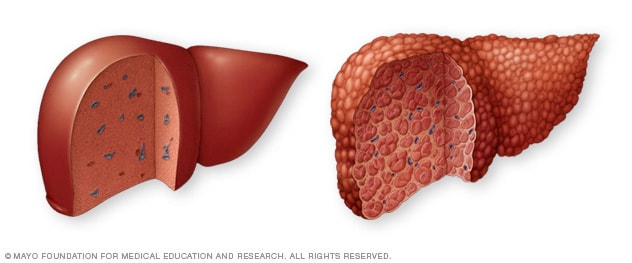
Healthy liver vs. liver cirrhosis
A healthy liver, at left, shows no signs of scarring. In cirrhosis, at right, scar tissue replaces healthy liver tissue.
Liver transplant is a treatment option for people with liver failure. It's also an option for some people with liver cancer when other treatments are no longer working.
Liver failure may happen quickly or over a long period of time. Liver failure that occurs quickly — in a matter of weeks — is called acute liver failure. Acute liver failure is not a common condition. It is usually the result of complications from certain medicines or infections.
Although a liver transplant may treat acute liver failure, it is more often used to treat chronic liver failure. Chronic liver failure occurs slowly over months and years.
Chronic liver failure may be caused by a variety of conditions. The most common cause of chronic liver failure is scarring of the liver, called cirrhosis. Cirrhosis occurs when scar tissue replaces typical liver tissue, preventing the liver from working as it should. Cirrhosis is the most frequent reason people need a liver transplant.
Major causes of cirrhosis leading to liver failure and liver transplant include:
Liver transplant also may treat certain cancers that start in the liver.
Risks
Complications of the procedure
Liver transplant surgery comes with a risk of serious complications. Some of these risks are related to the procedure itself, and others come from the medicines needed to keep the body from rejecting the new liver.
Possible risks of the procedure include:
- Bile duct complications, including bile duct leaks or shrinking of the bile ducts.
- Bleeding.
- Blood clots.
- Failure of the donated liver.
- Infection.
- Rejection of the donated liver.
- Mental confusion or seizures.
Over time, there also is a chance that the original liver disease could come back in the transplanted liver.
Antirejection medicine side effects
After a liver transplant, you take medicines for the rest of your life to help prevent your body from rejecting the donated liver. These antirejection medicines can cause side effects, including:
Because antirejection medicines work by suppressing the immune system, they also increase the risk of infection. Your healthcare professional may give you other medicines to help you fight or prevent infections.
How you prepare
Choosing a transplant center
If your healthcare professional recommends a liver transplant, you may be referred to a transplant center. You're also free to select a transplant program on your own or choose a program from your insurance company's list of preferred transplant centers.
When you're looking at a transplant program, you may want to:
- Learn about the number and type of transplants the center performs each year.
- Ask about the transplant center's liver transplant survival rates.
- Compare transplant program statistics using the database maintained by the Scientific Registry of Transplant Recipients.
- Understand the costs you'll likely have before, during and after your transplant. These costs may include tests, organ recovery, surgery, hospital stays, and transportation to and from the center for the procedure and follow-up appointments.
- Consider other services provided by the transplant program, such as support groups, travel arrangements, local housing during recovery and referrals to other resources.
- Assess the center's commitment to keeping up with the latest transplant technology and techniques, which indicates that the program is growing.
Once you choose a transplant center, you need an evaluation to see if you meet the center's eligibility requirements. Each transplant center has its own eligibility criteria. If one center doesn't accept you, you may still be evaluated at another center.
The evaluation process aims to determine whether you:
- Are healthy enough to have surgery and to take medicines after the transplant for the rest of your life.
- Have any medical conditions that could make a transplant less successful.
- Are willing and able to take medicines as directed and to follow the suggestions of the transplant team.
As part of your evaluation, you may have several tests and consultations, including:
- Laboratory tests, such as blood and urine tests to check how well your liver and other organs are working.
- Imaging tests, such as an ultrasound of your liver.
- Heart tests to study the health of your cardiovascular system.
- A general health exam, including routine cancer screening tests, to look at your overall health and to check for any other conditions that could affect your transplant.
Your evaluation also may include:
- Nutrition counseling with dietitians who review your diet and suggest ways to plan healthy meals before and after your transplant.
- Psychological evaluation to look for and treat any underlying conditions, such as depression or anxiety, and to make sure you fully understand the risks of a liver transplant.
- Meetings with social workers who assess your support network to see whether you have friends or family to help care for you after transplant.
- Addiction counseling to help if you're having trouble stopping your use of alcohol, drugs or tobacco.
- Financial counseling to help you understand the costs of a transplant and follow-up care, and to review what your insurance will cover.
When liver transplant surgery was in its infancy, transplants were offered mostly to young and middle-aged people. Today people in their 60s and older may receive a transplant depending on their health.
After you finish all the tests and consultations, the selection committee at the transplant center meets to discuss your results. The committee decides whether a liver transplant is an option for you and whether you're healthy enough for a transplant.
If the answer to both questions is yes, you are added to the liver transplant waiting list.
What you can expect
Before the procedure
Being placed on the waiting list
Healthcare professionals use the results of your liver function tests and other factors to see how serious your illness is, how urgently you need a transplant and where you should be placed on the liver transplant waiting list.
Your place on the waiting list is based on a scoring system. Healthcare professionals use the Model for End-Stage Liver Disease (MELD) score for adults and the Pediatric End-Stage Liver Disease (PELD) score for children younger than age 12.
Your healthcare professional calculates your MELD score using a formula based on your test results. The score can range from 6 to 40. It helps estimate the risk of death within 90 days without a transplant. A high MELD score means you urgently need a transplant.
When livers from deceased donors become available, they're matched by blood type to people on the waiting list. Then, they're given to people based on their MELD scores. People with higher MELD scores are usually offered donated livers first. If people have the same MELD score and blood type, the person who has been on the waiting list the longest time gets priority.
Some liver conditions, such as liver cancer, may not give a person a high MELD score. For these people, the transplant center can ask for more MELD points if the person meets certain medical requirements.
Also, adults with acute liver failure are not subject to ranking with the usual MELD score system. Instead, they may be placed higher on the transplant waiting list according to how severe their disease is.
Waiting for a new liver
The wait for a donor liver can vary greatly. Some people may get a liver within days, while others wait months or may never receive a liver from a deceased donor.
While you wait, your healthcare team treats the complications caused by your liver failure to keep you as comfortable as possible.
Complications of end-stage liver failure are serious, and you may be frequently hospitalized. If your liver disease gets worse, your MELD score is updated to reflect your current condition.
Living liver donors
Each year, a small number of liver transplants come from living donors. In living-donor liver transplant, surgeons transplant a small portion of a liver from a healthy, living person. Living-donor liver transplants were first used for children needing liver transplants because finding suitable deceased-donor organs for them was difficult. Now, living-donor livers also are an option for adults with advanced liver disease.
A living-donor liver transplant is an alternative to waiting for a liver from someone who has died. This type of transplant can help patients avoid the possible health complications of waiting for a transplant. The first step is to find a living donor who is healthy enough to safely have major surgery. The donor's age, blood type and organ size also are very important in making sure you and the donor are a match for living-donor liver transplant.
Most living liver donors are close family members or friends of the person who needs the transplant. If you have family members or friends who are willing to donate part of their livers to you, talk with your transplant team about this option.
Both living-donor liver transplants and deceased-donor transplants help people who need liver transplants. However, finding a living donor may be hard. Donors go through many tests to ensure they are good matches with organ recipients and that they are physically and emotionally healthy enough for surgery. The surgery also carries serious risks for donors.
Most living donors recover well, and their livers grow back to usual size within a few months.
Your transplant team can discuss the benefits and risks with you and the potential donor.
Domino liver transplant
Another, less common, type of living-donor liver transplant is called a domino liver transplant. In a domino liver transplant, you receive a liver from a living donor who has a rare inherited condition but whose liver still works well. Common examples of these conditions include familial amyloidosis and maple syrup urine disease (MSUD).
In this procedure, the living donor with familial amyloidosis or MSUD first receives a liver transplant to treat the condition. Then, the living donor's liver is given to you because it still works well. If your donor had familial amyloidosis, you may eventually develop symptoms, but usually not for many years. If your donor had MSUD, the transplanted liver usually does not cause symptoms because your body can process amino acids in the usual way.
Healthcare professionals usually select recipients who are middle-aged or older for domino liver transplants. Older people are less likely to develop symptoms of the donor's condition during their lifetimes. Sometimes, children receive a domino liver transplant. After the procedure, the healthcare team watches closely for any signs of the donor's condition.
Healthcare professionals evaluate you to see if you may be a candidate for a domino liver transplant or if another treatment option would be better for your condition.
Staying healthy
Whether you're waiting for a donated liver or your transplant surgery is already scheduled, work to stay healthy. Being as healthy and as active as you're able can help make sure you're ready for the transplant surgery when the time comes. It also may help you recover faster from surgery. Be sure to:
- Take your medicines as prescribed.
- Follow your diet and exercise plans.
- Keep all appointments with your healthcare team.
- Stay involved in healthy activities, including relaxing and spending time with family and friends.
Stay in touch with your transplant team and tell the team about any important changes in your health. If you're waiting for a donated liver, make sure the transplant team knows how to reach you at all times. Keep your packed hospital bag ready and arrange in advance for transportation to the transplant center when you get the call.
During the procedure
Living-donor liver transplant
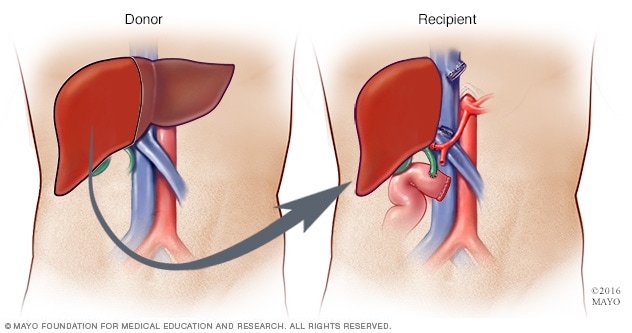
Living-donor liver transplant
During a living-donor liver transplant, surgeons remove about 40% to 70% of the donor liver and place it into the recipient.
Living-donor liver regeneration
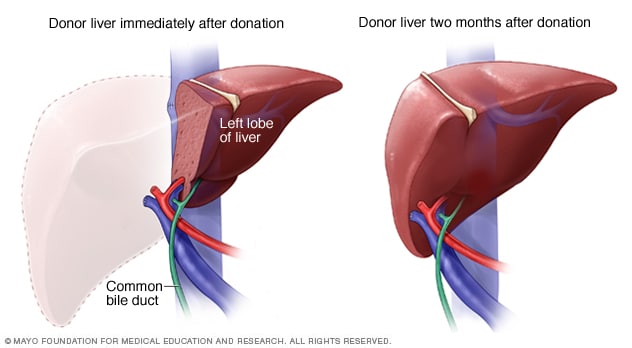
Living-donor liver regeneration
Within a couple of months after living-donor liver surgery, the donor's liver typically grows back to its usual size, volume and capacity.
Deceased-donor liver transplant
If a liver from a deceased donor becomes available for you, you'll be asked to come to the hospital right away. Your healthcare team admits you to the hospital and performs an exam to make sure you're healthy enough for the surgery.
Liver transplant surgery is done using general anesthesia, so you'll be in a sleeplike state during the procedure.
The surgeon makes a long cut, also called an incision, across your belly to access your liver. The location and size of your incision depend on your surgeon's approach and your own anatomy.
The surgeon removes your liver and places the donor liver in your body. Then the surgeon connects your blood vessels and bile ducts to the donor liver. Surgery can take up to 12 hours depending on your situation.
Once your new liver is in place, the surgeon uses stitches and staples to close the surgical incision. You're then taken to the intensive care unit to begin recovery.
Living-donor liver transplant
If you're receiving a liver transplant from a living donor, your surgery is scheduled in advance.
Surgeons first operate on the donor, removing a portion of the liver for transplant. Then surgeons take out your liver and place the donated liver portion in your body. They then connect your blood vessels and bile ducts to the new liver.
The transplanted liver portion in your body and the portion left behind in the donor's body grow back quickly, reaching typical volume within a few months.
After the procedure
After a liver transplant
After your liver transplant, you can expect to:
- Possibly stay in the intensive care unit for a few days. Healthcare professionals monitor your condition to watch for signs of complications. They also test your liver function frequently for signs that your new liver is working.
- Spend 5 to 10 days in the hospital. Once you're stable, you move to a transplant recovery area until you're ready to go home.
- Have frequent checkups as you continue recovering at home. Your transplant team creates a checkup schedule for you. You may have blood tests a few times each week at first and then less often over time.
- Take medicines for the rest of your life. You take several medicines after your liver transplant. You'll likely need to continue taking many of them for the rest of your life. Medicines called immunosuppressants help keep your immune system from attacking your new liver. Other medicines help reduce the risk of other complications after your transplant.
It usually takes six months or longer to feel fully healed after liver transplant surgery. You may be able to resume your usual activities or go back to work a few months after surgery. How long it takes you to recover may depend on how ill you were before your liver transplant.
Results
Liver transplant survival rates
Your chances of a successful liver transplant and long-term survival depend on your specific situation.
In general, about 75% of people who receive a liver transplant live for at least five years after surgery. That means that for every 100 people who receive a liver transplant for any reason, about 75 live for five years and 25 die within five years. About 60% of people who have liver transplants live 10 years or more.
People who receive a liver from a living donor often do better in the short term than those who receive a liver from a deceased donor. However, comparing long-term results is difficult because people who have a living donor usually have a shorter wait for a transplant and aren't as sick as those who receive a deceased-donor liver.
Survival rates among liver transplant recipients also vary among U.S. transplant centers. You can look up these statistics on the Scientific Registry of Transplant Recipients.
Clinical trials
Explore Mayo Clinic studies of tests and procedures to help prevent, detect, treat or manage conditions.
Coping and support
It's common to feel anxious or overwhelmed while waiting for a transplant. Many people also have concerns about rejection, returning to work or other issues after a transplant. Getting support from friends and family can help you cope during this time.
Your transplant team can help you find other useful resources and coping strategies throughout the transplant process. You might:
- Join a support group for transplant recipients. Talking with others who have shared your experience can ease worries and anxiety.
- Share your experiences on social media. Social media is another way to connect with others who have had similar experiences. This may help you adjust to your new situation.
- Find rehabilitation services. If you're going back to work, your social worker may be able to connect you with rehabilitation services provided by your home state's department of vocational rehabilitation.
- Set realistic goals and expectations. Life after transplant may not be the same as before. Having realistic expectations about results and recovery time can help reduce stress.
- Educate yourself. Learn as much as you can about your procedure and ask questions about things you don't understand. Knowledge is empowering.
Diet and nutrition
After your liver transplant, eating a well-balanced diet is especially important to help you recover and keep your liver healthy.
Your transplant team includes a nutrition specialist called a dietitian who can talk with you about your nutrition and diet needs and answer any questions you have after your transplant.
In general, your diet after liver transplant should be low in salt, cholesterol, fat and sugar.
It's important to avoid alcohol to protect your new liver. Do not drink alcoholic beverages or use alcohol in cooking.
Your dietitian also provides you with several healthy food options and ideas to use in your nutrition plan. You may be told to:
- Eat at least five servings of fruits and vegetables each day.
- Avoid grapefruit and grapefruit juice because of their effect on a group of immunosuppression medicines.
- Get plenty of fiber in your daily diet.
- Choose whole-grain foods over processed ones.
- Eat or drink low-fat or fat-free dairy products, which is important for optimal calcium and phosphorus levels.
Your dietitian also may advise that you:
- Eat lean meat, poultry and fish.
- Follow food safety guidelines.
- Stay hydrated by drinking plenty of water and other fluids each day.
Exercise
After a liver transplant, exercise and physical activity should be a regular part of your life. This can help improve your overall physical and mental health.
Soon after surgery, you should walk as much as you can. Then, as you get stronger, you can start adding more physical activity into your daily life.
Walking, bicycling, swimming, light strength training and other physical activities you enjoy can all be a part of a healthy, active lifestyle after transplant. But be sure to check with your transplant team before starting or changing your exercise routine after the transplant.
Jan. 23, 2026