Mayo Clinic's approach
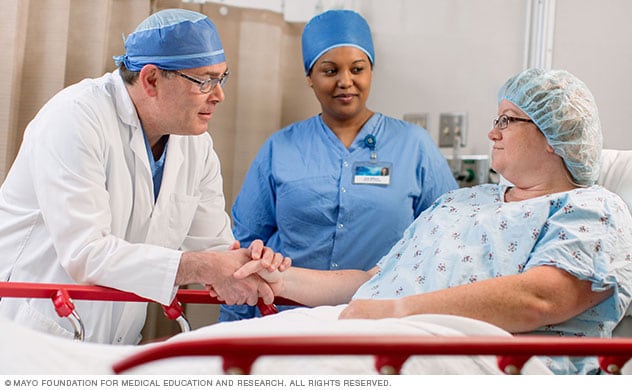 Liver transplant surgical consultation at Mayo Clinic
At Mayo Clinic, a team of surgeons, doctors, transplant nurses and other health professionals take care of you before, during and after transplant.
- Teamwork. At Mayo Clinic, a team of surgeons, doctors, transplant nurses, pharmacists, social workers and other health professionals take care of you before, during and after transplant. They provide quality care focused on the needs of you and your family.
- Coordinated care. Having all of this subspecialized expertise in a single place, focused on you, means that you're not just getting one opinion. Your care is discussed among the team, your test results are available quickly, appointments are scheduled in coordination and your transplant care team works together to determine what's best for you.
- Experience. Mayo Clinic has three sites, making it one of the largest liver transplant programs in the United States. Its liver transplant team is recognized nationally and internationally for its expertise in comprehensive specialty treatment for people with serious liver conditions.
- Advanced technology. The innovations and technology of Mayo Clinic's liver transplant team make transplants available to more people. Our doctors and surgeons offer specialized procedures available at only a small number of institutions. These services include heart-liver transplants, treatment for bile duct cancer and treatment for people with obesity who need a liver transplant with a weight-loss surgery called sleeve gastrectomy.
-
Research. Researchers at Mayo Clinic are actively working to develop new technologies, treatments and techniques to make transplants safer and more available to people. For example, Mayo Clinic researchers study ways to limit immune system rejection after liver transplant and how to use cell therapies to improve outcomes.
At Mayo Clinic, you may be able to take part in clinical trials and access new treatments while they are being studied.
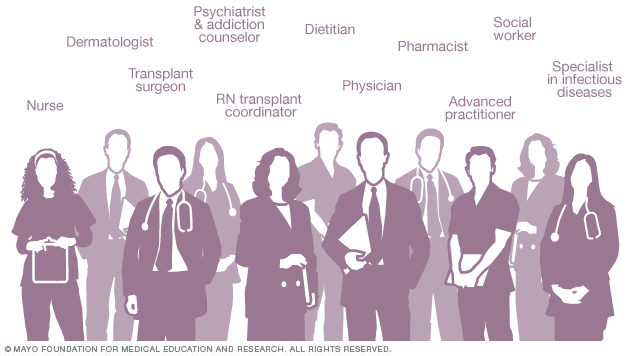 Care team roles
Healthcare professionals trained in many medical specialties work together as a team to ensure favorable outcomes from your liver transplant.
The Mayo Clinic experience and patient stories
Our patients tell us that the quality of their interactions, our attention to detail and the efficiency of their visits mean health care like they've never experienced. See the stories of satisfied Mayo Clinic patients.

3 lifesaving surgeries and a second chance (VIDEO)
What began as a routine check for swelling quickly turned Randy Ramey's life upside down. When pneumonia and swelling were diagnosed as stage 4 cirrhosis of the liver, Randy, of Denton, Texas, struggled to understand how it was all connected. A series of visits with local specialists revealed a fatty liver disease called metabolic dysfunction-associated steatohepatitis, or MASH. For Randy, the diagnosis set off a cascade of life-or-death decisions that led his wife and him to Mayo Clinic,…

(VIDEO) Rare transplant turns strangers into friends
Three is a lucky number for Doyle Duke and Tony Miranda. Both men are alive today thanks to an extremely rare and complex surgery – a triple-organ transplant, including a heart, liver and kidney simultaneously. Doyle Duke and Tony Miranda, triple-organ transplant patients Watch: Rare transplant turns strangers into friends https://youtu.be/dEB-cZR997Q Journalists: Broadcast-quality video (1:52) is in the downloads at the end of this post. Please courtesy: "Mayo Clinic News Network." Read the script. Tony's story…

(VIDEO) A rare cancer. A rare weapon. Curtis Jackson's inspiring story of survival
Curtis and Kim Jackson Curtis Jackson was living his dream life — a loving and supportive wife, three wonderful kids, and a future that looked as bright as could be. Then, one day, without warning, the dream was shattered. At only 46, Curtis was diagnosed with cholangiocarcinoma, one of the deadliest and most aggressive forms of cancer. It's a silent killer that strikes the liver. It is often diagnosed in later stages, leaving patients with few…

Social worker helps patients on transplant 'journey of cautious hope'
When Tiffany Coco steps into a room at Mayo Clinic Transplant Center in Arizona, she focuses on the patient's needs beyond the medical updates. "Often, patients put their best face forward with the physicians," says Coco, "And when they talk to us, they let their guard down and open up about how transplant affects their day-to-day life." As a licensed clinical social worker embedded in multidisciplinary care teams, Coco uses her clinical expertise to assess…
Expertise and rankings
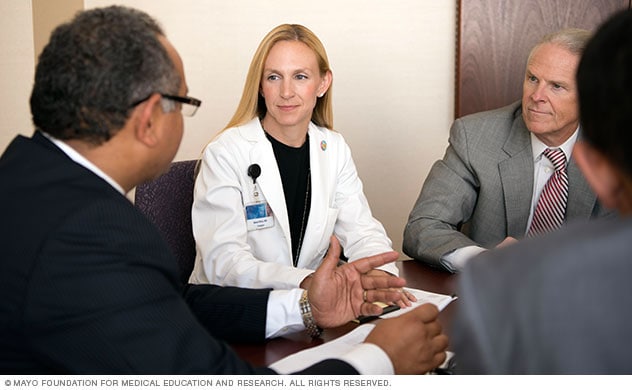 Transplant team at Mayo Clinic
Mayo Clinic's three-site Liver Transplant Program is one of the largest in the country.
Each year, Mayo's doctors and surgeons diagnose and treat thousands of people with liver disease. Mayo Clinic's three-site Liver Transplant Program is one of the largest in the country.
Mayo Clinic also has one of the largest living-donor programs in the United States. For many people, living-donor transplant is an option that reduces time on the waiting list for a donor liver and leads to better outcomes.
Experience
Mayo Clinic's Liver Transplant Program was established in 1985. Since then, Mayo Clinic has completed more than 11,500 transplants in children and adults. Mayo Clinic's campus in Florida has completed more than 4,470 liver transplants, a milestone that very few centers nationwide have achieved.
Innovation and research
Mayo Clinic's liver transplant teams in Arizona, Florida and Minnesota are leaders in innovative approaches. They are experts in heart-liver transplants and transplants for people with liver cancer, and they use antirejection medicines that help ensure positive outcomes.
People with complex health situations come to Mayo Clinic for help because our doctors and surgeons are highly skilled in specialized liver transplant options.
The Mayo Clinic Transplant Center supports many studies for liver transplant research. For example, Mayo Clinic researchers are working on a bioartificial liver that could help people as they wait for a donor liver.
Nationally recognized expertise
Liver transplant outcomes at Mayo Clinic compare favorably with the national average.
Volumes and outcomes
Mayo Clinic doctors' experience and team-based approach lead to transplant outcomes that compare favorably with national averages. Teams work with transplant recipients before, during and after surgery to ensure the greatest likelihood of success.
Volumes and statistics are maintained separately for the three Mayo Clinic locations. Taken together or separately, transplant recipients at Mayo Clinic enjoy excellent results.
Locations, travel and lodging
The Mayo Clinic Transplant Center offers care and housing for transplant recipients and their families in Arizona, Florida and Minnesota.
Mayo Clinic has major campuses in Phoenix and Scottsdale, Arizona; Jacksonville, Florida; and Rochester, Minnesota. The Mayo Clinic Health System has dozens of locations in several states.
For more information on visiting Mayo Clinic, choose your location below:
Costs and insurance
Liver transplant cost and insurance information
Mayo Clinic has dedicated transplant financial services representatives and social workers who can assist you with insurance and financial questions regarding your transplant.
Mayo Clinic works with hundreds of insurance companies and is an in-network provider for millions of people. In most cases, Mayo Clinic doesn't require a physician referral. Some insurers require referrals or may have additional requirements for certain medical care. Many insurance companies require you to get preapproval authorization prior to transplant services.
Insurance information
Before your transplant, it's important that you work closely with your insurance company to understand your benefit plan. You'll be responsible for any of your transplant and medical care costs not covered by your insurance company.
You may want to ask your insurance company several questions regarding your transplant expenses, such as:
- What is the specific coverage of my plan? What are my deductibles, coinsurance, copayments, lifetime maximum amount and annual maximum amounts for both medical care and transplant services?
- Does my plan have a preexisting or waiting period clause? If so, what is the time frame? Can this be waived?
- Does my plan include pharmacy coverage? If so, will my plan cover my current medicines and immunosuppressant medicines?
- Does my plan require any special approvals for evaluation or transplant? How long does the approval process take once submitted to insurance?
- Does my plan cover my transportation and lodging expenses during my transplant care?
- Does my current insurance require enrollment in Medicare when eligible?
- Does my insurance follow Medicare coordination of benefits guidelines?
- How will my current coverage change after enrolling in Medicare? Will my plan become a supplemental or secondary plan?
If your plan is a Medicare supplement, ask questions including:
- Does my plan follow Medicare guidelines?
- Does my plan cover Medicare Part A and B deductible and coinsurance?
- Does my plan have a preexisting or waiting period? If so, what is the time frame?
- Does my plan offer an option for Medicare Part D coverage?
Other expenses
Plan for other expenses that may occur related to your transplant, which may include follow-up medical appointments, long-term medicines, caregiver expenses, travel, parking, lodging and other expenses.
For international patients
Mayo Clinic has dedicated international patient account representatives who can assist you with questions regarding your costs and insurance. Read more about international financial services.
Case managers
Mayo Clinic financial staff will work closely with your case managers from your insurance company. Your case manager, who is assigned to you, is available to answer questions and calls related to your insurance costs.
Clinical trials
Explore Mayo Clinic studies of tests and procedures to help prevent, detect, treat or manage conditions.
Jan. 23, 2026