Overview
Minimally invasive heart surgery
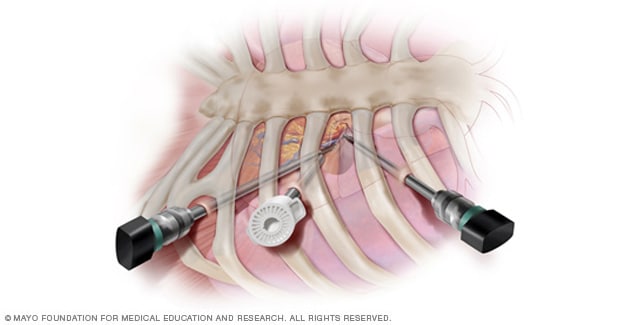
Minimally invasive heart surgery
In minimally invasive heart surgery, surgeons make small incisions in the side of the chest, between the ribs, to reach the heart. They do the surgery using long instruments.
Minimally invasive heart surgery involves making small cuts, called incisions, in the chest. This lets the surgeon reach the heart by going in between the ribs. The surgeon doesn't cut through the breastbone, as is done in traditional open-heart surgery.
Minimally invasive heart surgery can be used to treat many different heart conditions. Compared with open-heart surgery, this type of surgery often means less pain and a quicker recovery.
Robot-assisted heart surgery and thoracoscopic surgery are types of minimally invasive heart surgery.
Robotic heart surgery treats mitral regurgitation: Ed's story
[MUSIC PLAYING]
Ed, Mayo Clinic patient: So we started out in the morning at 7:30, 8:00 o'clock is when the race started. We started out at a very, very fast pace. Mentally, you prepare for a ride like that, knowing what kind of ride it is.
I didn't exactly know what was wrong, but I knew something wasn't right. That was the first time that I could not finish a ride. I was nauseated, just completely exhausted. I had nothing left.
Your heart is only pumping a certain percentage of your blood and in my case, it was like 65% of my blood was being pumped and the other 35 was being regurgitated back towards the lungs.
Joseph A. Dearani, M.D., Cardiovascular surgeon: The primary focus here is that his valve is a problem that lends itself to repairing as opposed to replacing.
Ed: Really, I just I wanted to have the best recovery possible. And so I chose Mayo because they had, at the time, they had done over 500 procedures on the mitral valve robotically.
Dr. Dearani: When you walk into an operating room where robotic heart surgery is going to be performed, you get to see that technology applied with this incredible flawless lines of communication. It's medicine at its peak.
Ed: I've been released to do whatever I want to do and however I want to do it so there's no limitations on what I can do right now.
Dr. Dearani: He's going to get back to doing what he loves to do and he's going to be able to do better than what he was doing.
Ed: That five weeks. I could actually take a complete deep breath without it hurting at all.
I'm riding, you know, 40, 50, 60 miles without any trouble. And I keep telling myself, I’m very, very lucky to have a procedure early and also to have to have Mayo do it for me robotically.
[MUSIC PLAYING]
Robot-assisted heart valve surgery
Products & Services
Why it's done
Many types of heart procedures can be done with minimally invasive heart surgery. Examples include:
- Closure of a hole in the heart, such as atrial septal defect or patent foramen ovale.
- Atrioventricular septal defect surgery.
- Maze procedure for atrial fibrillation.
- Heart valve repair or replacement.
- Surgery to remove tumors from the heart.
The benefits of minimally invasive heart surgery when compared with open-heart surgery can include:
- Less blood loss.
- Lower risk of infection.
- Less pain.
- Less time needing a breathing machine, also called a ventilator.
- Less time spent in the hospital.
- Faster recovery and quicker return to usual activities.
- Smaller scars.
Minimally invasive heart surgery isn't right for everyone. Your healthcare team reviews your health history and does tests to learn if it's a good option for you.
Specially trained surgeons do minimally invasive or robotic heart surgery. You might be referred to a medical center with surgeons and a surgical team who have the needed expertise.
Risks
Risks of minimally invasive heart surgery are similar to those of open-heart surgery. They may include:
- Bleeding.
- Heart attack.
- Infection.
- Irregular heart rhythms called arrhythmias.
- Stroke.
- Death.
Rarely, a minimally invasive heart surgery may need to change to an open-heart surgery. For example, this might happen if the surgeon thinks it's not safe to continue with the minimally invasive approach.
How you prepare
Before minimally invasive heart surgery, your care team tells you what to expect before, during and after the surgery. You also learn about the risks and benefits of the surgery.
You might be told about a legal document called an advance directive. This is information about the types of treatments you would want — or would not want — in case you become unable to express your wishes.
Before you go to the hospital for your surgery, talk to your family or caregiver about your hospital stay. Discuss the help you'll need when you return home.
Food and medications
Ask your healthcare team:
- When or if you can take your regular medicines before your surgery.
- At what time you should stop eating or drinking before the surgery.
Tell your healthcare team about all the medicines you take, including those bought without a prescription. It can be helpful to bring a list of your medicines to the hospital. Also tell the team about any allergies you have to medicines.
Clothing and personal items
Your care team might suggest that you bring some items to the hospital, including:
- Eyeglasses, hearing aids or dentures.
- Personal care items, such as a brush, comb, razor and toothbrush.
- Loose-fitting, comfortable clothing.
- A copy of your advance directive.
- Items that might help you relax, such as a portable music player or books.
During surgery, do not wear:
- Contact lenses.
- Dentures.
- Eyeglasses.
- Jewelry.
- Nail polish.
What you can expect
Before
You may need to have some hair shaved before surgery. Hair may be removed in the areas of your body where the surgery will take place. Your skin is usually washed with special soap to lower the risk of infection.
During
Incision sites in robot-assisted heart surgery
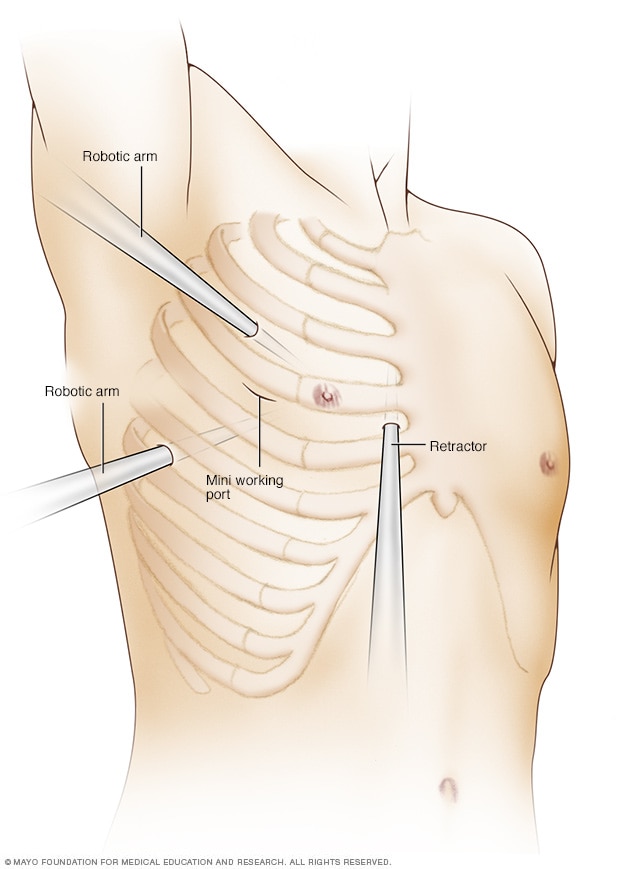
Incision sites in robot-assisted heart surgery
In robot-assisted heart surgery, a surgeon creates small cuts, called incisions, in the chest between the ribs. Robotic arms with small tools and a video camera go through the incision sites.
How the surgery is done depends on the specific type of surgery you're having. Types of minimally invasive heart surgery include:
- Robot-assisted heart surgery.
- Thoracoscopic surgery, which sometimes is called a minithoracotomy.
In all types, a surgeon reaches the heart through small incisions in the chest between the ribs. A tool with a small video camera placed through one of the incisions helps the surgeon see inside the body.
You usually are connected to a heart-lung bypass machine during the surgery. The machine keeps blood moving through the body during the surgery.
Robot-assisted heart surgery
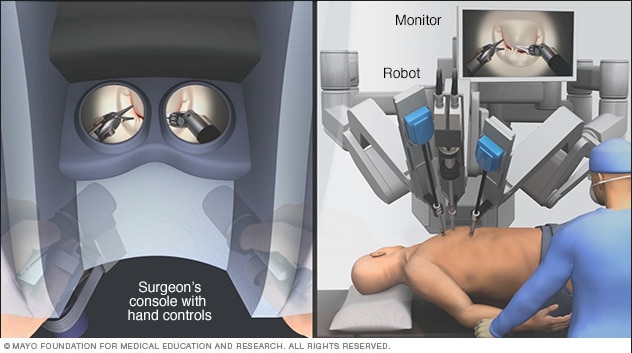
Robot-assisted heart surgery
In robot-assisted heart surgery, a surgeon sits at a nearby computer station, called a console, and views the heart on a video monitor. The surgeon uses robotic arms to do the surgery. A surgical team assists at the operating table.
Robot-assisted heart surgery
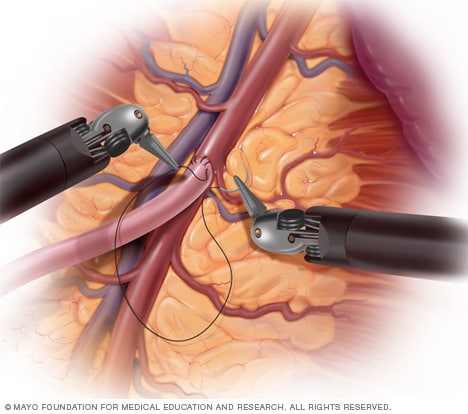
Robot-assisted heart surgery
During robot-assisted heart surgery, a surgeon works at a remote console controlling the robotic instruments, which use small, precise movements to perform the surgery.
Robot-assisted heart surgery
In this type of minimally invasive heart surgery, robotic arms are used to do the surgery. The surgeon controls the arms from a nearby computer station. The surgeon looks at a magnified 3D view of the heart on a video monitor. When the surgeon's arms and wrists move, the robotic arms move the same way to do the surgery.
Surgical tools are attached to the robotic arms. A surgical team at the operating table changes those tools as needed.
Thoracoscopic surgery
This type of surgery also is called a minithoracotomy. The surgeon inserts a long, thin video camera called a thoracoscope into a small incision between the ribs in the chest.
The surgeon repairs the heart using long instruments placed through small incisions between the ribs.
After
It's typical to spend one night in the intensive care unit after minimally invasive heart surgery. The intensive care unit is called ICU for short. In the ICU, you usually have:
- Fluids and medicines going through an IV.
- Tubes to drain urine from your bladder or fluid and blood from your chest.
- Extra oxygen through a face mask or through a small plastic tube next to your nose.
After the ICU, you move to a regular hospital room. The number of days you spend in the hospital depends on the type of surgery and your overall health.
Your healthcare team watches you closely while you're in the hospital. The team will:
- Watch for signs of infection.
- Check your blood pressure, breathing and heart rate.
- Work with you to manage pain.
- Get you up and walking, and help you slowly become more active.
- Show you how to do deep-breathing exercises and teach you to cough to keep your lungs clear.
- Remove all drainage tubes.
Your healthcare team gives you instructions to follow during your recovery. These instructions tell you how to:
- Watch for signs of infection.
- Take care for your incisions.
- Take medicines.
- Manage pain.
Your healthcare team also tells you when you can get back to your daily activities, such as working, driving and exercise.
Results
Minimally invasive heart surgery typically has a quicker recovery time when compared with open-heart surgery. This may help improve your quality of life.
You need regular health checkups after surgery. Tests may be done to see how your heart is working. Your healthcare team may suggest tips to help you follow a heart-healthy lifestyle, such as:
- Eat a healthy diet.
- Get regular exercise.
- Manage stress.
- Do not smoke or chew tobacco.
Your healthcare professional might suggest a personalized exercise and education program to help you get stronger after surgery. This program is called cardiac rehabilitation, also known as cardiac rehab. It's done to improve health in those with a heart condition or a history of heart surgery. Cardiac rehabilitation usually includes supervised exercise, emotional support and education about a heart-healthy lifestyle.
Dec. 30, 2025