Overview

Inflammatory bowel disease FAQs

Gastroenterologist William Faubion, M.D., answers the most frequently asked questions about inflammatory bowel disease.

{Music playing}

How much will IBD affect me?

William A. Faubion, Jr., M.D., Gastroenterology, Mayo Clinic: I think most simply, it depends on where in the bowel the disease is affecting and how severe your case is. Every practitioner will tell you that in an ideal world, it shouldn't affect your life at all. It's been well studied that actually inflammatory bowel disease does not significantly change the overall lifespan of the patients. But what we really care about is quality of life. I think for the vast majority of patients that we see, the appropriate medical plan can keep patients generally free of symptoms over the order of one to three years. So I think the biggest ways that the disease is going to affect your life is perhaps you may need to watch a bit what you eat. You'll need to keep in touch with your treatment team and you'll need to take medications as they've been prescribed. But if you do those three things, I think that most practitioners would tell you, we'd rather you not be thinking about your inflammatory bowel disease. Let us worry about that.

Why do people get IBD?

Most of us that are involved in the research of this condition would suggest that there's three major causes that we study for this condition. The first would be the environment. Most of us believe that there's some environmental insult that leads to the chronic inflammation in the intestine. That environmental insult may be dietary. It may be a particular bug that lives in the bowel, or may be a function of that bug, which is also a function of the diet. The second most important thing is having the right genes. The genetics of inflammatory bowel disease is complicated and actually quite widespread. So most people have the right genetic makeup for this disease but don't actually develop the disease. And then the third component is these two things impact on the immune system. And the immune system is what is actually causing the chronic inflammation that's present in the intestine that we prescribe medications to treat.

Can IBD affect my lifespan?

The short answer is no, it will not. There's multiple lines of research that when patients with inflammatory bowel disease are controlled against patients their same age, with their same medical problems, without inflammatory bowel disease, achieve roughly the same lifespan.

Does my diet affect IBD?

If one has a narrowing in the small bowel related to Crohn's disease, something called a stricture, diet becomes very important because if certain patients eat foods that have too much roughage or fiber, then those types of foods can cause an impaction or block the narrowing in the small bowel, leading to signs and symptoms of something we call an obstruction: Belly pain, vomiting, loud noises in the bowel. Another way diet can impact the disease is if you have damage of the small bowel, that can impact your ability to do certain types of functions in the small bowel -- like absorbing dairy products, for example.

Is there any cancer risk from having IBD?

The main risk factor for cancer would be colorectal or cancer of the large bowel. And that comes, we believe, from the chronic inflammation of the colon. That's why it's a good idea to maintain close contact with your treatment team. And that's why we recommend routine colonoscopies, passing the scope up into the colon, looking for those early changes associated with cancer.

What's the risk of passing IBD to my children?

That's a very common and valid concern amongst parents that come for evaluation for their inflammatory bowel disease. Generally the risk is slightly higher for Crohn's disease than ulcerative colitis. But that being said, you're still far more likely to be the only member of your family with this condition, than have a familial what we call penetrance.

Are stool transplants real?

The short answer is yes. This science was actually developed for an infection rather than inflammatory bowel disease. The science has been developed over a period of about 15 years. And it really has come to age with an infection called clostridium difficile or C. diff. Stool transplants now are actually a very common tool to treat recurrent or refractory infection with this C. diff species. Because of the excitement in the infectious disease field or the C. diff field, there are numerous trials that are running in inflammatory bowel disease.

How can I be the best partner to my medical team?

So I think just showing up is the first thing that you can do. We always consider this as a partnership between the patient and the provider. There's a lot to consider when we talk about the medications for inflammatory bowel disease. Some of those medications have risk factors. So those discussions are important, can be complex and can be time-consuming. So showing up, being present, participating in those conversations, and being educated yourself. There are a lot of resources out there to investigate what the risks and benefits to a variety of different strategies might be. Communicating well with your team and again, just being there and showing up.

{Music playing}

Gastroenterology & GI Surgery Blog

Connect with others and follow the latest advances in treating Crohn's disease and ulcerative colitis on Mayo Clinic Connect.

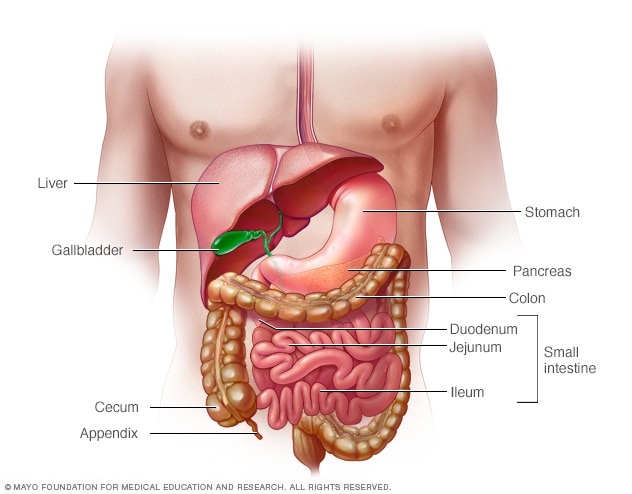
Inflammatory bowel disease (IBD) refers to a group of long-term conditions that cause inflammation in the digestive tract. The digestive tract is the part of the body that breaks down and absorbs food.

IBD is not the same as irritable bowel syndrome (IBS). IBS does not cause the inflammation or intestinal damage seen with IBD.

The most common types of IBD include:

  • Ulcerative colitis. This causes inflammation and sores, called ulcers, in the lining of the colon and rectum.
  • Crohn's disease. This causes inflammation in the digestive tract. It often affects the small intestine and the colon, but it can affect other parts too. It may reach deeper layers of the bowel wall.

IBD often comes and goes. There may be times when symptoms get worse. These are called flare-ups. There also may be times when symptoms get better or go away. This is called remission.

For some people, IBD causes mild symptoms. For others, it can be more serious and may lead to complications.
Symptoms

Symptoms of inflammatory bowel disease depend on where the inflammation is and how severe it is.

Common symptoms include:

  • Diarrhea.
  • Belly pain and cramping.
  • Blood in the stool.
  • Loss of appetite.
  • Weight loss without trying.
  • Feeling very tired.

Some people notice early signs before a flare-up, such as feeling more tired than usual, changes in bowel habits or a loss of appetite.

When to see a doctor

See a healthcare professional if your bowel habits change or if you have symptoms of IBD. Get care soon if you have:

  • Diarrhea that does not stop or signs of dehydration.
  • Severe belly pain.
  • Blood in the stool that does not go away.
  • Fever or signs of infection.
  • Weight loss without trying.

Get the latest health information from Mayo Clinic delivered to your inbox.

Subscribe for free and receive your in-depth guide to digestive health, plus the latest on health innovations and news. You can unsubscribe at any time. Click here for an email preview.

We use the data you provide to deliver you the content you requested. To provide you with the most relevant and helpful information, we may combine your email and website data with other information we have about you. If you are a Mayo Clinic patient, we will only use your protected health information as outlined in our Notice of Privacy Practices. You may opt out of email communications at any time by clicking on the unsubscribe link in the email.

Causes

The exact cause of inflammatory bowel disease is not known. Diet and stress do not cause IBD, but they may make symptoms worse for some people. Experts think several factors may play a role.

  • Immune system. One possible cause is change in the function of the immune system.
  • Genes. Several genetic markers have been associated with IBD. Traits passed down in families also seem to play a role, as IBD is more common in people who have family members with the disease. However, most people with IBD don't have this family history.

Risk factors

Risk factors for inflammatory bowel disease include:

  • Age. Most people who get IBD are diagnosed before they're 30 years old. But some people don't get the disease until their 50s or 60s.
  • Patient population. IBD is more common in white people, but it can occur in anyone. The number of people with IBD is increasing in all races and ethnicities.
  • Family history. You're at higher risk if you have a blood relative — such as a parent, sibling or child — with the disease.
  • Cigarette smoking. Cigarette smoking is the most important controllable risk factor for severe Crohn's disease.

IBD can affect people at any stage of life, including children and those who are pregnant. Specialized care may be needed in these situations.

Complications

Ulcerative colitis and Crohn's disease have some complications in common and others that are specific to each condition. Some complications can happen with both conditions, although some are more common with one type than the other. The risk of complications often depends on how long the disease has been active and how well it is controlled.

Complications found in both conditions may include:

  • Colon cancer. Having ulcerative colitis or Crohn's disease that affects most of your colon can increase your risk of colon cancer. Screening for cancer with a colonoscopy usually starts about 8 to 10 years after the IBD diagnosis is made. It may be repeated every 1 to 5 years depending on the findings.

    If you also have primary sclerosing cholangitis (PSC) and colonic disease, colon cancer screening is recommended every year starting at diagnosis. This is due to an elevated risk of colon cancer. Ask a healthcare professional whether you need to have this test done sooner and more frequently.

  • Skin, eye and joint inflammation. Certain conditions may occur during IBD flare-ups. They include arthritis, skin lesions and eye inflammation called uveitis.
  • Treatment side effects. Certain medicines for IBD are associated with a risk of infections. Some carry a small risk of developing certain cancers. Corticosteroids can be associated with a risk of osteoporosis, high blood pressure and other conditions.
  • Primary sclerosing cholangitis, a rare, long-term disease of the liver involving inflammation and scarring within the bile ducts.
  • Severe dehydration from diarrhea.

Crohn's disease also may lead to:

  • A blockage in the bowel, called an obstruction. Crohn's disease affects the full thickness of the bowel wall. Over time, parts of the bowel can thicken and narrow, which may block the flow of digestive contents. Surgery may be needed to remove the diseased part of the bowel.
  • Malnutrition. Diarrhea, belly pain and cramping may make it difficult for you to eat or for your intestine to absorb enough nutrients to keep you nourished. It's also common to develop anemia due to low iron or vitamin B-12 caused by the disease.
  • Fistulas. Fistulas are tunnels between body parts that are not usually connected. Fistulas near or around the anal area are the most common kind. In some cases, a fistula may become infected and form a pocket of pus known as an abscess.
  • Anal fissure. This is a small tear in the tissue that lines the anus or in the skin around the anus where infections can occur. It's often associated with painful passing of stool and may lead to a fistula around the anus.

Ulcerative colitis also may lead to:

  • Toxic megacolon. Ulcerative colitis may cause the colon to rapidly widen and swell, a serious condition known as toxic megacolon. This can increase the risk of a hole in the colon, also called a perforation.

Aug. 21, 2026
  1. Kellerman RD, et al. Inflammatory bowel disease: Crohn disease and ulcerative colitis. In: Conn's Current Therapy 2026. Elsevier; 2026. https://www.clinicalkey.com. Accessed May 5, 2026.
  2. Goldman L, et al., eds. Inflammatory bowel disease. In: Goldman-Cecil Medicine. 27th ed. Elsevier; 2024. https://www.clinicalkey.com. Accessed May 5, 2026.
  3. Inflammatory bowel disease (IBD) basics. Centers for Disease Control and Prevention. https://www.cdc.gov/inflammatory-bowel-disease/about/index.html. Accessed May 5, 2026.
  4. Chung RT, et al., eds. Epidemiology, pathogenesis, and diagnosis of inflammatory bowel diseases. In: Sleisenger and Fordtran's Gastrointestinal and Liver Disease: Pathophysiology, Diagnosis, Management. 12th ed. Elsevier; 2026. https://www.clinicalkey.com. Accessed May 5, 2026.
  5. Crohn's disease and ulcerative colitis: A guide for parents. Crohn's and Colitis Foundation. https://www.crohnscolitisfoundation.org. Accessed May 5, 2026.
  6. Kliegman RM, et al. Inflammatory bowel disease. In: Nelson Textbook of Pediatrics. 22nd ed. Elsevier; 2025. https://www.clinicalkey.com. Accessed May 5, 2026.
  7. Yao D, et al. New progress of small-molecule drugs in the treatment of inflammatory bowel disease. Chinese Medical Journal. 2024; doi:10.1097/CM9.0000000000003026.
  8. Xeljanz, Xeljanz XR (tofacitinib): Drug safety communication — Initial safety trial results find increased risk of serious heart-related problems and cancer with arthritis and ulcerative colitis medicine. U.S. Food and Drug Administration. https://www.fda.gov/safety/medical-product-safety-information/xeljanz-xeljanz-xr-tofacitinib-drug-safety-communication-initial-safety-trial-results-find-increased?utm_medium=email&utm_source=govdelivery. Accessed May 5, 2026.
  9. Crohn's disease. National Institute of Diabetes and Digestive and Kidney Diseases. https://www.niddk.nih.gov/health-information/digestive-diseases/crohns-disease. Accessed May 5, 2026.
  10. Nimmagadda R. Allscripts EPSi. Mayo Clinic. May 10, 2024.
  11. Medical review (expert opinion). Mayo Clinic. Oct. 9, 2024.