Inflammatory bowel disease (IBD) Diagnosis and treatment
Diagnosis
To find out if someone has inflammatory bowel disease, a healthcare professional may use several tests and procedures. Diagnosis usually includes stool tests, blood tests and a colonoscopy. It also may include imaging tests.
Lab tests
These may include:
-
Blood tests. Blood tests can check for signs of infection, inflammation or anemia — a condition in which there are reduced numbers of red blood cells.
These tests also may be used to check liver function or the presence of infections that aren't active, such as tuberculosis.
- Stool tests. A stool sample may be tested for blood, infection-causing bacteria and, rarely, parasites. These can be causes of diarrhea and symptoms. Sometimes looking for stool markers of inflammation, such as calprotectin, can be helpful.
Endoscopic procedures
These tests use a thin tube with a light and camera to look inside the digestive tract:
- Colonoscopy. This lets a healthcare professional look at the whole colon and part of the small intestine. A small tissue sample, called a biopsy, may be taken. A biopsy is the way to make the diagnosis of IBD versus other forms of inflammation.
- Flexible sigmoidoscopy. This checks the rectum and lower part of the colon. If the colon is badly inflamed, this test may be done instead of a full colonoscopy.
- Upper endoscopy. This checks the esophagus, stomach and first part of the small intestine. While it is rare for these areas to be involved with Crohn's disease, this test may be recommended if you are having nausea and vomiting, difficulty eating, or upper abdominal pain.
- Capsule endoscopy. This test is sometimes used to help diagnose Crohn's disease involving the small intestine. For this test, you swallow a capsule that has a camera in it. The images are transmitted to a recorder you wear on your belt, after which the capsule exits your body painlessly in your stool.
- Balloon-assisted enteroscopy. This test lets the technician look farther into the small bowel where standard endoscopes don't reach. This technique is useful when capsule endoscopy results raise concerns, but more testing is needed to make a diagnosis.
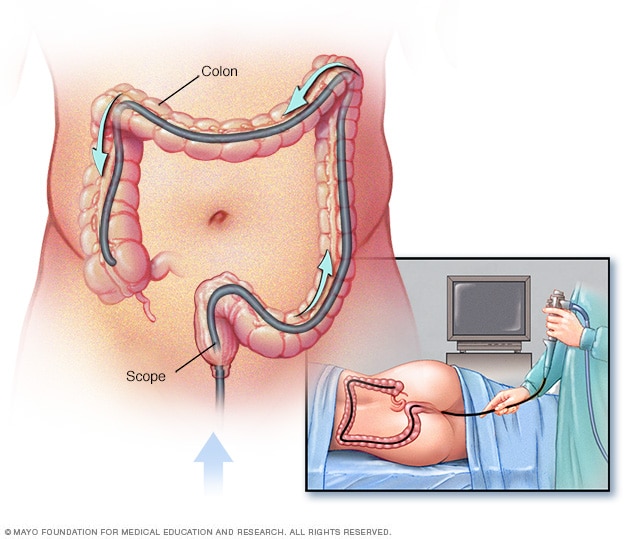
Colonoscopy
During a colonoscopy, the healthcare professional uses a thin, flexible, lighted tube with an attached camera, called a colonoscope, to view the condition of the colon.
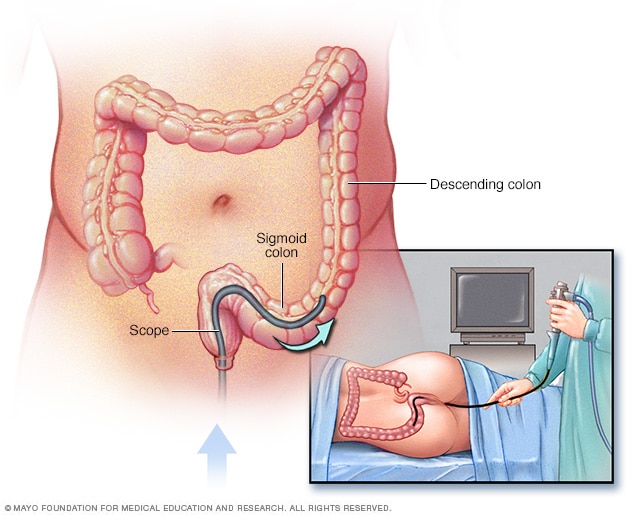
Sigmoidoscopy exam
During a flexible sigmoidoscopy exam, the healthcare professional uses a thin, flexible, lighted tube with an attached camera, called a sigmoidoscope, to see the condition of the rectum and last segment of the colon.
Imaging tests
Common imaging tests used to help diagnose inflammatory bowel disease include:
- X-ray. If you have severe symptoms, your healthcare professional may use a standard X-ray of your abdominal area to rule out serious complications, such as toxic megacolon or a perforated colon.
-
CT scan. A CT scan is a special X-ray technique that provides more detail than a standard X-ray does. This test looks at the entire bowel as well as at tissues outside the bowel.
CT enterography is a special CT scan that involves drinking an oral contrast material and getting intravenous contrast images of the intestines. This test provides better images of the small bowel and has replaced barium X-rays in many medical centers.
-
MRI. An MRI scan uses a magnetic field and radio waves to create detailed images of organs and tissues. MRI used with a contrast fluid, called MR enterography, is particularly useful for evaluating a fistula around the anal area or the small intestine.
Sometimes MR enterography can be performed to check for disease status or progression. This test may be used instead of CT enterography to reduce the risk of radiation, especially in younger people.
- Ultrasound. Similar to CT and MRI, an ultrasound of your intestines can be performed to assess for inflammation and complications related to Crohn's disease.
-
Capsule endoscopy. This test involves swallowing a capsule with a camera in it. The camera takes pictures of the small intestine and sends them to a recorder worn on a belt. The images are then downloaded to a computer, displayed on a monitor and checked for signs of Crohn's disease. The camera exits the body painlessly in stool.
Endoscopy with biopsy may still be necessary to confirm a diagnosis of Crohn's disease. Those with Crohn's disease of the small intestine may be at a higher risk of the capsule getting stuck in the intestine, especially if there is a history of narrowing or surgery of the small intestine. Capsule endoscopy should not be done if there is a suspected stricture or blockage, also called an obstruction, in the bowel.
Treatment
Treatment for inflammatory bowel disease aims to lower inflammation, improve symptoms and help prevent complications. Treatment may include medicines, surgery or both.
The type of treatment recommended depends on several factors, including how severe the disease is, which parts of the digestive tract are affected, and whether complications are present. Treatment plans often change over time based on how the condition responds.
Medicines
Medicines may include:
- 5-aminosalicylates (5-ASA). These anti-inflammatory medicines are often the first step in the treatment of ulcerative colitis, typically for mild to moderate disease. They include mesalamine (Rowasa, others), balsalazide (Colazal) and olsalazine (Dipentum).
- Corticosteroids. Corticosteroids such as prednisone and budesonide (Entocort EC) can help reduce inflammation in the body, but they don't work for everyone. Sometimes, IV corticosteroids are used in the hospital setting. Corticosteroids may be used for a short time to improve symptoms and to help calm the inflammation.
- Immunomodulators. These medicines lower immune system activity that contributes to inflammation. Examples of immunosuppressant medicines include azathioprine (Azasan, Imuran), mercaptopurine (Purinethol, Purixan) and methotrexate (Trexall).
- Small molecules. Janus kinase (JAK) inhibitors are a type of small molecule medicine. They help reduce inflammation by targeting parts of the immune system that cause inflammation in the intestines. JAK inhibitors for IBD include tofacitinib (Xeljanz) and upadacitinib (Rinvoq). Ozanimod (Zeposia) and etrasimod (Velsipity) are another type of small molecule medicine available for IBD.
- Biologics. These target proteins in the body that cause inflammation. Some are given by infusion, and some are given by injection. Examples include infliximab (Remicade), adalimumab (Humira) and golimumab (Simponi). They include certolizumab pegol (Cimzia), vedolizumab (Entyvio) and ustekinumab (Stelara). They also include risankizumab (Skyrizi), mirikizumab (Omvoh) and guselkumab (Tremfya).
- Antibiotics. Antibiotics may be used when infection is a concern. Often-prescribed antibiotics include ciprofloxacin (Cipro) and metronidazole (Flagyl).
Nutritional support
If weight loss is serious, a healthcare professional may suggest special nutrition through a feeding tube or a vein. If there is a narrowing in the bowel, a low-residue diet may be recommended.
Surgery
Surgery may be recommended if medicines and lifestyle changes do not help enough.
- Surgery for ulcerative colitis. This may involve removing the colon and rectum. In some cases, surgeons create an internal pouch so stool can still leave the body through the anus.
- Surgery for Crohn's disease. Surgery may remove a damaged part of the digestive tract, close fistulas, or drain abscesses. Surgery does not cure Crohn's disease, and the disease may come back later. The best approach is to follow surgery with medicine to lessen the risk of recurrence.
Clinical trials
Explore Mayo Clinic studies testing new treatments, interventions and tests as a means to prevent, detect, treat or manage this condition.
Alternative medicine
Many people with digestive disorders use some form of complementary or alternative medicine. But there is little research on how safe and effective these treatments are. Talk with your healthcare team before taking these treatments.
Self-care
Healthy habits may help manage symptoms, but they do not replace medical treatment.
Diet
There is no clear proof that food causes IBD. Still, some foods and drinks may make symptoms worse, especially during a flare-up.
These tips may help:
- Keep a food diary to track what seems to trigger symptoms.
- Eat smaller meals more often.
- Drink plenty of liquids. Water is best.
- Limit dairy products if they make symptoms worse.
- Ask your healthcare team about vitamins or meeting with a dietitian if your diet becomes limited.
Smoking
Smoking raises the risk of Crohn's disease and can make it worse. People with Crohn's disease who smoke are more likely to have relapses and need medicines and repeat surgeries.
Stress
Stress may make symptoms harder to manage for some people. These steps may help:
- Exercise. Even mild exercise can help reduce stress, relieve depression and adjust bowel function. Talk with your healthcare professional about an exercise plan that's right for you.
- Cognitive behavioral therapy. This type of talk therapy can help you manage stress, anxiety and depression by changing unhelpful thought patterns and building coping skills.
- Regular relaxation and breathing exercises. One way to cope with stress is to regularly relax and use techniques such as deep, slow breathing to help you feel calm.
Get the latest health information from Mayo Clinic delivered to your inbox.
Coping and support
IBD doesn't just affect you physically — it takes an emotional toll as well. If signs and symptoms are severe, your life may revolve around a constant need to run to the toilet. Even if your symptoms are mild, you may find it difficult to be out in public. All of these factors can alter your life and may lead to depression. Here are some things you can do:
- Be informed. One of the best ways to better manage your IBD is to find out as much as possible about inflammatory bowel disease. Look for information from reputable sources such as the Crohn's and Colitis Foundation.
- Join a support group. Although support groups aren't for everyone, they can provide valuable information about your condition as well as emotional support. Group members frequently know about the latest medical treatments or integrative therapies. You may also find it reassuring to be among others with IBD.
- Talk with a therapist. Some people find it helpful to consult a mental health professional who's familiar with inflammatory bowel disease and the emotional difficulties it can cause.
Although you may feel discouraged about living with IBD, research is ongoing, and treatment continues to improve.
Preparing for your appointment
Symptoms of inflammatory bowel disease may first lead to a visit with your main healthcare team. However, you may then be referred to a professional who specializes in treating digestive disorders, called a gastroenterologist.
Because appointments can be brief, and there's often a lot of information to discuss, it's a good idea to be well prepared. Here's some information to help you get ready and what to expect at your visit.





CON-20312396
Mayo Clinic does not endorse companies or products. Advertising revenue supports our not-for-profit mission.
Advertising & Sponsorship
Mayo Clinic Press
Check out these best-sellers and special offers on books and newsletters from Mayo Clinic Press.
