概述
清醒脑部手术也称为清醒开颅术,是在您醒着和保持警觉的状态下在脑部执行的一种手术。清醒脑部手术用于治疗某些脑部(神经)疾病,包括一些脑肿瘤或癫痫发作。
如果您的肿瘤或导致癫痫样发作的大脑区域(癫痫病灶)位于控制视力、运动或言语的大脑区域附近,则您可能需要在手术过程中保持清醒状态。您的外科医生可能会问您一些问题,并在您做出反应时监测您大脑的活动。
您的回答将帮助您的外科医生确保他或她治疗需要实施手术的大脑区域。该手术还降低了损伤影响视力、运动或言语的大脑功能区域的风险。
Types
There are different approaches and techniques used in awake brain surgery. Your care team chooses the best options based on your condition and the area of the brain being treated.
Awake craniotomy approaches
For some awake craniotomies, you may be asleep at the beginning and end of the surgery and awake during the middle part. In other instances, you may remain awake for most of the procedure.
You are usually awake when your care team needs to check brain function, such as during brain mapping. This allows them to ask you to speak, move or respond. When this testing is not needed, you may be given more medicine to help put you into a sleeplike state.
Your care team chooses the approach based on where the surgery is happening in your brain, the type of procedure, and what will keep you safest and most comfortable.
Brain mapping techniques
Your care team may map your brain during surgery by gently stimulating areas of the brain to see how they affect movement, speech and other functions. In some cases, the team also may do mapping before surgery using special tests.
Brain mapping can be done during surgery or, sometimes, before surgery using electrodes placed on or in the brain.
Imaging and navigation tools
Your surgical team may use detailed imaging, such as MRI or computer-guided systems, to help guide the surgery and improve accuracy.
One example is frameless stereotaxy. This is a type of navigation system that uses MRI or CT scans to create a 3D map of the brain. It helps the surgeon find the exact location of the tumor or seizure area and improves accuracy during surgery.
目的
如果大脑中导致癫痫发作的肿瘤或区域需要手术切除,医生必须确保其没有损伤影响您的语言、言语和运动技能的大脑区域。
手术前很难准确定位这些区域。清醒脑部手术能让外科医生准确知道您大脑的哪些区域控制这些功能并避开它们。
风险
清醒脑部手术的一些风险包括:
- 视力改变
- 癫痫发作
- 言语或学习困难
- 记忆力减退
- 协调与平衡能力受损
- 卒中
- 脑部肿胀或脑液过多
- 脑膜炎
- 脊椎液泄漏
- 肌肉无力
General surgical risks
- Bleeding.
- Infection.
- Swelling in the brain.
- Buildup of fluid in the brain.
- Spinal fluid leaks.
Changes in brain function
- Trouble with speech or understanding.
- Weakness or trouble moving.
- Changes in vision.
- Memory problems.
- Trouble with balance or coordination.
Other possible risks
- Seizures.
- Stroke.
- Meningitis.
Because different parts of the brain control different functions, the type of risk depends on the area being treated. Awake brain surgery is often used to help lower the risk of damage by allowing the surgical team to monitor brain function during the procedure. However, risks cannot be completely avoided.
可能出现的情况
手术前
医生首先将确定清醒脑部手术是否适合您。医生还会说明在手术过程中会发生什么以及清醒脑部手术的益处和风险。
清醒脑部手术具有许多优点。脑肿瘤或癫痫中心(癫痫灶)位于功能性脑组织附近的患者曾被认为无法进行外科手术,此时他们可以考虑进行清醒脑部手术,以降低并发症和损伤功能性脑组织的风险。
清醒脑部手术可能有助于安全地缩小正在生长的脑肿瘤,这可能会延长寿命并改善生活质量。
与任何脑部手术一样,清醒脑部手术具有潜在的风险和并发症。这包括出血、脑肿胀、感染、脑损伤或死亡。
其他手术并发症可能包括癫痫发作、肌无力以及记忆和思维问题。
手术之前,神经外科医生或言语语言病理学家可能会要求您识别卡片或计算机上的图片和文字,以便在手术过程中比较您的答案。
术中
脑图谱
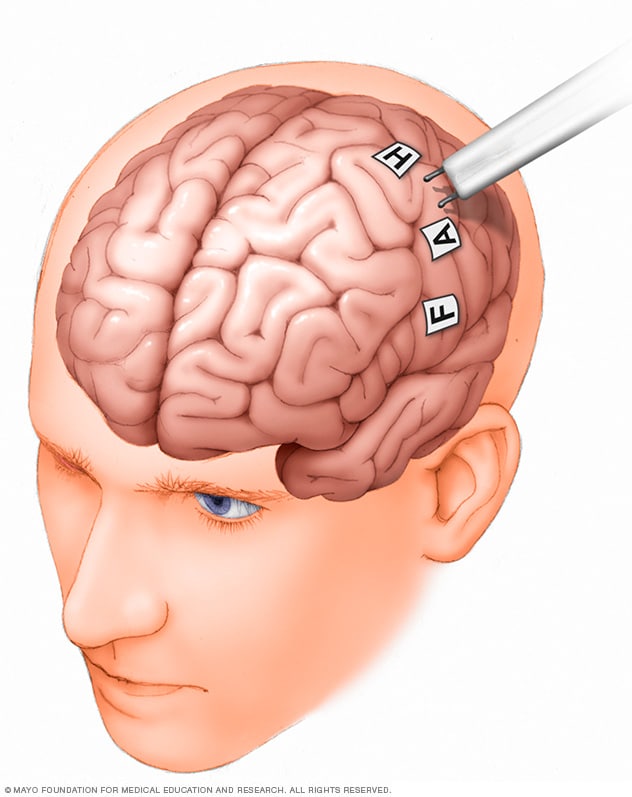
脑图谱
医生可以借助脑图谱识别出控制视力、言语和活动的脑区,从而实现精准定位,在进行脑部手术时不会降低脑功能。
麻醉专家(麻醉师)会给您用一些药物,让您在手术中昏昏欲睡,且大脑保持清醒状态。神经外科医生会在您头皮抹上麻醉药物,以确保您的舒适感。
手术过程中,医生会将您的头部固定,以保持头部静止并确保手术的准确性。部分头发会被剪掉。然后,外科医生将移开部分颅骨以够到大脑。
在手术开始移除部分颅骨时,以及在手术结束重新连接颅骨时,您会感到镇静和困倦。手术过程中,麻醉医师将停止使用镇静药物并让您醒来。
如果您的脑肿瘤或癫痫病灶靠近大脑的视觉、语言或运动控制区域,您的医生会进行大脑映射。这为神经外科医生提供了控制每个功能的大脑中枢图。外科医生还可以在手术过程中更深入地进行大脑映射。
神经外科医生使用该图避免损坏这些区域并保护这些功能。外科医生可通过大脑映射以及三维计算机图像,尽可能多地切除脑肿瘤或癫痫病灶,降低损害重要身体功能的风险,手术过程安全。
手术过程中,神经外科医生或言语病理学家可能会问您问题,或者请您识别术前看到的卡片或计算机上的图片和文字。医生可能会要求您做动作、识别卡片上的图片、对数字进行计数或抬起手指。您的回答将帮助您的外科医生识别并避开大脑中的功能区域。
您的医疗团队还利用术前和术中拍摄的大脑详细三维计算机图像,包括术中核磁共振成像和计算机辅助脑手术,指导尽可能多地切除脑肿瘤或癫痫病灶。
麻醉师和外科团队会仔细监测和评估您的身体和大脑功能,如果手术影响大脑功能就会提醒您的外科医生。
手术后
手术后,外科医生可能需要进行 MRI 检查,以确保完成肿瘤或癫痫病灶的切除。
手术后,您可能会在重症监护室中待一会儿,并需要在医院中待两到三天。
通常,您可能会在六周到三个月内恢复工作和正常活动。手术后约三个月,您需要去医生那里复诊。
结果
如果您接受清醒脑部手术来控制痫病,癫痫发作情况通常会在术后得到改善。有些人的癫痫不再发作,而有些人的癫痫发作次数要比手术前少。但有些人的癫痫发作频率没有变化。
如果您接受清醒脑部手术以切除肿瘤,您的神经外科医生通常应该能够切除大部分肿瘤。您可能仍需要进行其他治疗,例如放射疗法或化疗,以帮助破坏肿瘤的残余部分。
临床试验
探索 Mayo Clinic 的研究 测试新的治疗、干预与检查方法,旨在预防、检测、治疗或控制这种疾病。