Overview
Penile implants are devices that surgeons put inside the penis to help people who can't get an erection firm enough for sex. This condition is called erectile dysfunction (ED). Most often, penile implants are a choice for people who can't use other treatments for ED or after other treatments haven't worked.
There are two main types of penile implants, semirigid and inflatable. Each type works differently and has its own pros and cons.
You need surgery to place the penile implant. Before choosing this treatment, learn all you can about the surgery, including possible risks, complications and follow-up care.
Products & Services
Why it's done
Most often, treatment for erectile dysfunction includes medicines or use of a penis pump, also called a vacuum constriction device. You might think about a penile implant if you tried these treatments and they didn't work. Or you might think about it if you can't have other treatments or can't get an erection firm enough for sex any other way.
Penile implants also can treat ED that results from penile injury or a condition that causes scarring inside the penis, leading to curved, painful erections. The condition is called Peyronie's disease.
Penile implants aren't for everyone. Your healthcare professional might suggest other treatments if you have:
- An infection, such as a lung infection or urinary tract infection.
- Diabetes that isn't well managed or serious heart disease.
Penile implants can cause an erection, but they can't raise sexual desire or sexual feelings. Penile implants won't make your penis larger than it is at the time of surgery. In fact, with an implant, your erect penis may seem slightly shorter than it used to be.
Our caring team of Mayo Clinic experts can help you with your health concerns. Visit Mayo Clinic Men's Health to
get started.
Get the process started
Risks
Risks of penile implant surgery include:
- Infection. As with any surgery, infection is a risk. You might be at higher risk of infection if you have a spinal cord injury or diabetes.
- Implant issues. New penile implant designs work well. But, rarely, they can fail. You need surgery to repair or replace a broken implant. Or you can leave a broken implant in place if you don't want another surgery.
- Internal erosion or adhesion. Sometimes, an implant may stick to scar tissue inside the penis, called adhesion. Or an implant can wear away the skin from inside the penis, called erosion. Rarely, an implant breaks through the skin. These issues may be linked to an infection.
Treating an infection
Most often, infections after penile implant surgery happen within three months. If you get an infection, you may need surgery to remove the implant. Medicines treat the infection. You may be able to have a new implant after the infection clears.
How you prepare
Most often, you talk with your main healthcare professional. Or you may talk with a specialist in conditions of the urinary tract, called a urologist, about penile implants. The visit includes:
- A review of your medical and sexual history. Be ready to answer questions about current and past medical conditions, especially your ED. Talk about medicines you take or have taken recently, as well as surgeries you've had.
- A physical exam. The exam includes a complete urologic exam. It helps make sure a penile implant is a good choice for you and that your ED can't be treated another way.
Your healthcare professional also may try to find out whether penile implant surgery is likely to cause complications.
- Finding out what you want from the implant. Make sure you understand what the procedure involves and the types of penile implants that may work well for you. The procedure is for life and can't be reversed. Once you have the surgery, you won't be able to have a natural erection again.
Your healthcare professional also explains what a penile implant can do for you and the risks, including possible complications. It's best if both you and your partner talk with your healthcare professional.
Types of penile implants
3-piece penile implant
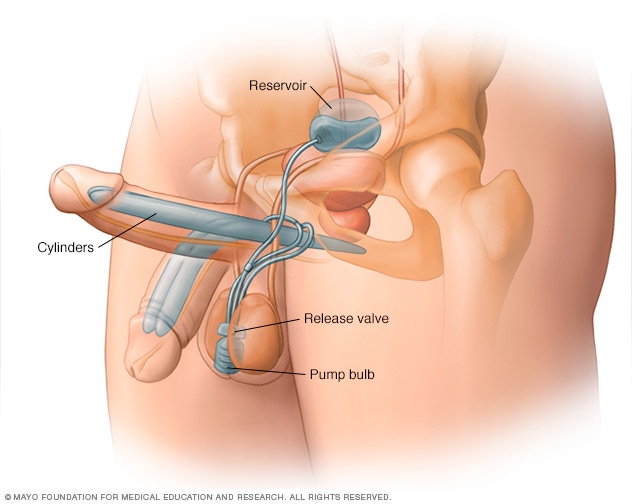
3-piece penile implant
The three-piece inflatable penile implant consists of inflatable cylinders inside the shaft of the penis, a fluid reservoir under the abdominal wall, and a pump inside the scrotum.
2-piece penile implant
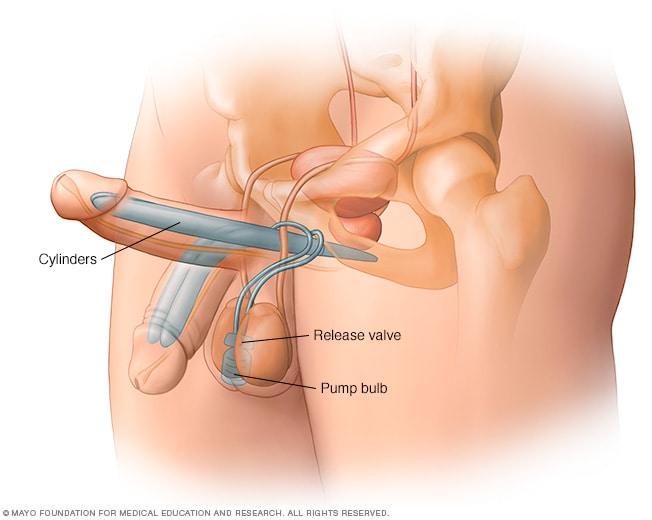
2-piece penile implant
The two-piece inflatable penile implant consists of inflatable cylinders inside the shaft of the penis and a combined fluid reservoir and pump unit in the scrotum.
Semirigid penile implant
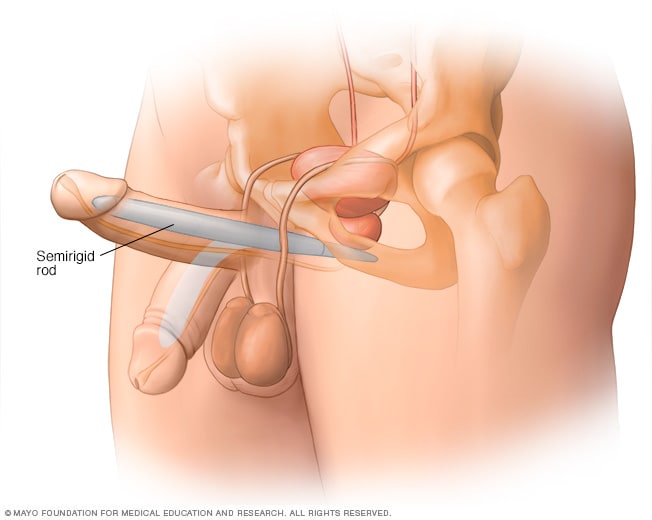
Semirigid penile implant
The semirigid penile implant is bent upward for sex and toward the body for concealment under clothing.
There are two main types of penile implants:
- Inflatable devices. Inflatable devices are the most common type of penile implant. They can be pumped up to make an erection. Three-piece inflatable implants hold fluid in a reservoir. The reservoir goes under the stomach wall or in the pelvis behind the pubic bone.
Your healthcare team fills the reservoir with salt water on the day of surgery. The salt water stays in the device. There's also a pump and a release valve put inside the scrotum. Two cylinders that inflate go inside the penis.
To get an erection, you pump the salt water from the reservoir into the cylinders. Afterward, you release the valve inside the scrotum to drain the fluid back into the reservoir.
- Semirigid rods. Semirigid rods are always firm. You can bend the penis away from the body for sex. And you can bend it toward the body so that it doesn't show at other times.
Semirigid rods may be easier to use than inflatable devices. So they might be better for people who have issues with thinking or with using their hands.
There are special designs that can fit a shorter penis or one that's larger than average. Some inflatable penile implants have antibiotic coatings. Others can absorb antibiotics into the material. Antibiotics on the device might help lower the risk of infection.
Comparing implant types
When choosing a type of penile implant, think about what you prefer and your medical history. Your healthcare professional might suggest one type of design over another based on a few factors. These include your age, risk of infection, and health conditions, injuries or medical treatments you've had.
| Type of penile implant |
Pros |
Cons |
|
|
Three-piece inflatable
|
- Makes the most natural, rigid erection
- Becomes limp when deflated
|
- Has more parts, which means more chances for something to go wrong
- Needs a place to hold fluid above or under the belly wall
|
|
Semirigid rod
|
- Has few parts, so there's less to go wrong
- Is easy to use
|
- Makes the penis always slightly rigid
- Always presses on the inside of the penis, which can cause injury
- Can be hard to keep from showing under clothing
|
Before penile implant surgery, you also might need to:
- Stop certain medicines.. Your healthcare professional may ask you to stop taking aspirin and other anti-inflammatory medicines for a time. They can raise your risk of bleeding.
- Plan for a ride home. Ask your healthcare team when you can go home after surgery. You need someone to drive you. And penile implant surgery might mean an overnight stay.
- Limit food and liquids.Don't eat or drink anything after midnight before your surgery. Do as your healthcare team tells you.
What you can expect
Before the procedure
Penile implant surgery is usually done at a surgery center or hospital. Your health care provider might give you medication to make you unconscious during the surgery (general anesthesia) or medication that blocks pain in the lower part of your body (spinal anesthesia).
Your health care provider will give you IV antibiotics to help prevent infection. The surgery site will also be washed with an alcohol-based antibiotic solution and shaved before surgery to reduce the risk of infection.
During surgery
A tube (catheter) might be inserted into your bladder via your penis to collect urine at some point during surgery. Your surgeon will make an incision below the head of the penis, at the base of the penis or in the lower abdomen.
Next, your surgeon will stretch the spongy tissue in the penis that would normally fill with blood during an erection. This tissue is inside each of two hollow chambers called the corpora cavernosa.
Your surgeon will choose the correct size implant and place the implant cylinders inside your penis. All sizes are customized to your body measurements.
If your surgeon is implanting a two-piece inflatable device, a pump and valve are placed inside the scrotum. For a three-piece device, he or she will also implant a fluid reservoir above or under the abdominal wall using the initial incision. Sometimes a second incision in the abdomen in used.
Once the device is in place, your surgeon will sew the incisions closed. Penile implant surgery usually takes 45 minutes to an hour.
After surgery
After penile implant surgery, you'll likely need to take medications to ease pain. Often a long-acting injection is given into the scrotum to help reduce pain for 48 to 72 hours. Mild pain might persist for several weeks. You might be given an antibiotic to be taken by mouth for a week.
Ask your health care provider when you can resume your regular activities. Most men can resume strenuous physical activity and sexual activity about 4 to 6 weeks after surgery.
After you learn how to use the device, usually 3 to 6 weeks after surgery, your health care provider might recommend inflating and deflating inflatable penile implants to give you practice using them and stretch the area surrounding the cylinders.
Results
Although penile implants are the most invasive treatment for erectile dysfunction, most men who have them and their partners report satisfaction with the devices. In fact, penile implants have the highest rate of satisfaction of all erectile dysfunction treatments.
Jan. 19, 2024